
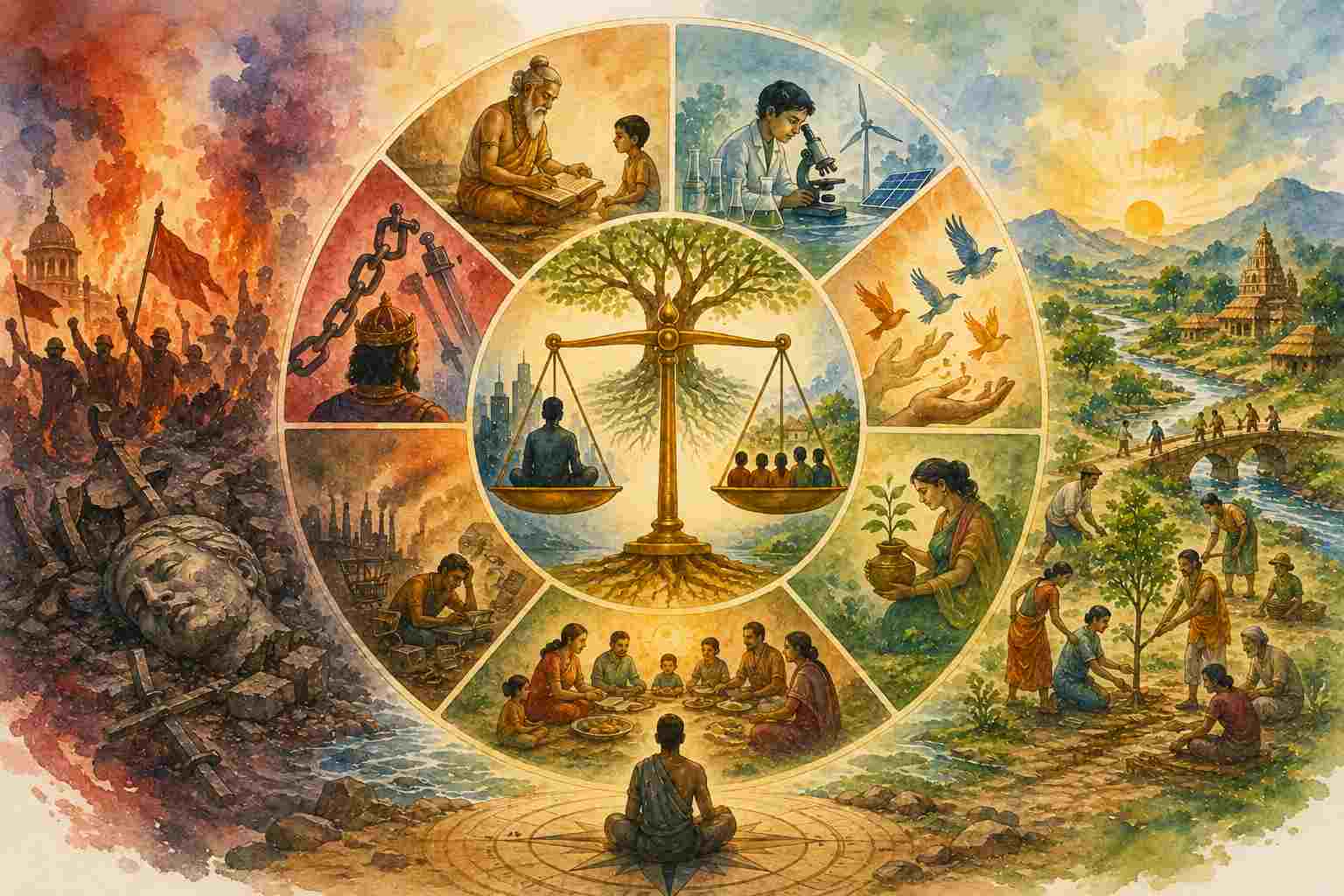
What should guide long-term reform?
Every society changes, but the real question is not whether change should occur. It is how change should be guided. When one generation pushes too strongly in one direction, another often pushes back. When tradition becomes rigid, demands for reform emerge. When innovation accelerates without restraint, societies begin to ask what has been lost. When the state becomes excessively powerful, individuals demand autonomy; when individual autonomy becomes absolute, societies rediscover the need for responsibility and community.
These tensions are not temporary defects that can be permanently solved. They are recurring conditions of social life.
Modern political thought has often approached them by privileging one principle over another. Liberalism may prioritize freedom, conservatism may prioritize continuity, socialism may prioritize equality, nationalism may prioritize collective identity, and market-oriented thought may prioritize economic growth. Each principle identifies a genuine dimension of social life, but problems emerge when any one dimension becomes the sole organizing principle.
The Indic approach begins from a different premise. Social life is constituted by relationships that must be kept in balance. Freedom has value, but freedom without responsibility can become destructive. Authority is necessary, but authority without restraint can become domination. Prosperity is desirable, but prosperity without ethical limits can become exploitation. Tradition provides continuity, but tradition without self-correction can become rigidity.
The question, therefore, is not which principle should permanently defeat its opposite. The question is how societies can continuously adjust themselves when one dimension becomes disproportionately powerful.
This is the foundation of The Balance Principle.
Society as a Dynamic Balance
The Indic tradition does not generally imagine balance as a fixed midpoint between two extremes. Such an understanding would be too mechanical. Social balance is dynamic because the conditions of society continuously change.
A society recovering from disorder may require greater stability. A highly centralized society may require decentralization. A community facing economic deprivation may need greater material expansion, while an excessively consumerist society may need greater restraint. The appropriate response therefore depends upon context.
This makes the Indic understanding of balance different from ideological compromise. A compromise simply divides the difference between two opposing positions. Balance asks a deeper question: what arrangement sustains the larger order under present circumstances?
A person walking maintains balance not by remaining completely motionless but by making continuous adjustments. A civilization functions in a similar manner. Change, correction and stability are not mutually exclusive. They are interconnected processes.
The guiding principle in this process is Dharma.
Dharma as the Principle of Rebalancing
Dharma cannot be reduced to a fixed political programme. Its strength lies precisely in its ability to examine relationships, responsibilities and consequences within a particular context.
A social institution may have once performed an important function but later become disconnected from the conditions that originally justified it. A policy may produce desirable results in one period and harmful consequences in another. Economic expansion may improve livelihoods while simultaneously damaging ecological systems. Individual rights may protect citizens from arbitrary authority, yet a society that speaks only of rights may weaken the language of reciprocal responsibility.
Dharma asks whether the different parts of the social order are fulfilling their appropriate relationships and responsibilities.
The Balance Principle therefore does not seek a perfect and permanent equilibrium. It seeks continuous rebalancing. When excess emerges, correction becomes necessary. When correction itself creates another imbalance, further adjustment may be required.
This approach is particularly important because human societies are not machines. A machine can be calibrated to a predetermined setting. A society contains changing generations, different aspirations, unequal circumstances and unpredictable challenges. Sustainable transformation requires a framework capable of responding to complexity.
The Major Tensions of Social Life
The Balance Principle can be understood through several recurring tensions:
| Social Tension | The Danger of One Extreme | The Danger of the Other Extreme | The Indic Question |
|---|---|---|---|
| Tradition and Innovation | Rigidity and stagnation | Civilizational amnesia | What should be preserved and what should evolve? |
| Freedom and Responsibility | Oppressive control | Social atomization | How can freedom remain connected to consequences and duty? |
| Authority and Autonomy | Centralized domination | Institutional fragmentation | At what level should decisions be made? |
| Prosperity and Restraint | Poverty and material deprivation | Excessive consumption and ecological damage | How can artha remain connected to dharma? |
| Individual and Community | Suppression of individuality | Isolation and weakening of social bonds | How can personal development strengthen rather than destroy social relationships? |
| Continuity and Reform | Preservation of injustice | Destructive rupture | How can deep reform occur without destroying social capacity? |
These tensions cannot be permanently eliminated because each side represents a genuine human need. Innovation is necessary, but so is continuity. The individual requires freedom, but human beings are also formed through families and communities. Authority is essential for collective coordination, but autonomy is essential for human initiative and local adaptation.
The failure of many political frameworks lies in their attempt to produce permanent solutions to permanent tensions.
The Purushartha Framework and Balanced Human Development
The idea of balance is deeply connected with the Purushartha framework. Human life cannot be reduced to a single objective. Dharma, artha, kāma and mokṣa represent different dimensions of human aspiration.
The importance of this framework is not merely philosophical. It provides a model for understanding why social systems become unstable when one objective becomes absolute.
A society focused only on artha may produce enormous wealth but fail to address ethical responsibility. A society focused only on regulation and moral restraint may suppress legitimate human aspiration. A social order that neglects material life cannot provide dignity and security, but prosperity that ignores responsibility can produce exploitation and ecological destruction.
The Purushartha framework therefore suggests that development itself must be multidimensional.
This has direct implications for contemporary policy. Economic growth cannot be the sole measure of national success. Nor can welfare, liberty, cultural preservation or environmental sustainability be treated as completely separate sectors. A sustainable society must consider how these dimensions interact.
The Balance Principle extends this logic from the individual to the social order.
Why Sustainable Transformation Requires Continuity
The contemporary language of reform often assumes that institutions must either be defended completely or rejected completely. Yet institutions are rarely entirely good or entirely harmful. They often carry accumulated experience while simultaneously developing weaknesses.
The family, for example, can provide care, social security and emotional support, but family structures may also reproduce unequal relationships. The state can protect rights and provide public goods, but it can also become excessively centralized. Markets generate innovation and prosperity, but they can also concentrate wealth and commodify social relationships.
The appropriate response is therefore neither blind preservation nor complete destruction. Institutions must be examined according to the functions they perform, the distortions they produce and the capacities they possess for renewal.
This is why the Balance Principle emphasizes institutional continuity with ethical correction.
A reform that destroys every existing institution creates a difficult problem: who will perform the social functions previously carried by those institutions? A community may reject a local institution because of genuine injustice, but the need for community coordination does not disappear. If an old system of welfare is dismantled, another system must carry that responsibility.
Sustainable transformation therefore requires replacement only where necessary, reform where possible and preservation where valuable.
The State, Society and the Balance of Power
The principle also provides an important framework for governance. Modern states possess capacities that earlier political systems did not possess. They can collect enormous quantities of information, regulate large populations and centralize decision-making across vast territories.
These capacities can be useful, particularly in the provision of infrastructure, public health and national coordination. But the assumption that every social problem should therefore be solved by the state creates another imbalance.
The Indic social experience historically contained multiple centres of authority and responsibility. Families, communities, guilds, temples, maṭhas, village institutions and local networks performed social functions alongside political authorities.
This suggests a principle of distributed responsibility. The state should perform functions that require large-scale coordination, while families, communities and local institutions should retain the capacity to perform functions for which proximity, local knowledge and social participation are essential.
The question is not simply whether power should be centralized or decentralized. Different functions may require different institutional locations.
This is again the Balance Principle: authority should exist at the scale appropriate to the responsibility involved.
From Permanent Solutions to Continuous Rebalancing
One of the greatest attractions of ideology is the promise of final answers. Once the correct system is implemented, conflict will supposedly disappear. The Indic perspective is more cautious.
No society reaches a point at which all tensions disappear permanently. Economic prosperity creates new questions. Technological innovation creates new ethical dilemmas. Social mobility changes family structures. Individual freedom produces new demands for responsibility. Every solution generates conditions that require further reflection.
Sustainable social transformation must therefore be understood as a continuing process rather than a final destination.
This requires institutions capable of self-correction. It requires traditions capable of reinterpretation. It requires communities capable of learning. It requires the state to recognize the limits of central power and citizens to recognize that freedom cannot survive without responsibility.
Balance is not an end of history. It is the capacity to remain responsive to history.
The Balance Principle as an Indic Framework
The Balance Principle offers an alternative to two common tendencies in social thought. The first is rigid preservation, which assumes that inherited structures should remain unchanged. The second is radical rupture, which assumes that progress requires the destruction of the existing order.
The Indic framework proposes a third possibility: transformation through continuous rebalancing.
It does not ask whether society should choose tradition or innovation, freedom or responsibility, authority or autonomy, prosperity or restraint, individual or community. It asks how each can be situated within a larger social order so that the pursuit of one does not destroy the conditions necessary for the others.
This is where Dharma becomes politically and socially significant. Dharma is not merely a command to preserve the past. It is the principle through which relationships and responsibilities are repeatedly examined in the context of changing conditions.
A sustainable society will not be one in which every tension has disappeared. It will be one capable of recognizing imbalance before it becomes destructive and capable of correcting itself without requiring the destruction of its entire institutional and civilizational structure.
The deepest transformation, therefore, may not come from choosing one extreme over another. It may come from learning how to hold competing human needs together, allowing each to develop without permitting any single one to become absolute.
The Balance Principle is ultimately a framework for sustainable civilization: not the elimination of tension, but the continuous capacity to restore proportion, responsibility and harmony as society changes.
