
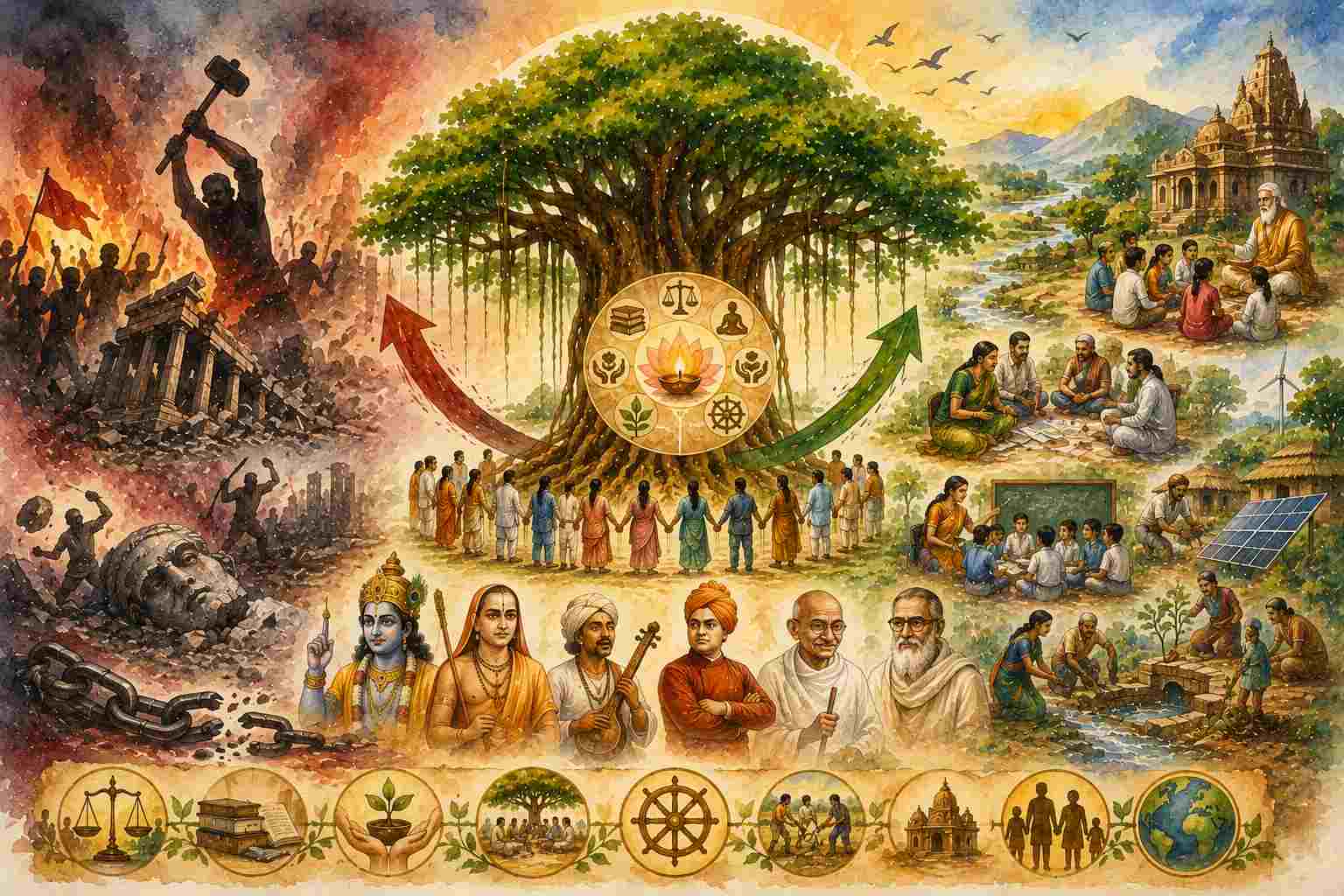
When society declines, what should be done?
When a society begins to decline, the modern political imagination often offers two opposite responses. One says: preserve everything because it is tradition. The other says: destroy the existing order because it has failed.
The first can produce stagnation. The second can produce civilizational amnesia. But Bharatiya civilization repeatedly developed another response: restore what has been distorted, reform what has become unjust, renew institutions that have become weak and adapt inherited principles to new circumstances.
This is the central meaning of Restoration over Revolution.
It is not an argument that societies should return mechanically to an earlier period. Restoration is not restoration of the past as a museum. It is the restoration of a sustaining principle. When a river is polluted, one does not restore it by returning to an earlier century; one restores the conditions that allow the river to flow again. In the same manner, civilizational renewal requires the recovery of social and ethical capacities that have become weakened.
The crucial Indic concept here is Dharma-sthāpana.
Dharma as Restoration, Not a Blueprint
The Bhagavad Gita presents perhaps the most important Indic formulation of civilizational renewal. In the fourth chapter, Krishna does not say that when Dharma declines, society itself must be destroyed. The language is one of decline and re-establishment: when adharma rises, the task is dharma-saṃsthāpanārthāya—the re-establishment of Dharma. The response to imbalance is therefore restoration of order, not the construction of an entirely new social world.
This distinction is historically significant. Dharma-sthāpana does not mean that every existing institution is already perfect. In fact, if Dharma has declined, institutions themselves may have become part of the problem. The point is that reform must identify the difference between a civilization’s sustaining principles and the particular historical forms through which those principles were expressed.
A particular institution may disappear. A custom may change. A social practice may require reform. Yet the civilizational principle that connects responsibility, reciprocity, restraint, knowledge and social order can remain available for renewal.
This is why the Indic model cannot be reduced either to preservationism or revolution. Restoration may require profound change, but profound change need not require civilizational self-destruction.
Adi Shankaracharya: Intellectual Restoration Through Institution Building
The example of Adi Shankaracharya illustrates this model particularly clearly. He did not attempt to create a completely new civilization. His work emerged from within an already complex intellectual landscape containing multiple philosophical traditions, sects and debates.
His response was not political revolution. It was intellectual and institutional renewal.
Shankaracharya entered existing philosophical debates, developed a systematic interpretation of Advaita Vedanta, wrote commentaries and travelled across the subcontinent. More importantly, the intellectual tradition associated with him developed durable institutional centres, with the matha becoming an important structure for teaching, debate and transmission. The traditional account of the four major mathas at Sringeri, Dwaraka, Puri and Jyotirmath represents an attempt to understand this renewal as a geographically distributed institutional architecture rather than the creation of a centralized religious state.
The importance of this example lies in the method. Intellectual decline was not answered by destroying older knowledge traditions. The response was commentary, debate, travel, institution-building and the creation of new networks of transmission.
Restoration, therefore, required innovation.
The Bhakti Movements: Social Renewal Without a Single Revolutionary Centre
The Bhakti traditions provide an even broader historical example. They unfolded over centuries across different regions, languages and communities. There was no single Bhakti organization, central committee or revolutionary headquarters.
Tamil devotional traditions developed their own forms. Later devotional cultures emerged across Maharashtra, Karnataka, Bengal, North India, Punjab and other regions. Poet-saints such as Kabir, Mirabai, Tulsidas, Namdev, Tukaram, Ravidas and Chaitanya expressed devotional and social concerns in distinct ways.
The significance of this process was institutional and cultural. Sacred expression increasingly moved into vernacular languages and songs, expanding the social reach of religious and philosophical ideas. Oxford scholarship describes the Bhakti narrative as a long civilizational movement of song, communal sharing, common speech and devotional expression travelling across regions and languages over centuries.
The social consequence was important. Change did not require the destruction of the entire religious landscape. Instead, new voices entered the landscape and transformed its internal balance. Critique emerged from within cultural forms familiar to society: poetry, devotion, pilgrimage, music and shared sacred language.
This is a recurring Indic pattern. Social renewal often proceeds by changing participation rather than first destroying the civilization in which participation takes place.
Vivekananda: Regeneration by Reaching the Masses
By the nineteenth century, Bharat faced a very different crisis. Colonial rule had altered political power, economic structures and intellectual self-perception. Yet Swami Vivekananda did not respond by arguing that India required the destruction of its civilizational foundations.
His central concern was regeneration through the awakening of social capacity.
Vivekananda repeatedly argued that the neglect of the masses had become one of India’s fundamental weaknesses. His response was education, organization, service and the spread of knowledge. In his own words, political change alone would not regenerate India unless the masses were educated, fed and cared for.
His institutional legacy reflected this approach. The Ramakrishna Mission connected spiritual practice with education, health, relief work and social service. The transformation of society was not separated from the transformation of human capability.
This is an important example of restoration because Vivekananda did not merely call for a return to the past. He sought to activate the ethical and spiritual resources of the tradition for the problems of modern India. The old vocabulary remained, but its social application expanded.
Gandhi: Political Freedom Required Social Reconstruction
Mahatma Gandhi provides perhaps the clearest modern example of the distinction between revolution and constructive transformation.
Gandhi led mass resistance against colonial rule, but he did not consider political power sufficient for social renewal. His Constructive Programme included communal unity, removal of untouchability, khadi, village industries, sanitation, basic education, women’s empowerment, health, economic equality and the concerns of peasants, labourers and Adivasis. This is a remarkable model of transformation. The objective was not merely to replace British rulers with Indian rulers. If the same social weaknesses remained after independence, political freedom alone would not create Swaraj.
Gandhi therefore linked resistance with reconstruction.
The spinning wheel was not simply an economic symbol. Village sanitation was not merely a public health issue. The removal of untouchability was not a separate programme from national regeneration. Gandhi’s approach attempted to transform the interconnected foundations of society.
Political change without social reconstruction would be incomplete.
Vinoba Bhave and the Bhoodan Experiment
Vinoba Bhave carried this approach into the post-independence period. The problem was concrete: land inequality and landlessness.
A revolutionary solution could have centred entirely upon violent seizure. Vinoba attempted something fundamentally different. Beginning at Pochampalli in 1951, the Bhoodan movement appealed to landowners to donate land voluntarily for redistribution among landless people. It later developed into wider experiments associated with Gramdan.
The scale was substantial, although the practical success of land transfer and redistribution varied and the movement also faced serious implementation problems. Government sources record claims of approximately 4.2 million acres received through donation and note Vinoba’s extensive travels across India.
The limitations of Bhoodan are important because they prevent romanticization. Not all donated land was cultivable, not all land was effectively transferred, and voluntary redistribution could not automatically solve structural inequality. Yet as a civilizational experiment, its method remains significant.
Vinoba did not deny inequality. He attempted to transform the relationship between property and responsibility through moral persuasion and voluntary action.
The important point is not that Bhoodan solved the land question. It did not. The important point is that it demonstrated an alternative method: social transformation through moral mobilization rather than the assumption that every structural problem requires social destruction or coercive conflict.
What Does Restoration Actually Mean?
Restoration is often misunderstood as preservation. It is not.
A decaying institution may need deep reform. A harmful practice may need to be abandoned. A society may require new laws, technologies and institutions. Restoration becomes conservative only when it protects dysfunction merely because it is inherited.
The real principle is more demanding.
| Decline | Revolutionary Response | Restorationist Response |
|---|---|---|
| Intellectual weakness | Reject inherited knowledge | Reinterpret and renew knowledge |
| Social injustice | Destroy the whole social order | Reform structures and expand participation |
| Institutional failure | Abolish institutions | Identify functions and rebuild capacity |
| Economic inequality | Treat all relationships as conflict | Combine reform with ethical responsibility |
| Cultural stagnation | Erase inherited forms | Renew culture through new expression |
| Political oppression | Replace one elite with another | Transform power while strengthening society |
Restoration asks four questions before acting: What has declined? What remains valuable? What has become harmful? What new capacity must be created?
These questions prevent two dangerous simplifications. They prevent us from assuming that everything inherited is sacred. But they also prevent us from assuming that everything inherited is worthless.
The Civilizational Principle of Renewal
A civilization cannot remain alive through permanent repetition. Every tradition must respond to new economic conditions, technologies, social relationships and political realities.
But equally, a civilization that destroys every connection with its accumulated memory becomes dependent upon abstract blueprints.
The Indic model of restoration offers another possibility. It treats civilization as a living system with the capacity for self-correction, reinterpretation and renewal. The Bhakti movements expanded participation. Shankaracharya strengthened intellectual and institutional transmission. Vivekananda redirected spiritual resources toward national regeneration. Gandhi connected political freedom with constructive social work. Vinoba experimented with voluntary economic transformation.
These examples were different in scale, method and success. They should not be forced into a single doctrine. Yet together they reveal a recurring civilizational pattern: when imbalance emerges, transformation need not begin with the destruction of everything that exists. It can begin with the renewal of society’s own moral, intellectual and institutional resources.
This is the deeper meaning of Dharma-sthāpana. It is not a call to preserve a frozen past. It is the capacity to restore a sustaining order when that order has become distorted.
A civilization survives not because it never declines. Every civilization experiences decline, conflict and failure. It survives because it possesses mechanisms through which renewal becomes possible.
The task, therefore, is neither blind revolution nor blind restoration. It is discerning restoration: the courage to reform what has become unjust, the wisdom to preserve what remains valuable and the creativity to build institutions capable of meeting new conditions.
That is the central argument of Restoration over Revolution. The alternative to revolution is not stagnation. It is civilizational renewal.
