
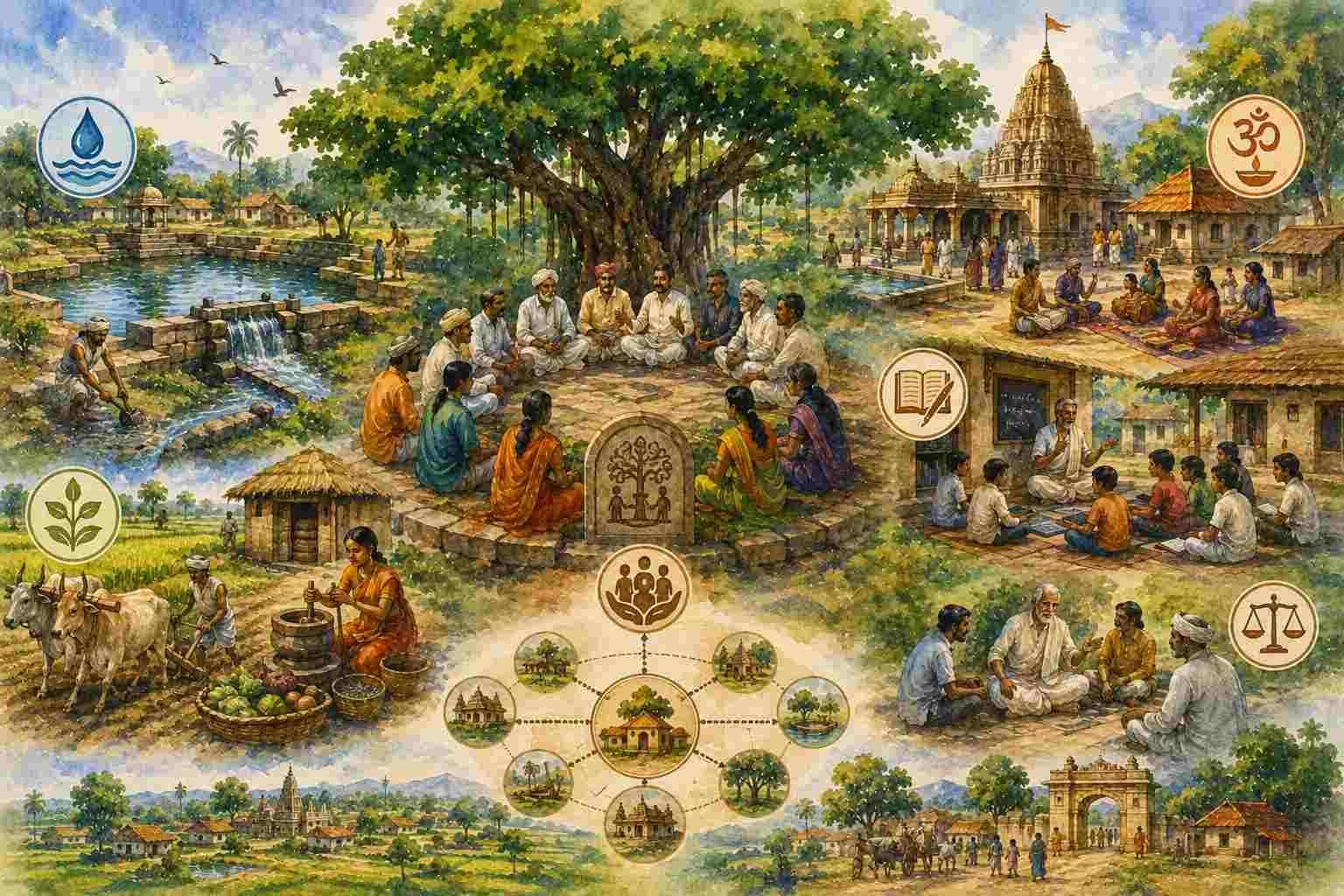
Why did villages remain remarkably resilient across centuries despite changes in dynasties and empires?
A kingdom could fall. A capital could be abandoned. A dynasty could disappear. The political map of Bharat could be redrawn repeatedly. Yet the village often continued. This is one of the most striking features of Indian history.
But why?
The conventional answer is that Indian villages were “little republics,” self-sufficient and almost entirely independent. Charles Metcalfe famously popularized this image in the nineteenth century. Yet modern scholarship has rightly criticized it. Villages were not isolated worlds. They were connected through trade, caste and kinship networks, pilgrimage, regional markets, political authority and larger agrarian systems. They were also not egalitarian communities; authority and representation were often unequally distributed.
But rejecting the romantic image should not lead us to reject the larger historical reality. The village in Bharat was indeed more than an administrative unit. It was one of the most durable institutions through which economic life, resource management, dispute settlement, cultural continuity, welfare and political relationships were organized.
The important question, therefore, is not whether every Indian village was a perfect autonomous republic. The question is: why did the village possess sufficient institutional capacity to survive political change? The answer lies in the evolution of the Grāma as a civilizational institution.
From Grāma to Political Community
The idea of the village did not suddenly emerge as a modern administrative category.
Vedic political vocabulary already reveals a social order organized through nested units. Classical historical accounts describe the family or kula as forming the basis of the grāma, while groups of settlements were associated with larger units such as viś and jana. The Grāmaṇī—literally associated with the grāma—appears among significant figures in the political organization of the period.
However, we must be historically careful. The Vedic grāma should not simply be equated with the modern revenue village. The meaning of social and political terms evolved, and early Vedic society itself was not identical with the settled agrarian civilization of later centuries. Yet an important pattern is already visible: political order did not begin with an abstract state standing above society. It emerged through social units.
The Vedic world also contains the vocabulary of collective deliberation—vidatha, sabha and samiti. Their precise institutional functions remain debated among historians. We should therefore resist simplistic claims that they were identical to modern parliaments or village panchayats. But their presence demonstrates that assembly, deliberation and collective decision-making were not alien to early Indic political thought.
This matters because the Indian political imagination did not develop exclusively around the solitary ruler. The Rājan mattered. But so did the Sabha. So did the Samiti. So did the Grāma. Political life was distributed across different levels.
The Village Becomes a Territorial Institution
By the time of the Arthaśāstra, we can see a much more clearly articulated relationship between village and state.
The text discusses the formation of villages, their boundaries and their organization within larger administrative groupings. It describes a settlement system in which villages were connected in wider clusters: ten villages around a saṅgrahaṇa, and larger centres associated with hundreds of villages. The village was therefore neither isolated nor swallowed entirely by the centre.
This is an important development. The Grāma was becoming a territorial and administrative reality, with recognizable boundaries, economic activity and a place within a wider political structure.
The village was local. But it was not outside the state.
This distinction is fundamental to understanding Indic autonomy. Autonomy did not mean sovereignty in the modern sense. The village could remain connected to a kingdom, pay revenue and come within wider political authority while retaining substantial institutional life of its own. In other words, being politically connected did not require becoming administratively empty.
The Village Was a Functional World
Why did villages possess such resilience? Because the village performed multiple functions simultaneously.
It was an economic unit, because agriculture, artisanal activity and local exchange were organized within and around it. It was an ecological unit, because water, pasture, forests and land required collective regulation. It was a judicial and regulatory unit, because disputes and local norms could be addressed through community institutions. It was a cultural unit, because festivals, temples, rituals and local traditions organized collective life. It was also a welfare unit, because kinship and community institutions often provided forms of support before the emergence of a modern welfare state.
This multifunctionality is crucial. A modern administrative village may be defined through jurisdiction. A civilizational village was sustained through relationships. It contained fields, water bodies, pathways, occupational groups, temples, households and institutions of collective action. The village was therefore not simply a point on a map.
It was an institutional ecosystem.
Ūr, Sabha and Nagaram: The Chola Evidence
The strongest historical evidence for local institutional autonomy comes from South India, particularly the Chola period. Here we must move beyond vague claims about ancient village democracy and examine the actual institutional vocabulary.
In the Chola polity, inscriptions and historical studies identify different corporate bodies, including the Ūr, Sabha and Nagaram. The Ūr was associated with non-Brahmadeya agricultural villages; the Sabha functioned in Brahmadeya settlements; and the Nagaram represented organized mercantile settlements. These bodies were not identical, and their social composition and powers differed.
The inscriptions of Uttaramerur provide particularly important evidence. They describe procedures relating to local governance, including qualifications and disqualifications for office, territorial divisions and the organization of committees. The point is not that Uttaramerur should be mechanically presented as a modern democracy. It was not. Participation was historically restricted, and social hierarchy mattered.
But the inscriptions reveal something historically significant: village administration could possess detailed institutional procedures rather than functioning merely through informal custom.
This is where the village evolved from a social settlement into a sophisticated institution. The village could manage committees, resources, taxation, public works and local affairs. It became a centre of administration without becoming a modern centralized bureaucracy. This is the real significance of village autonomy.
The villagers were not merely subjects governed by an external authority. They could also participate in governing the institutional world closest to them.
Village Autonomy Was Also Ecological
The autonomy of the village cannot be understood without understanding resources. A village required water. Water required tanks, channels, wells, embankments and systems of maintenance. Maintenance required labour. Labour required rules. Rules required institutions. Thus, ecology created governance.
The tank systems of South India, the ahar-pyne systems of Bihar, the phad irrigation systems of Maharashtra and numerous other local resource systems reveal the same larger principle: communities had to develop institutions capable of managing resources that no single household could maintain alone. A water tank could not be treated purely as private property because its condition affected the agricultural life of many. But neither could its daily maintenance always depend upon a distant state.
This created a sphere of collective responsibility. The village became resilient partly because resource governance was embedded within local society. This also explains why autonomy should never be romanticized. Local resource systems could contain inequalities. Labour could be unequally distributed. Access could be restricted. Power could remain concentrated among dominant groups. Therefore, the historical lesson is not that everything local was automatically just.
The lesson is that local institutions possessed real governing capacity—and must be studied both for their resilience and their inequalities.
Panchayat: From Customary Institution to Wider Political Form
Over time, village-level collective decision-making increasingly came to be associated with the idea of the Panchayat. However, “Panchayat” should not be imagined as one institution that remained unchanged from the Vedic period until today. Institutions evolved regionally and historically.
In the medieval period, village panchayats and headmen continued to perform important local functions. Evidence from the Mughal period shows village panchayats as bodies involving influential members of local communities, while the muqaddam or mandal performed administrative functions. Yet these institutions were embedded within wider agrarian and political hierarchies and were not necessarily representative of every inhabitant.
This continuity is significant. Empires changed. The village remained connected to the empire. But the village was not simply created by the empire. It possessed its own social and institutional density. That is why political change at the top did not automatically erase social organization below.
Colonialism and the Transformation of the Village
Colonialism produced one of the most important transformations in the history of the Indian village.
British administrators were fascinated by the apparent resilience of village communities. Metcalfe called them “little republics.” Marx, from an entirely different ideological position, also used the supposedly self-sufficient village to explain the persistence and “unchangeableness” of Asian society.
Both captured something real and exaggerated it into a theory. The village was resilient. But it was not isolated. The village possessed internal organization. But it was not necessarily politically independent. The village was locally self-reliant in many functions. But it was connected to wider markets, states and social networks.
Colonial revenue settlements, legal codification and administrative restructuring transformed these relationships. The older institutional ecology of the village increasingly encountered a centralized bureaucratic state. The village was now increasingly legible as a revenue unit. But what was lost when it became primarily an administrative object? Perhaps this is the deeper question.
From Village Community to Gram Swaraj
In the twentieth century, the village returned to the centre of political imagination through Gandhi’s idea of Gram Swaraj.
Gandhi did not merely imagine village administration as a lower tier of bureaucracy. He imagined self-governing communities as the foundation of a decentralized political order. Independent India, however, inherited a large centralized state and a constitutional system that had to govern a vast and diverse population.
The Constitution nevertheless retained the principle of village self-government. Article 40 directs the state to organize village panchayats and endow them with the authority necessary to function as units of self-government. The 73rd Constitutional Amendment later gave constitutional status to Panchayati Raj institutions, creating a three-tier system while recognizing the Gram Sabha as the foundational participatory body at the village level.
This was not simply a return to an ancient system. Modern Panchayati Raj introduced constitutional democracy, universal adult participation and reservations for historically excluded groups, including provisions for Scheduled Castes, Scheduled Tribes and women.
That is an important transformation. The contemporary Panchayat is therefore not the old village assembly surviving unchanged. It is a modern democratic institution connected to a much older civilizational question: How can the people closest to a problem participate in governing it?
The Village as a Civilizational Institution
This is the central argument. The village was never merely autonomous in the sense of being isolated. Its deeper strength was that it possessed multiple capacities. It could produce. It could maintain resources. It could preserve local knowledge. It could organize cultural life. It could resolve some disputes. It could connect households with larger institutions. It could survive political change because not every aspect of social life depended upon a king, a capital or a bureaucracy.
This is why the village can be understood as a civilizational institution. A dynasty is primarily a political institution. A state is primarily an institution of organized public authority. But the village could combine economy, ecology, culture, community and governance. It operated at the intersection of these worlds.
From Local Autonomy to Polycentric Civilization
The village therefore helps us understand the larger Indic framework of Polycentric Autonomy.
Bharatiya civilization did not derive all its strength from one political centre. Power existed at different levels. Knowledge existed in different institutions. Resources were governed through local communities and wider authorities. Culture developed across multiple regions and traditions.
The village was one of these centres. Not the only centre. And not an isolated centre. A village was connected to the nadu, region, kingdom, trade networks, pilgrimage routes and the wider civilizational world. Its autonomy existed within relationships. That is the deeper principle.
The village was strong not because it was cut off from civilization, but because civilization did not require the village to surrender every capacity to the centre.
Perhaps this is the question that Bharat must revisit today. We have created extraordinarily powerful states and increasingly sophisticated technologies. But has the expansion of administrative capacity also weakened local social capacity? Can every water body be governed from a distant office? Can every ecological problem be solved through regulation alone? Can every cultural decision be standardized? Can every development programme succeed if the community remains merely a beneficiary rather than an institution of action?
The Indic village does not provide a ready-made model for twenty-first-century governance. Its historical inequalities cannot be ignored, and its institutions cannot simply be recreated unchanged. But it offers a powerful civilizational insight.
A society becomes resilient when people are not merely governed. They also retain the capacity to govern parts of their own collective life.
That was the significance of the Grāma. Not isolation. Not romantic self-sufficiency. Not a mythical golden age. But local institutional capacity within a larger civilizational order. And that may explain why, while dynasties changed, villages endured.
