
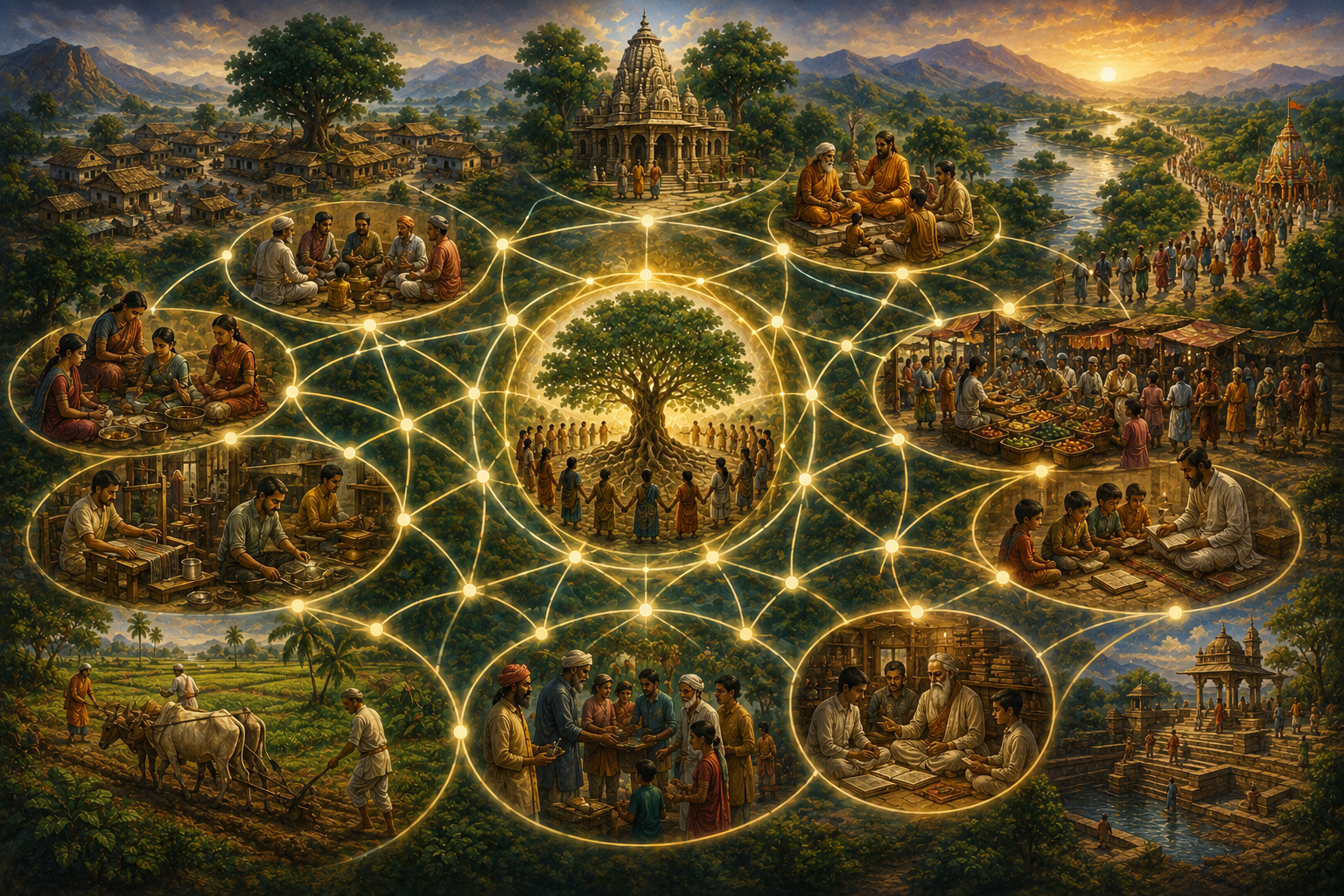
How does order arise without centralized control?
One of the most interesting questions in the study of society is also one of the simplest: Who is actually organizing society?
If every village, family, market, temple, guild, pilgrimage route and community required continuous direction from a central authority, social order would be extraordinarily expensive to maintain.
Yet societies often generate order without anyone controlling the whole system.
- A village develops its own customs.
- A guild regulates professional conduct.
- A temple becomes connected to education, charity and local economy.
- Pilgrimage routes connect distant communities.
- Families transmit knowledge and norms across generations.
No single institution necessarily designs the entire network.
And yet, a pattern emerges.
This is the central insight of complexity science: systems composed of many interacting parts can generate organized patterns without a central designer. Concepts such as emergence, self-organization, feedback, distributed intelligence and resilience have become increasingly important for understanding such systems.
The question is whether this provides a useful lens for understanding Indic civilization.
Order Without a Single Centre
Indic social organization historically contained numerous institutions with considerable autonomy.
The village possessed local structures of administration and cooperation. Guilds and occupational associations regulated economic activity and professional relationships. Temples could function as centres of ritual, education, cultural activity and economic exchange. Family networks transmitted knowledge, occupation and social norms. Pilgrimage networks connected geographically distant communities through shared sacred landscapes.
These institutions were not necessarily isolated.
They overlapped.
- A family participated in a village.
- The village interacted with markets and temples.
- Guilds connected producers and traders.
- Pilgrimage connected regions.
- Customs regulated behaviour across institutions.
The result was something larger than any individual institution. Civilizational order emerged from their interaction.
From Central Control to Distributed Intelligence
This offers an interesting contrast with the assumption that social order must always be produced from above. Modern states are extraordinarily capable of centralized coordination. But centralized coordination is not the only way order can emerge. Elinor Ostrom’s work on common-pool resources demonstrated that communities can develop institutional arrangements for governing shared resources without relying exclusively on either complete privatization or centralized state control. The broader insight is important:
People can generate rules, coordination and cooperation through repeated interaction.
This is remarkably relevant to the study of Indian social institutions. The intelligence of the system does not necessarily reside in one institution. It is distributed across relationships.
Dharma as an Ordering Principle
Here, the Indic concept of Dharma becomes particularly interesting. We should not claim that Dharma is simply an ancient equivalent of “complexity theory.” It is not. But it can be examined as a civilizational principle of distributed order.
When different persons and institutions perform their appropriate responsibilities, social order does not need to be recreated from zero every morning.
- The family has its dharma.
- The ruler has rājadharma.
- The student has responsibilities.
- The teacher has responsibilities.
- The householder has obligations.
- The community has norms.
Order is therefore produced through many centres of responsibility rather than through one centre of command.
This is a fundamentally different imagination of governance.
Yajña and Feedback
The concept of Yajña adds another dimension.
A system survives when its participants contribute to the conditions that sustain the system itself.
- The farmer contributes food.
- The teacher contributes knowledge.
- The householder supports dependants.
- The ruler provides protection and justice.
- The community sustains shared institutions.
Contribution creates a feedback loop:
Contribution → Social Sustenance → Stability → Further Contribution
When this cycle works, institutions reinforce one another. When extraction consistently exceeds contribution, the feedback loop reverses.
Extraction → Depletion → Institutional Weakness → Reduced Contribution → Further Depletion
This gives Yajña an interesting analytical connection with contemporary systems thinking without reducing the Indic concept to modern terminology.
Civilization as a Complex Adaptive System
The most important implication is that civilization may not be understood adequately as something designed once and administered continuously.
It may be better understood as something that evolves through interaction. Institutions adapt. Customs change. Communities experiment. Practices that work are transmitted. Practices that fail disappear or transform. New relationships emerge. Old institutions acquire new functions. This is precisely where the idea of resilience becomes important.
A resilient civilization is not necessarily one in which nothing changes. It is one in which the system can change without losing its capacity for continuity. Indic civilization’s long historical experience therefore raises a fascinating research question:
How did decentralized institutions, shared norms, networks and civilizational principles collectively produce order across enormous geographical and historical diversity?
The answer may not lie in identifying a single master institution. It may lie in studying the relationships between institutions. And this changes the way we understand civilization itself. Perhaps civilization is not a machine built by a central engineer.
Perhaps it is closer to a living network, in which millions of small acts—family practices, community cooperation, economic exchange, ritual participation, local governance and transmission of knowledge—continuously reproduce a larger order. That is the deeper possibility of the Indic Systems Model:
Order does not always have to be imposed.
Sometimes it emerges. And perhaps one of the great intellectual tasks before Indic social science is to understand how Dharma, Yajña, local autonomy and institutional networks enabled such emergence to become civilizational continuity.
