
Can society be understood by studying its parts separately?
Modern social sciences have become exceptionally skilled at dividing society into variables.
- Economics studies production and markets.
- Political science studies power and governance.
- Sociology studies institutions and social relations.
- Anthropology studies culture.
- Psychology studies the individual.
This specialization has produced enormous knowledge. But it also creates a problem: what happens when the connections between these domains disappear from our analysis?
Can we understand the economy without understanding the family? Can we understand politics without understanding culture? Can education be separated from social structure? Can governance remain unaffected by changes in economic life?
The Indic perspective begins with a different intuition:
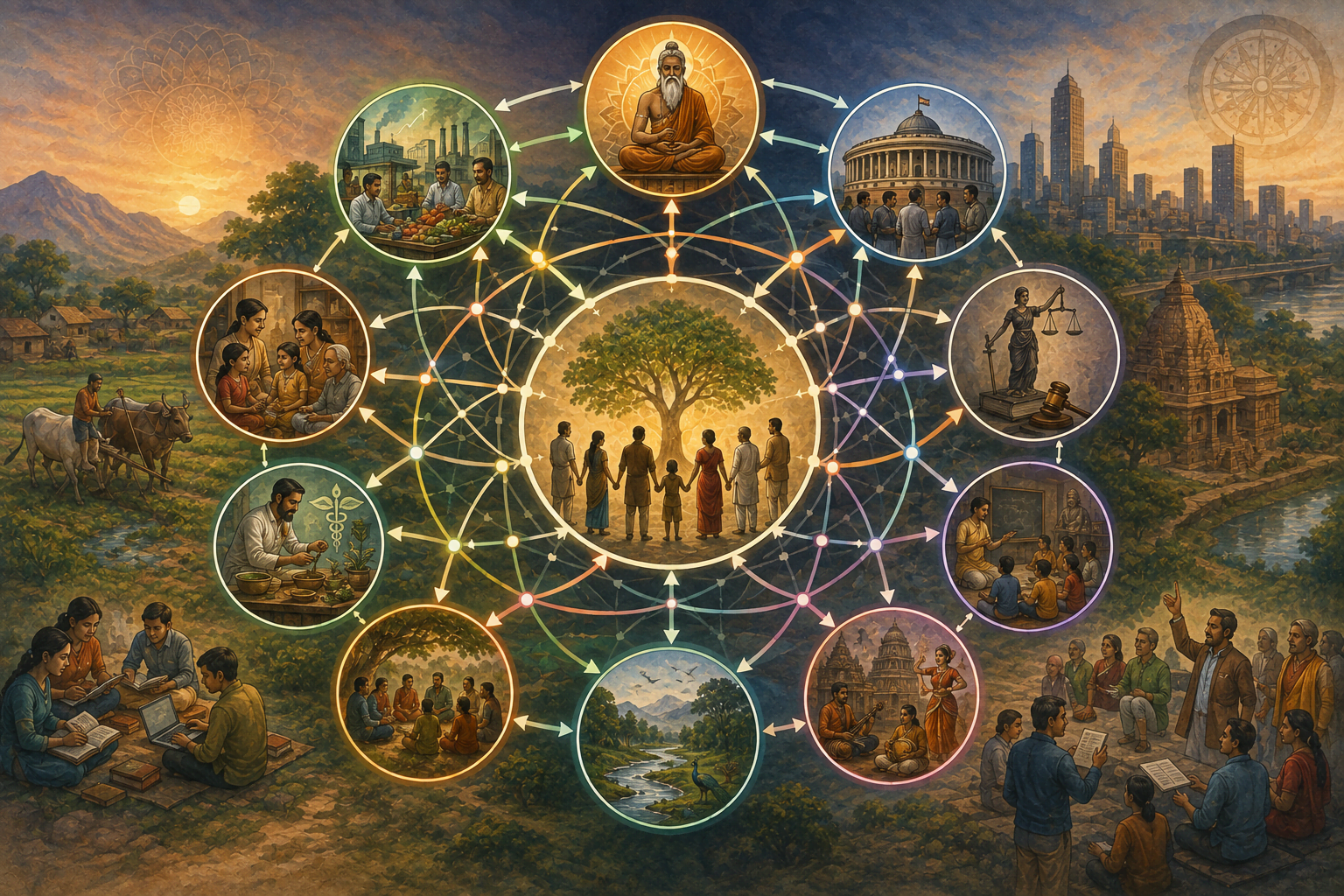
Society is not a machine made of independent parts. It is an interconnected system in which changes in one sphere can transform the others.
Society as an Interconnected Order
Consider a simple chain.
Dharma → Economy → Family → Education → Governance
A society’s understanding of dharma influences ideas about legitimate economic behaviour. Economic transformation changes patterns of family life. Families influence how children are educated and socialized. Education shapes citizens and administrators. Those citizens, in turn, influence governance.
The relationship is not linear. It is circular and adaptive.
A change in education can transform family aspirations. New economic opportunities can alter marriage and migration patterns. Changes in family structure can reshape welfare requirements. Political decisions can transform markets, which then influence households. The system continually responds to itself. This is why the Indic idea of social order cannot be reduced to a single institution. Concepts such as Dharma, Artha, Kāma and Mokṣa already suggest that human life involves interconnected ethical, material, emotional and transcendent dimensions rather than isolated spheres.
An Indic Systems Intuition
This insight can also be found in classical Indian political thought.
Kauṭilya, for instance, did not treat the state simply as a political institution detached from society. His Arthaśāstra connects the ruler’s responsibilities with agriculture, taxation, trade, law, security, social order and public welfare. His Saptāṅga theory of the state similarly conceptualizes political organization through interconnected constituent elements rather than a single institution called “government.”
The broader Indic intellectual tradition repeatedly returns to relationships between parts and wholes.
- The individual exists within the kutumba.
- The kutumba exists within samāja.
- Samāja exists within larger political and civilizational formations.
The health of the whole depends upon the functioning of its relationships.
From Variables to Relationships
This suggests a methodological shift for social science.
Instead of asking only: “What causes X?”
we might also ask: “How does X alter the system within which it exists?”
- Instead of studying unemployment only as an economic variable, we examine its consequences for family, migration, education and political participation.
- Instead of studying education merely through literacy rates, we examine how education transforms aspirations, occupations, family structures and civic behaviour.
- Instead of studying governance merely through institutions, we examine how governance interacts with social trust, economy, culture and community organization.
The unit of analysis therefore becomes not merely the variable, but the relationship.
Society as a Living System
This does not mean that society is literally a biological organism. The metaphor has limits. But society does possess characteristics that make a systems perspective useful: interdependence, feedback, adaptation, continuity and unintended consequences. A policy designed for one sector can produce consequences somewhere else. A demographic change can become an economic change. An economic change can become a cultural change. A cultural change can become a political change. And a political decision can feed back into all of them. This is why social problems rarely remain confined to the discipline that first identifies them.
The deeper Indic proposition is therefore simple:
To understand society, we must study not only its components but the relationships through which those components sustain and transform one another.
The challenge before Indic social science is to develop this insight into a rigorous analytical framework. Perhaps society should not be imagined as a machine whose parts can be dismantled and studied independently. Perhaps it is better understood as a living, adaptive web of relationships. And once we begin looking at society this way, the question changes from:
“Which institution is responsible?”
to the more difficult—and perhaps more useful—
“What happens to the whole when one part changes?”
