
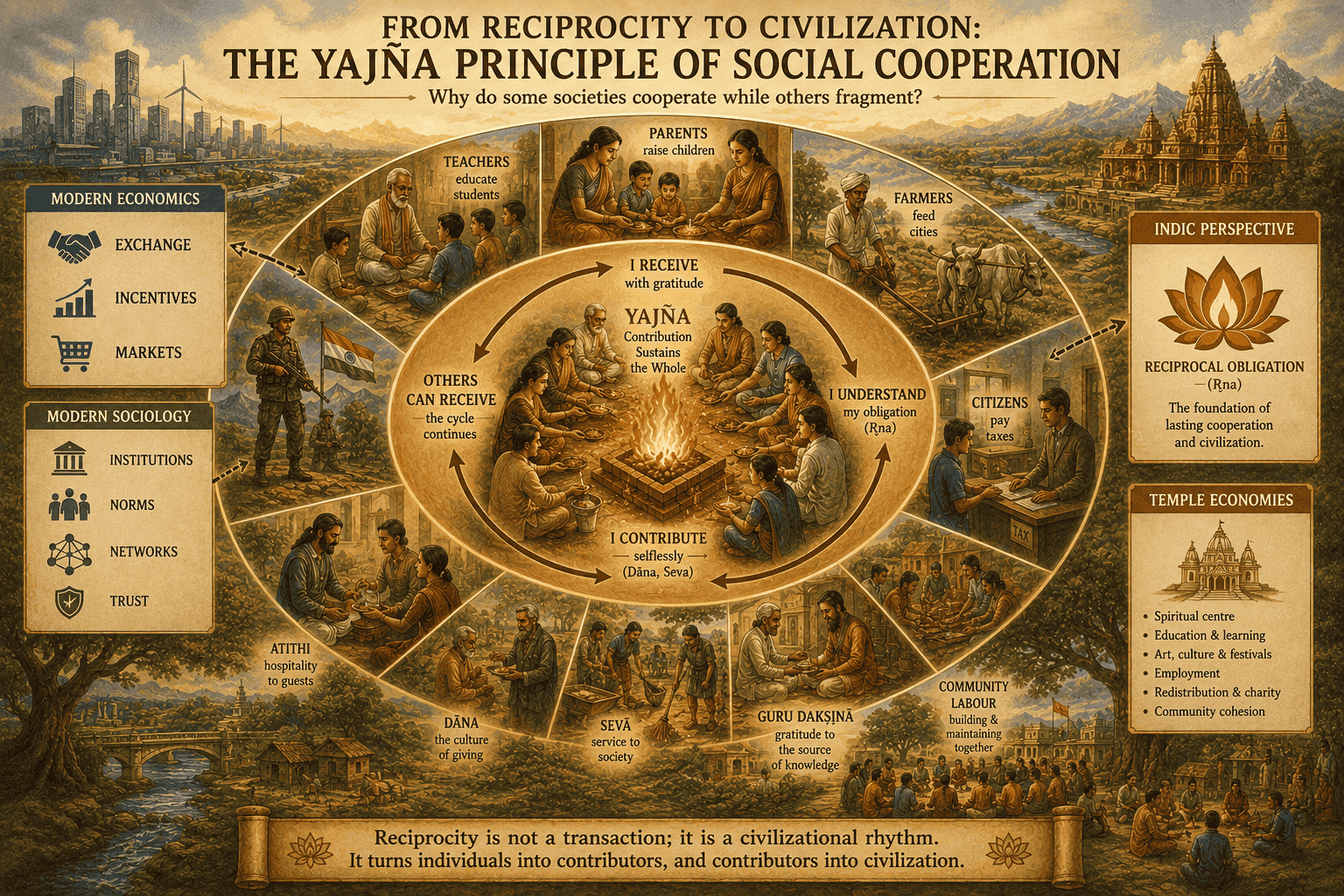
Why do some societies cooperate while others fragment?
A market can explain why I exchange with you. A contract can explain why I fulfil an agreement. An incentive can explain why I participate in a particular activity. But can these explain why a society holds together?
This is where the Indic idea of Yajña becomes particularly interesting. Modern economics has developed sophisticated explanations around exchange, incentives and markets. Sociology has explored institutions, norms, networks and trust. The contemporary literature on social capital, for instance, explicitly connects networks, trust and reciprocity with cooperation and collective action.
The Indic question begins somewhere else:
What if social cooperation is not merely an exchange of benefits, but a system of reciprocal obligations?
Yajña gives us a language for thinking about precisely this. Yajña is not simply the ritual act of placing an offering into a sacred fire. As a conceptual principle, it can be understood as contribution toward the maintenance of a larger order. One receives from a system because someone, somewhere, has contributed to it—and one is expected to contribute in turn.
This creates a very different social logic:
I receive → therefore I am indebted → therefore I contribute → therefore another can receive.
Civilization begins to look less like a marketplace and more like a circulatory system.
The Invisible Infrastructure
Consider the seemingly ordinary practices through which society survives.
Dāna creates a culture of giving.
Sevā turns service into a social ethic.
Ṛṇa reminds us that human beings inherit obligations from those who came before them.
Atithi transforms hospitality toward the guest into a social virtue.
Guru-dakṣiṇā recognizes that knowledge creates an obligation toward the source from which it was received.
These are not simply acts of charity. They create relationships of memory and obligation.
A student receives knowledge from a teacher. A child receives life and care from parents. A community receives from its farmers, artisans and workers. A generation inherits institutions, language and knowledge from earlier generations.
What happens next? The receiver becomes a contributor. This is fundamentally different from a transaction in which the relationship ends once the exchange is complete. Reciprocity creates continuity.
And this is where the idea connects intriguingly with modern social-capital theory. Reciprocity embedded in personal relationships is understood as one of the mechanisms through which trust and cooperation are generated; social capital literature similarly emphasizes networks, norms and trust as conditions facilitating collective action. But the Indic vocabulary adds something important: obligation across time. I may contribute today not because you can immediately repay me, but because I have received from those before me and understand myself as participating in a continuing cycle.
That is ṛṇa.
From Household to Civilization
The same principle can operate at larger scales. The family cares for its members. The village organizes collective labour. Communities maintain shared institutions. Temples historically served not only ritual purposes but could become centres around which networks of patronage, employment, redistribution and cultural activity developed.
The form changes. The principle remains: Contribution sustains the whole.
This also explains why Yajña should not be reduced to individual altruism. It is a theory of institutional reproduction.
- A school survives because teachers teach and communities support education.
- A temple survives because devotees, patrons, workers and communities contribute.
- A village survives because people perform functions that benefit others beyond themselves.
- A civilization survives because each generation does more than consume what it inherits.
It adds something to the inheritance.
This may be the most powerful way to understand reciprocity—not merely as “I help you because you may help me,” but as:
I contribute because I am already a beneficiary of a world created by others.
Reciprocity Is Not Always Symmetrical
There is another important insight here. Reciprocity does not require immediate or equal exchange.
Parents may give more to children than they receive from them for decades. Teachers may transmit knowledge to students who later transmit it to someone else. A farmer feeds millions of people without personally meeting most of them. A soldier protects citizens who will never know his name.
The return may come across generations rather than between two individuals. This is why Yajña can become a civilizational principle. The relevant unit is no longer: “What did I get back?” It becomes: “What did I receive, and what will I pass forward?” That is a radically different conception of social cooperation.
Competition Cannot Explain Everything
None of this means competition is irrelevant. Markets, incentives and individual ambition can generate innovation, productivity and economic dynamism.
But competition alone cannot explain civilization.
Who builds the trust necessary for exchange?
Who maintains the institutions markets depend upon?
Who educates the next generation?
Who preserves knowledge that has no immediate market value?
Who cares for those who cannot reciprocate immediately?
A civilization requires activities whose value cannot be reduced to immediate price. This is where reciprocity becomes an invisible infrastructure. When reciprocity is strong, people can cooperate without calculating every interaction. When it weakens, increasingly formal mechanisms may be required—contracts, surveillance, enforcement and incentives.
The paradox is striking: The more social trust declines, the more society must spend to compensate for its absence. Social capital research similarly cautions that networks and trust can facilitate cooperation, although their effects depend on how those networks are structured and used. The Indic insight, therefore, is not that every traditional relationship is automatically virtuous. Reciprocity can also become exclusionary when confined within narrow groups. The real civilizational challenge is to extend reciprocal obligation beyond the immediate circle.
From family → community → society → humanity. That is where Yajña becomes more than an ethic of giving. It becomes a theory of social cooperation across time and scale. Perhaps civilizations do not survive because everyone receives exactly what they contribute. They survive because people are willing to contribute more than they immediately receive—and trust that what they sustain will continue beyond themselves.
That is the deeper meaning of reciprocity. And perhaps the most important question for modern society is therefore not:
“What do I get from the system?”
but:
“What have I received, what do I owe, and what am I willing to contribute so that the next person can receive?”
That is the movement from reciprocity to civilization. And that is the Yajña principle.
