
What If…
Bharat Had Actually Been an “Exclusive Society”?
One of the most repeated descriptions of Indian society is that Bharat was a closed, rigid and exclusionary civilisation. Caste, restrictions on marriage, occupation, food, ritual and social interaction are often presented as evidence, and from these institutions a much larger conclusion is drawn: that Indian society was fundamentally exclusive. But I want to begin with a different question. What if Bharat had actually been an exclusive society? What should its history look like? Would we expect people, languages, customs, knowledge and communities to move so extensively across its geographical and social landscape? Or would we expect a civilisation whose boundaries were rarely crossed?
What if Bharat had been closed to other languages?
If Bharat had been culturally sealed, its linguistic traditions should have developed largely within separate boundaries. Yet the history of the subcontinent tells us something rather different. Sanskrit travelled across regions and interacted with Prakrits and later with regional languages. Tamil, Kannada, Telugu, Marathi, Bengali and other languages developed their own literary worlds while continuously borrowing and adapting vocabulary, literary forms and intellectual concepts. Persian and Arabic later entered Indian administrative and literary life, while English eventually entered almost every major Indian language. These languages did not simply replace one another. They interacted. A word could travel from one language to another and acquire a new life in its new setting. If we call this openness, however, we should be precise: linguistic interaction did not eliminate linguistic identity. Bharat remained extraordinarily multilingual precisely because different traditions could interact without necessarily becoming identical.
What if Bharat had rejected foreign customs?
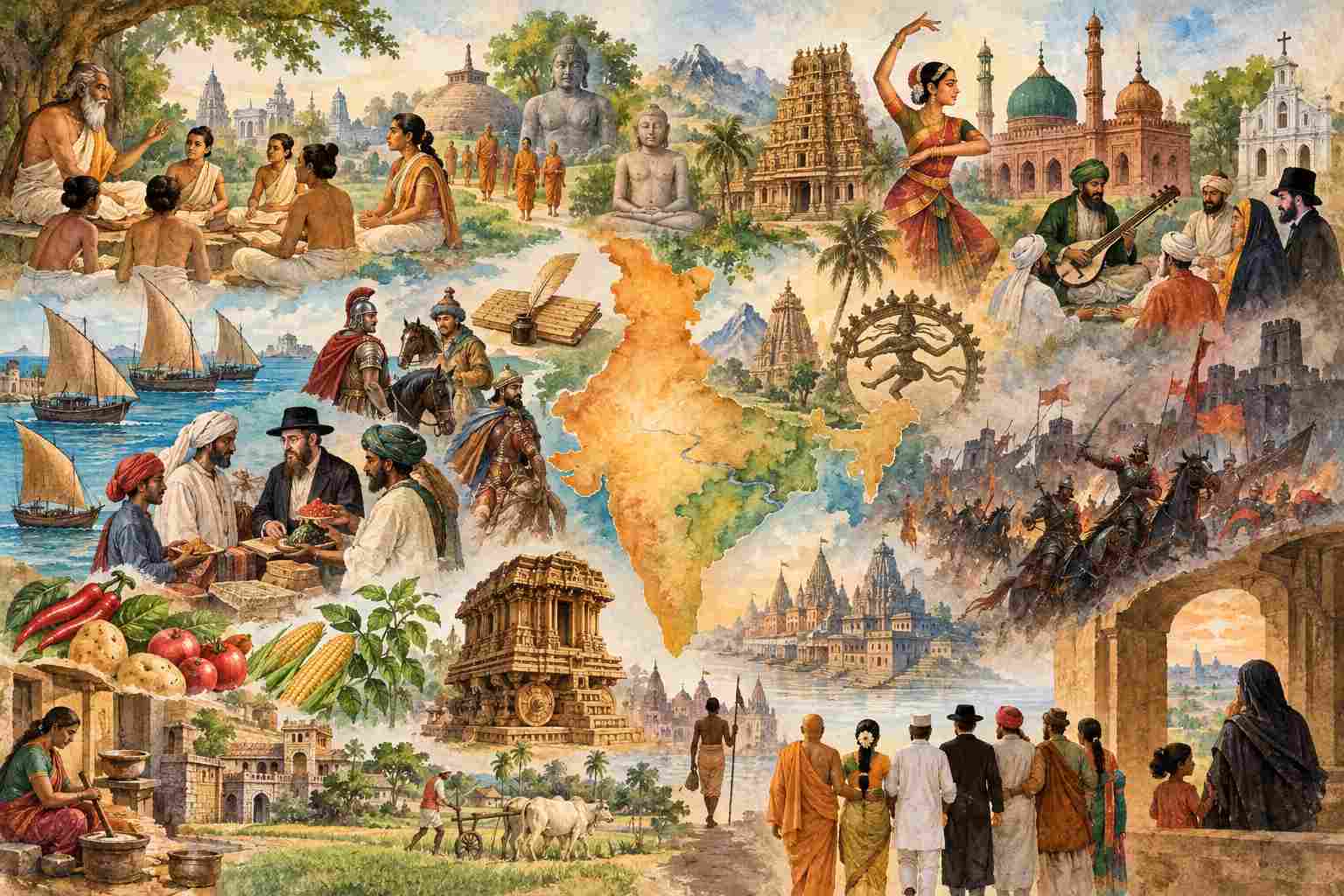
The answer is visible on our dining tables. Chilli, potato and tomato are now so thoroughly embedded in Indian food that we rarely think of them as foreign introductions. Yet all three came to India from the Americas after the Columbian exchange. Indian cuisines did not merely copy them; they incorporated them into existing culinary traditions and produced forms that became distinctly regional. Similar stories can be found in architecture, clothing, music and artistic traditions. The Persianate influence on later Indian architecture, for instance, did not simply produce Persian architecture in India; it interacted with existing Indian forms and generated new combinations. This tells us something important about cultural contact: receiving an external influence does not necessarily mean losing one’s own culture. Sometimes the receiving civilisation transforms what it receives.
What if Bharat had been unable to absorb new communities?
This question takes us from objects to people. Indo-Greeks, Śakas, Kuṣāṇas and later Huns entered different parts of the subcontinent and became part of its political history in different ways. Arab merchants established long-standing connections with the western coast. Parsis settled in India and maintained their distinctive religious identity. Jewish communities established enduring settlements, particularly along the Malabar coast. Armenians and other merchant communities also participated in Indian commercial life. None of these stories can be reduced to the claim that every outsider simply became “Indian” and lost his identity. That did not happen. What happened was often more complicated: communities retained institutions and identities while becoming part of local economic, political and cultural life. This suggests that assimilation in Bharat could sometimes mean incorporation without complete cultural erasure.
What if Bharat had been closed to other religions?
Then the intellectual history of the subcontinent would be difficult to explain. Buddhist and Jain traditions developed alongside Brahmanical traditions and engaged them in sustained philosophical debate. Nyāya, Mīmāṃsā, Sāṃkhya, Yoga and Vedānta developed elaborate arguments against competing schools. Śaiva, Vaiṣṇava and Śākta traditions developed distinct theological and ritual worlds while sharing a larger cultural landscape. Later, Islam and Christianity entered this already complex environment. None of this should be romanticised into a history without conflict. There were disagreements, rivalries and political conflicts. But interaction does not require agreement. In fact, the extraordinary tradition of Indian philosophical debate suggests that difference could become a reason for argument rather than an automatic reason for separation.
What if Bharat had been closed to trade?
Then the history of the Indian Ocean would look entirely different. Indian merchants and sailors connected the subcontinent with Arabia, East Africa and Southeast Asia. Roman trade left material evidence in several parts of India. Indian textiles, spices, beads and other goods travelled across maritime networks. Along with them travelled merchants, monks, ideas, artistic forms and technologies. The sea was therefore not merely a geographical boundary around India. For centuries it was also a highway connecting Indian societies with distant worlds. A civilisation can have a strong cultural identity and still participate extensively in international exchange.
What if Bharat had been closed to knowledge?
Here the evidence becomes even more striking. India developed multiple traditions of learning through gurukulas, pāṭhaśālās, agrahāras, monasteries, temple-linked institutions and centres such as Nalanda. Vedic learning continued through long chains of transmission. Buddhist and Jain institutions created their own intellectual networks. Grammar, logic, mathematics, astronomy, medicine and philosophy were cultivated through specialised traditions. Political disruptions undoubtedly affected institutions, and some centres declined or were destroyed. But institutional disruption is not the same thing as the disappearance of knowledge. Traditions continued, sometimes by moving into different institutional settings. If knowledge itself had been closed and static, it would be difficult to explain the continuous development and transmission of these intellectual traditions.
What if Bharat had never fought with itself?
This question is useful precisely because it destroys another simplistic picture. Bharat was not a civilisation without war. Mahājanapadas fought one another; Mauryan, Gupta, Chalukya, Pallava, Chola, Rajput, Sultanate, Vijayanagara, Deccan and Maratha powers all participated in conflicts of different kinds. Political competition was a permanent feature of Indian history. But political conflict did not necessarily erase wider cultural connections. Two kingdoms could fight one another while sharing languages, sacred geographies, religious traditions, artistic forms and intellectual practices. Political unity and civilizational connectedness were therefore not identical things.
What if Bharat had been closed to food and technology?
Modern Indian life itself provides the answer. The chilli, potato, tomato and maize entered Indian agriculture and food cultures from outside. Technologies also travelled across regions and civilisations, from metallurgy and irrigation to military technologies and later printing. Yet imported technologies were not necessarily adopted unchanged. They were adapted to local circumstances. This is another recurring pattern worth examining: the movement of something from one civilisation to another does not tell us what the receiving civilisation ultimately became. The process of adaptation matters.
What if Bharat had been closed to people?
Then the history of pilgrimage, scholarship and commerce becomes difficult to understand. People travelled to Kāśī, Prayāga, Mathurā, Puri, Rāmeśvaram, Dwārakā and countless other centres. Monks travelled between monasteries. Merchants crossed regions. Artisans moved. Teachers travelled. Political elites migrated. Communities established themselves far from their places of origin. The subcontinent was not made up of perfectly sealed communities. People crossed boundaries constantly, even though those boundaries could be socially important.
What if Bharat had never experienced insecurity?
This is where I think the story needs another turn. A society does not respond to security and insecurity in exactly the same way. From the early medieval period onward, different parts of the subcontinent experienced warfare, raids, political upheaval and the establishment of new ruling powers. These experiences were neither simultaneous nor identical everywhere, but prolonged insecurity can change social behaviour. Communities may become more concerned with internal solidarity. Restrictions around marriage and women’s mobility can become stronger. Practices of social protection can become more rigid. What begins as a response to particular historical conditions can eventually become customary and, after several generations, appear to have existed from the beginning.
This is particularly important when we discuss women. Early Indian sources preserve figures such as Gārgī and Maitreyī within intellectual traditions, and women appear in different capacities across religious, literary and political texts. At the same time, it would be historically careless to describe all women in ancient Bharat as uniformly free. Their lives differed by period, region, community and social position. The more useful question is whether certain restrictions became stronger in particular historical circumstances. Practices such as purdah and child marriage have complex histories and cannot be attributed to a single cause, but political insecurity, warfare and concerns about protection deserve to be part of that discussion.
What if Bharat had remained completely open despite changing conditions?
Perhaps this is the question that brings the entire argument together. It is entirely possible for a civilisation with a strong capacity for accommodation to become more defensive under prolonged pressure. The resulting social practices can then survive long after the circumstances that produced or intensified them have changed. Over time, the historical reason for a practice can disappear while the practice itself remains.
This possibility asks us to be careful when we look at later social restrictions and project them backwards across thousands of years. A civilisation has a history, and so do its institutions.
What if “exclusive” describes only one part of Bharat’s history?
When I put all these questions together, I find it difficult to describe Bharat through a single word. There were strong social boundaries, hierarchies and restrictions. There were also extensive movements of people, languages, ideas, commodities, technologies and religious traditions. There was assimilation, but not always through cultural erasure. There was conflict, but conflict did not necessarily destroy wider civilizational connections. There were periods of openness and periods of greater defensiveness.
So perhaps the more useful historical question is not simply whether Bharat was an “exclusive society.” It is to ask when, where and why particular boundaries became stronger.
If the underlying civilizational capacity for accommodation was present, then changing historical conditions may help explain why some boundaries hardened at particular moments. And if those boundaries later became embedded in social institutions, we need to distinguish the original institution from the historical circumstances that transformed it.
That is the “What If?” I want to leave with the reader: What if Bharat’s social history was not a straight line from ancient openness to medieval closure, but a much more complicated story in which a civilisation with strong internal boundaries repeatedly absorbed difference, and then, under changing historical conditions, developed stronger mechanisms of protection and separation?
The answer cannot be found in a single theory. It has to be recovered from the history itself.
The more I think about this question, the less comfortable I am with the simple description of Bharat as an “exclusive society.” Not because I want to deny the existence of exclusion, hierarchy or social restrictions. They existed, and some of them were deeply consequential. But I am not convinced that the existence of social boundaries is sufficient to describe the character of an entire civilisation.
What interests me much more is the historical movement of those boundaries. Why were some boundaries created? Which of them were very old, which developed later, and which became stronger under particular political or social circumstances? Why did some communities remain distinct while becoming part of the larger social order? Why did some practices weaken while others became more rigid? And what happened to institutions of learning, women’s lives, community organisation and cultural exchange when the political environment of the subcontinent changed?
I think these questions deserve to be asked without beginning with either admiration or condemnation.
The same approach can take us into many other areas. We can ask what happened to Indian languages when new languages entered the subcontinent. We can ask how religious communities interacted, competed and assimilated. We can examine food and agriculture and trace how crops that were once foreign became part of what we now consider Indian. We can look at migration and ask how communities moved and settled. We can examine warfare and political conquest and ask what changed politically, socially and culturally after each major transition. We can study women’s mobility, marriage and education across different periods rather than treating “Indian women” as though their historical experience was identical for three thousand years. We can even ask what happened to knowledge traditions when institutions were disrupted but the traditions themselves survived.
That, for me, is the real purpose of the What If? series.
I do not want to begin with a conclusion and then collect evidence for it. I would rather take a claim that we have heard repeatedly, turn it into a question, and then see what happens when we follow the question through history. Perhaps we will discover that the claim was correct. Perhaps we will discover that it was only partly correct. Perhaps we will discover that the category itself was too simple. But that is precisely why I find the counterfactual useful. It forces us to ask questions that ordinary descriptions often allow us to avoid.
And perhaps the most interesting question of all is this: when we call a civilisation “exclusive”, are we describing its deepest civilizational character—or are we describing one historical moment, one institution, or one response to circumstances that changed over time?
I don’t think we should answer that question before looking at the evidence. Let us look first. Then let us decide.
Now your comments!
