
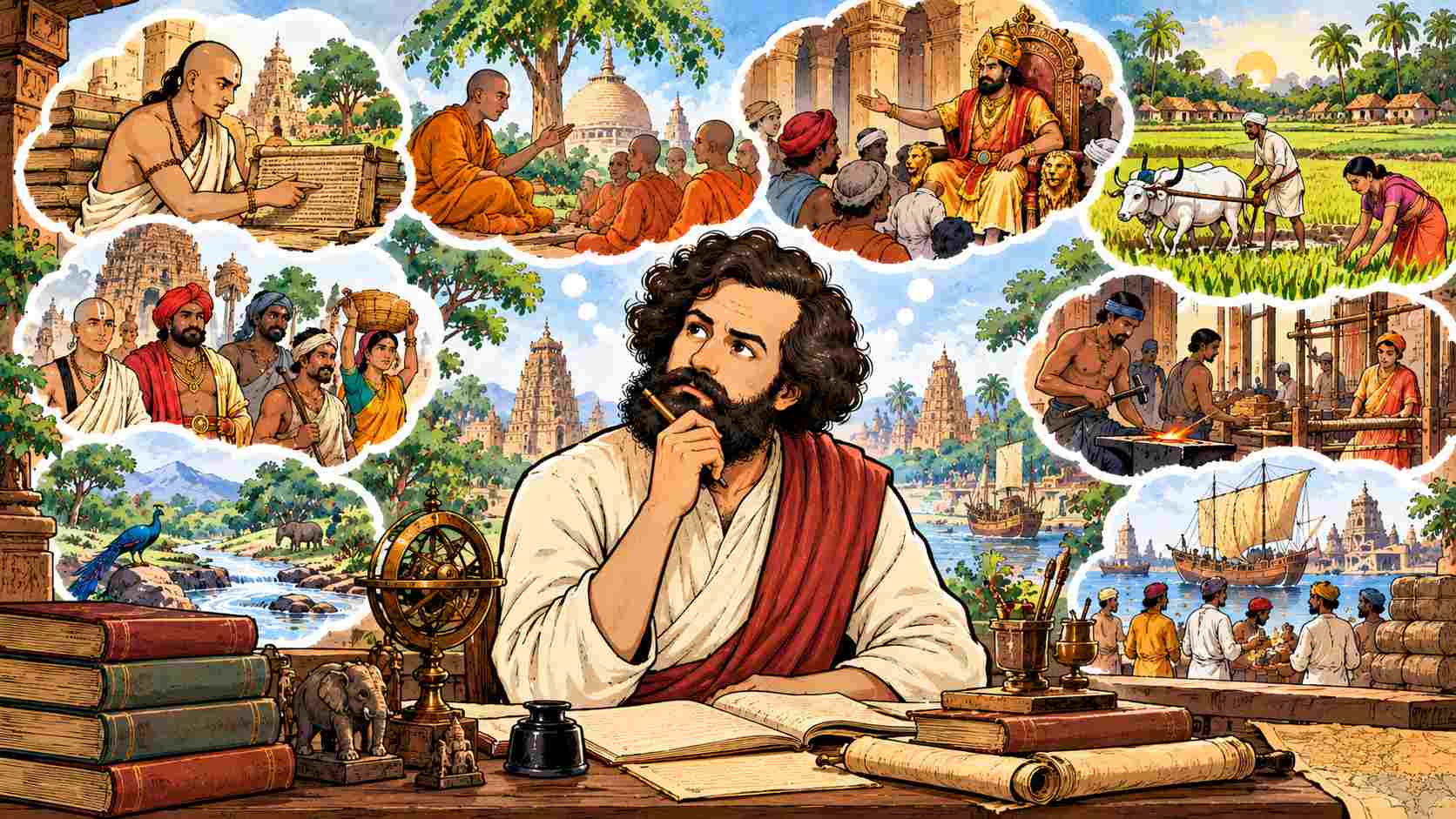
WHAT IF?
Marx was born in Bharat?
Let me begin with a confession. I have no idea what Karl Marx would have become if he had been born in Bharat. Nobody does. A person’s intellectual life is shaped by an almost impossible combination of family, education, temperament, historical circumstances and the questions of his time and this is just a hypothetical condition I am thinking. So I am not trying to manufacture an “Indic Marx” here. I am asking a different question.
What if we changed one variable in Marx’s intellectual history?
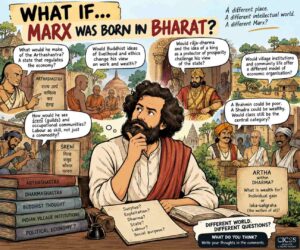 What if Marx had been born in nineteenth-century Bharat rather than nineteenth-century Europe? What if, before encountering Ricardo, Smith, Hegel and the political economy of industrial capitalism, he had grown up encountering Arthaśāstra, Dharmaśāstra, Buddhist ideas of livelihood, śreṇī traditions, village institutions and the Indic understanding of artha? Would he still have developed the same categories of class, labour, capital and surplus value?
I suspect he would have had a much harder time doing so. But there is an important historical caveat.
Nineteenth-century Bharat was not some untouched ancient civilisation waiting for Marx to discover it. It was already living through enormous changes. British colonial rule had transformed systems of land revenue, trade and production. Indian artisans were confronting industrial competition. Railways and new commercial networks were changing economic relationships. New forms of property and administration were being imposed. English education was creating new intellectual classes. Global capitalism had already entered Indian economic life.
So the counterfactual is not “What if Marx lived in ancient India?” It is much more interesting: What if a nineteenth-century Marx had grown up inside Bharat’s own civilizational and intellectual traditions while simultaneously experiencing colonialism and the arrival of modern capitalism?
Now the story changes.
Marx’s actual intellectual environment gave him a very particular economic problem. He saw industrial capitalism reorganising society around factories, wage labour, private capital and rapidly expanding markets. He asked what lay beneath the apparently free exchange between worker and capitalist.
His answer took him toward labour, capital, class and surplus value. But imagine that the same young Marx first encountered a society where economic position did not map neatly onto social position.
A Brahmin could be poor. A Shudra could be wealthy. A merchant could possess enormous economic influence without being a ruler. An artisan could possess highly specialised knowledge while belonging to an occupational community with its own traditions and institutions. A king could command political authority without being a capitalist owner of productive enterprise. That would immediately create a problem for a simple class analysis.
Marx might have looked at society and asked: where exactly is the class?
The answer would not have been obvious. This does not mean that inequality or exploitation were absent. Far from it. It means that wealth, occupation, social status and political authority could not simply be treated as different names for the same economic relationship.
That distinction could have become fundamental to his theory. Then suppose he opens the Arthaśāstra. What does he find? He finds agriculture, trade, taxation, wages, prices, mines, forests, irrigation, guilds, markets and state regulation. He finds a ruler deeply involved in maintaining the productive capacity of the kingdom. Economic life is not imagined as something completely separate from political order.
This would have forced him to reconsider the state. Marx’s analysis of the state was deeply connected with the structure of class power. But what happens when the political ruler is also expected to protect agriculture, regulate commerce, maintain infrastructure, secure the realm and promote prosperity? The idea of rāja-dharma becomes particularly important here.
The king possesses daṇḍa, but daṇḍa is not simply unlimited power. Political authority carries obligations. The ruler is judged by what he does with power. I suspect Marx would have found this fascinating. He might have asked whether political authority could be understood only as an instrument of economic domination, or whether the state could also possess a normative responsibility toward the economic and social order.
Then we arrive at Marx’s most famous economic problem: surplus. In his actual theory, surplus value emerges from the difference between the value created by labour and the wages paid to labour under capitalism. The capitalist appropriates the surplus, and this relationship becomes central to his explanation of exploitation. Now put that question into the economic world Marx would have encountered in Bharat.
Who produces the surplus? The cultivator? The artisan? The merchant? The guild? The landlord? The state? The temple? And who collects it? Through what institution? Where does it go? What is it used for?
The question suddenly becomes much larger than the relationship between a factory owner and a wage worker. Perhaps Marx would have developed a theory not only of surplus value, but of surplus circulation—the institutions through which economic surplus is collected, controlled, redistributed and converted into political or social power.
And then there would be śreṇī. Organised occupational and commercial communities would complicate the image of the worker as an isolated individual selling labour to a capitalist. Skills, occupations and production could be embedded within communities and transmitted through established traditions.
This would have forced Marx to think differently about labour. Labour is certainly economic activity. But it can also be skill, occupation, knowledge, social contribution and inherited practice.
That is not a small distinction. The industrial worker can be separated from the craft and placed within a production system owned by someone else. But when occupational knowledge itself is embedded in a social institution, the relationship between labour and production becomes more complicated.
Marx might therefore have asked whether all labour should be understood primarily as a commodity. Then comes the idea that might have disrupted his political economy most deeply: artha does not stand alone. Wealth is a legitimate human concern. But the pursuit of wealth exists within a larger normative order. Dharma introduces a question that Marx’s economic categories do not easily answer:
Even if I can acquire wealth, what gives me the right to acquire it in this way? And what am I supposed to do with it once I have acquired it?
This changes the nature of the economic question. A merchant’s wealth can be economically successful and still be judged according to dharma. A ruler may possess enormous resources and still be judged according to rāja-dharma. Economic power does not automatically establish moral legitimacy.
Buddhist thought would add another dimension through ideas of right livelihood, restraint, generosity and ethical conduct. And loka-saṅgraha would introduce perhaps an even larger question: what does economic activity contribute to the preservation and welfare of the larger social order? This does not eliminate the problem of exploitation. It changes the framework within which exploitation is judged. Economic justice would involve not merely the distribution of wealth, but also the purpose, legitimacy and social consequences of wealth.
This is where I think our counterfactual Marx becomes particularly interesting.
- Would he still discover class? Of course.
- Would he still see economic inequality? Certainly.
- Would he still identify exploitation? Very likely.
But perhaps he would hesitate before making class the master explanation of society. He would have encountered a world in which a Brahmin could be poor and a Shudra wealthy; in which economic position could diverge from social status; in which merchants, artisans and occupational communities could organise economic life; in which political authority carried normative obligations; and in which wealth itself was embedded within a larger conception of human purpose.
His categories would have had to become more complicated. Perhaps he would have developed a theory in which class was one form of power rather than the explanation of all social power.
- Perhaps surplus would have been studied not merely through appropriation but through circulation.
- Perhaps labour would have been understood not only as labour power but also as skill and social contribution.
- Perhaps the state would have been examined not merely through domination but also through responsibility.
- And perhaps economics would have begun with a question that modern economics often postpones:
What is wealth for?
This is where I would stop myself from taking the counterfactual too far.
Marx was not simply a collection of ideas that could be transplanted from Germany to Bharat. His intellectual development depended upon European philosophy, Christianity, German idealism, British political economy, French socialism and the extraordinary transformations of nineteenth-century Europe. Likewise, nineteenth-century Bharat itself was changing rapidly. Colonialism, global markets, new technologies and modern political institutions were already transforming Indian society.
So no, I do not think we can seriously claim that “Marx would have become an Indic thinker.” That is not the point. The point is that ideas are never produced in a vacuum. Marx looked at one historical world and developed categories to explain it.
If he had looked at another, perhaps he would have asked different questions. And perhaps that is what this little experiment is really asking us to reconsider. We often treat concepts such as class, capital, labour, surplus and the state as though they are universal descriptions of human society.
- But what if they are, at least partly, historical responses to particular forms of society?
- What if another civilisation had supplied Marx with the starting vocabulary?
- What if artha had come before capital?
- What if dharma had accompanied economics from the beginning?
- What if śreṇī had been part of his theory of production?
- What if rāja-dharma had shaped his theory of the state?
- What if loka-saṅgraha had entered his understanding of economic purpose?
Perhaps Marx would still have written a critique of exploitation. But perhaps he would have written a very different political economy—one concerned not merely with who owns wealth, but also with how wealth is created, how surplus circulates, what obligations accompany it, and what economic life is ultimately meant to serve. That, to me, is a far more interesting “What If?” than asking whether Marx would have been a socialist.
What do you think?
If Marx had grown up in nineteenth-century Bharat, which text, institution or Indic concept do you think would have changed his understanding of class, labour, surplus, property and the economy?
Write your thoughts in the comments. I would genuinely like to hear where you would take this counterfactual.
