
Introduction
Indian political thought is often presented through its major works: Kauṭilya’s Arthaśāstra, Kāmandaka’s Nītisāra, Manu’s discussions of rājadharma, and the political teachings attributed to Śukra or Uśanas. Yet the history of political ideas does not end with the composition of a root text. It also includes the scholars who copied, edited, explained, and printed these works.
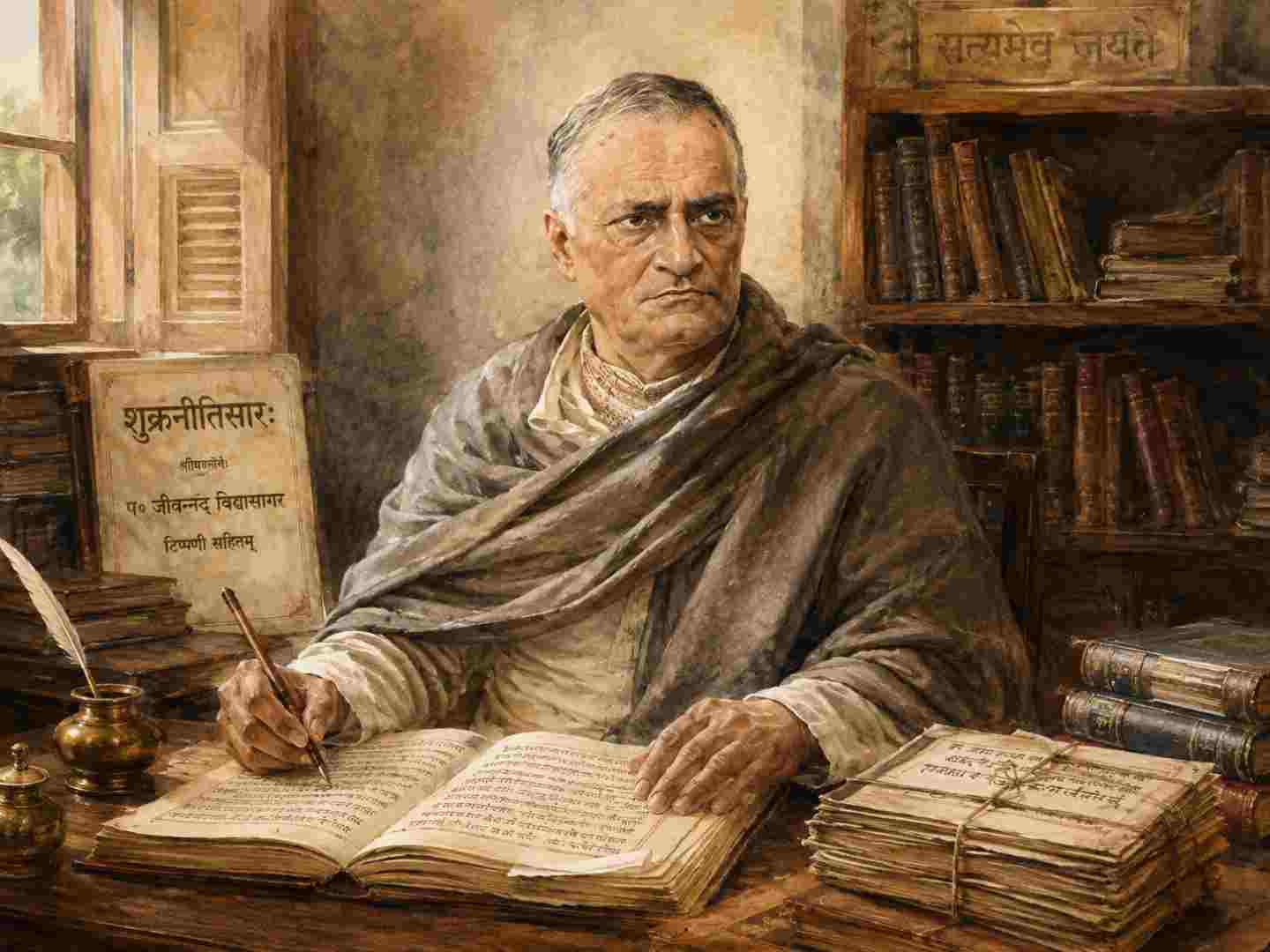
Jīvānanda Vidyāsāgara’s Sanskrit edition and commentary on the Śukranīti belongs to this history of textual mediation. The root text presents a wide-ranging account of kingship, administration, revenue, taxation, justice, defence, diplomacy, public works, social organization, arts, and sciences. Jīvānanda’s commentary gives readers a particular way of understanding that material.
The bibliographical identity of the edition requires care. Gustav Oppert’s Śukranītisāra was published at Madras in 1882 and included the Sanskrit text and critical apparatus. The readily identifiable Jīvānanda Vidyāsāgara edition with Sanskrit explanation is catalogued as a Calcutta printing of 1890 from Narayan Press.
The significance of Jīvānanda’s work is therefore twofold. It preserves a particular printed form of the Śukranīti, and it interprets that form for a nineteenth-century Sanskrit readership. The Śukranīti is the root text; the Śukranītiṭīkā is the later act of explanation.
The Edition and Its Historical Setting
The available digital record describes the Jīvānanda volume as Śukra Nīti Sāra of Śukrācārya with Explanation by Jīvānand Vidyāsāgar Bhattacharya, published in Calcutta by Narayan Press in 1890. A digital catalogue records the Sanskrit book as 684 pages, although the pagination and edition statement should be checked against the scan itself.
Jīvānanda’s work should be distinguished from Gustav Oppert’s 1882 Śukranītisāra. Oppert’s edition is associated with Madras, the collection of manuscripts, the establishment of a Sanskrit text, and critical material such as variae lectiones. These are not interchangeable bibliographical objects. Oppert’s edition represents one nineteenth-century attempt to establish the text; Jīvānanda’s edition represents another form of Sanskrit engagement, in which the root text is presented with explanatory material. A comparison between the two would be valuable, but it should be based on title pages, prefaces, manuscript statements, and actual variant readings.
Jīvānanda’s larger corpus places the book in a broad culture of Sanskrit editing and commentary. The collection of his works lists approximately two hundred texts associated with him across grammar, philosophy, literature, Dharmaśāstra, Purāṇa, Veda, Tantra, medicine, and other fields, including the Śukra Nīti Sāra with Sanskrit Commentary.
The book should therefore be read as a product of Sanskrit print culture. Its historical importance lies not only in the political ideas attributed to Śukra but also in the editorial and interpretive decisions through which those ideas became available in print.
Śukra as Authority and the Date of the Text
The Śukranīti is traditionally associated with Śukra or Uśanas, the preceptor of the Asuras and a recognized authority on political instruction. This attribution gives the work traditional authority, but it does not settle the historical authorship or date of the surviving textual form.
Four questions must be separated:
- Who is Śukra or Uśanas within the traditional history of nīti?
- When was the extant Śukranīti composed or compiled?
- What earlier and later layers may be present in the text?
- What did Jīvānanda do when he edited and explained the text?
The date of the extant Śukranīti has been disputed since its entry into modern scholarship. Some scholars have proposed an early or medieval date, while others have argued for a comparatively late composition. Lallanji Gopal famously argued that the extant text should be regarded as a nineteenth-century work; other scholars have placed it earlier. A modern scholarly discussion confirms that the disagreement over the date remains central to the study of the text.
The controversy should not lead us to dismiss the work. It instead requires a distinction between traditional authority and historical formation. The name Śukra may represent an inherited authority under which political teaching was transmitted, while the extant text may contain materials composed, revised, or assembled at different times.
Jīvānanda’s edition cannot by itself solve this problem. It is, however, evidence for the reception of the textual form available to nineteenth-century readers.
The Root Text: A Brief Map
The Śukranīti is unusually broad in scope. It discusses the education and conduct of the king, the crown prince, ministers, officers, treasury, taxation, land, revenue, forts, army, diplomacy, intelligence, justice, public works, social organization, arts, sciences, and household conduct.
Its opening presents nīti as necessary not only for the ruler but for society. The surviving English translation of the Sanskrit text renders the opening claim in this way:
“Other Śāstras treat of certain specialised departments of human activity … whereas Nīti Śāstra is useful to all and in all cases and is the means for the preservation of human society.”
The next passage gives the political reason for this universality:
“The two primary functions of the king are protection of subjects and constant punishment of offenders; these two cannot be achieved without Nīti Śāstra.”
The root text thus connects political knowledge with both protection and punishment. Jīvānanda’s importance lies in how he explains the terms, relationships, and practical implications contained in these compressed statements.
The work also presents a theory of the ruler’s responsibility:
“The ruler has been made by Brahma a servant of the people getting his revenue as remuneration, His sovereignty, however, is only for protection.”
This striking formulation should not be translated immediately into modern “social contract” language. It is better understood first in its own vocabulary: the ruler receives revenue in relation to service, while sovereignty is justified through protection.
Jīvānanda’s Commentarial Method
A commentary is not simply a dictionary attached to a root text. It selects points of difficulty, establishes relations between terms, supplies grammatical or conceptual explanations, and determines how inherited political language should be read.
The central question for the Śukranītiṭīkā is therefore: what does Jīvānanda consider necessary for understanding the Śukranīti?
The volume should be read for evidence of several possible practices:
- explanation of difficult words;
- prose order or anvaya;
- synonyms and definitions;
- grammatical parsing;
- identification of implied subjects and objects;
- citation of other śāstras;
- comparison of variant readings;
- clarification of administrative terminology;
- examples from political practice; and
- reconciliation of ethical and strategic rules.
The commentary’s method should be distinguished from the root text. When a verse presents a short political maxim and Jīvānanda expands it into a paragraph of explanation, the expansion is evidence for nineteenth-century reception, not automatically evidence for the historical author Śukra. Jīvānanda should also be understood as an editorial authority. By selecting a reading, deciding how the verse is divided, placing commentary beside the root text, and explaining technical expressions, he creates a particular reading environment.
Political Knowledge and the Meaning of Nīti
The definition of nīti should be treated as the conceptual centre of the book. The root text describes Nīti Śāstra as necessary for rulers and society, while the commentary should be examined for the precise meaning it gives to nīti.
The opening material presents nīti as connected with virtue, wealth, enjoyment, and liberation. It also presents it as essential for the king’s ability to defeat enemies, conciliate subjects, and practise statecraft. The translated text states:
“By knowing which, rulers can be victorious over foes, affectionate and conciliatory towards subjects and well up in the arts of statecraft.”
This formulation places political knowledge between coercion and conciliation. The ruler needs force against enemies, but also the ability to maintain relations with subjects.
The text’s definition of daṇḍanīti is equally important:
“Daṇḍa is restraint and punishment, hence the king is also known to be Daṇḍa. The Nīti that regulates punishment constitutes Daṇḍanīti, so called because it governs and guides.”
The Sanskrit source should be printed alongside this translation in the final article. The passage suggests that daṇḍa is not merely punishment. It includes restraint, regulation, and guidance. Jīvānanda’s commentary should be examined to determine whether he develops this semantic range or narrows it to a particular technical meaning.
The King: Authority, Service, and Discipline
The first major political problem addressed by the text is the character of the ruler. The king is powerful, but power alone does not make successful governance. He requires knowledge, discipline, courage, intelligence, and the ability to listen to counsel.
The root text insists that the ruler’s authority depends upon qualities rather than ancestry:
“The king is honoured because of these qualities. It is not birth that makes a king. He is not respected so much because of his ancestry, as for his prowess, strength and valour.”
This passage should be used carefully. It does not necessarily reject hereditary monarchy as a political institution; it states that effective honour and authority depend upon qualities such as prowess, strength, and valour.
The text also describes the king as possessing multiple social functions:
“The sovereign is always possessed of the attributes of seven persons, father, mother, preceptor, brother, friend, Vaiśravaṇa or Kuvera and Yama.”
The subsequent explanation presents the king as educator, nourisher, teacher, kin, confidant, provider of wealth, and punisher. The image is not simply of a military monarch. It is a composite theory of rulership in which the king carries familial, pedagogical, economic, and judicial responsibilities.
Self-discipline is presented as the first administrative requirement:
“The king should first provide discipline to himself, then to the sons, then to ministers, then to servants, then to the subjects.”
This sequence is important for reading Jīvānanda’s commentary. If he explains dama, vinaya, or mastery of the senses in political rather than merely spiritual terms, the commentary reveals how personal discipline is converted into a theory of administration.
The text gives the principle in a vivid form:
“How can the man who is unable to subdue one’s mind master the world extending to the sea?”
The commentary should be examined for whether it treats this as moral instruction, political psychology, or both.
The Seven Limbs of the Polity
The Śukranīti presents the kingdom as an organism of seven limbs:
“The kingdom is an organism of seven limbs, viz. the Sovereign, the Minister, the Friend, the Treasure, the State, the Fort and the Army.”
The text then assigns bodily analogies to the limbs:
“The king or Sovereign is the head, the Minister is the eye, the Friend is the ear, the Treasure is the mouth, the Army is the mind, the Fort is the arms and State is the legs.”
This metaphor deserves close attention. It presents the polity as a body whose parts perform different functions. The minister is associated with sight, the ally with hearing, the treasury with the mouth, the army with the mind, the fort with the arms, and the territory or state with the legs. The analogy should not be equated with modern constitutional theory. The king remains the head and the political order remains king-centred. Yet the king cannot function independently of the other limbs.
The commentary should be analysed for the exact meanings it assigns to svāmin, amātya, mitra, kośa, rāṣṭra or janapada, durga, and bala. Particularly important questions are:
- Does the minister represent vision, counsel, or knowledge?
- Does the ally represent information, external support, or diplomacy?
- Is the treasury treated as stored wealth or fiscal capacity?
- Does the state include land, population, production, or all three?
- Is the army understood through strength, organization, pay, or loyalty?
Revenue, Taxation, and the Political Economy of Rule
The Śukranīti gives unusual attention to the material basis of government. The ruler requires revenue, but the text also describes revenue as remuneration for service and sovereignty as protection.
The text specifies a hierarchy of rulers by revenue. A Sāmanta is described as a ruler whose annual revenue from one hundred villages lies between one and three lakh karṣas. Other titles—Māṇḍalika, Rājā, Mahārāja, Svarāṭ, Samrāṭ, Virāṭ, and Sārvabhauma—are associated with progressively larger revenue levels.
These figures should be treated as textual categories, not automatically as a statistical description of historical states. They show that the text links political rank with fiscal capacity. The root text also gives a warning against excessive extraction:
“The ruler who extracts his share through cupidity … is ruined with his subjects.”
This is an important political principle. Revenue is necessary, but greed destroys both ruler and subjects. A related passage says that the ruler should realise the share of produce according to the prescribed system and should use a different standard in times of danger or difficulty.
The article should examine how Jīvānanda explains the terms for revenue, share, land, produce, and emergency. Does he treat taxation as a legal entitlement, a service payment, a customary share, or an instrument of state survival?
The text’s account of land and measurement is highly detailed. It gives definitions of the grāma, pallī, kumbha, krośa, aṅgula, kara, daṇḍa, nivartana, and parivartana. It also compares measurements attributed to Prajāpati and Manu.
This material makes the Śukranīti more than a text about royal virtue. It is also concerned with the administrative technologies of land, measurement, assessment, and revenue.
Fiscal Administration and Written Records
The text assigns distinct responsibilities to ministers and officials. The translated account identifies Sumantra with income and expenditure and Amātya with land records, settlements, and land revenue. Officials are expected to submit reports at different intervals, while the king is instructed to examine the flow of income and expenditure.
The article on the commentary should determine whether Jīvānanda explains these offices as technical departments or as general royal functions. The exact Sanskrit terms should be quoted because modern translations such as “finance minister” or “land-revenue minister” may be interpretive rather than literal.
The text also emphasizes written orders. It states, in the modern summary of the passage, that the king should not issue commands without written orders because errors and corruption may result. This is a significant claim about documentation and administrative accountability.
The article should not call this modern bureaucracy without qualification. A historically cautious formulation is:
The passage gives written orders a role in controlling the transmission and execution of royal authority. It suggests that administrative reliability depends upon documentation, but the institutional implications must be reconstructed from the Sanskrit context.
Jīvānanda’s explanation may be especially valuable here. Does he explain the written order as a royal command, a sealed document, a record for verification, or a protection against official misuse?
Public Finance and Expenditure
The text provides an unusually detailed account of expenditure. A village-level budget is described with allocations for the village head, army and law-and-order expenses, officers’ wages, royal personal expenditure, citizen entertainment, charitable work, and treasury surplus. A modern analysis presents the shares as follows: one-twelfth for the village head, three-twelfths for army and law and order, one twenty-fourth for officers, one twenty-fourth for royal expenditure, one twenty-fourth for entertainment, one twenty-fourth for charity, and one-half as treasury surplus.
This is a valuable passage, but it requires careful treatment. The fractions should be checked against the Sanskrit text and the edition used. The modern table may be a reconstruction by Satish Y. Deodhar from the translation rather than a direct table in the original book.
The significance of the material is nevertheless clear: the Śukranīti links revenue with several categories of expenditure and reserves a substantial portion for the treasury. The text also directs accumulated wealth toward emergencies, public works, defence, and support of subjects.
The phrase “modern idea of no revenue deficit” should be avoided. A more precise formulation is:
The allocation prioritizes a substantial reserve after designated expenditures. It reflects concern with fiscal prudence and emergency capacity, although it should not be identified uncritically with a modern balanced-budget doctrine.
Public Works and the Material Kingdom
The text includes detailed prescriptions for the construction and arrangement of capitals, towns, villages, roads, drains, wells, tanks, parks, houses, temples, markets, and public buildings.
One translated passage describes the ideal capital as a place rich in trees, plants, cattle, birds, water, grain, grass, wood, boats, and level ground. It should be surrounded by walls and ditches, contain divisions for villages and other settlements, and have council buildings at the centre. It should also possess wells, tanks, pools, gates, roads, parks, temples, inns, and facilities for travellers.
The article should quote Jīvānanda’s Sanskrit explanation wherever it clarifies measurements or construction terminology. The modern analysis reports specific widths for major roads and pedestrian paths and detailed instructions for drainage and water facilities.
The material is important because public works are not treated as incidental decoration. They serve several possible functions:
- settlement and habitation;
- public health and water supply;
- movement and trade;
- military defence;
- economic productivity;
- royal merit; and
- public welfare.
The text also assigns responsibility for maintaining roads, repairing them, ensuring traveller security, and providing water. It recommends lands for temples, parks, public grounds, and dwellings for peasants. The word “development” should be used carefully. The text does not present a modern developmental state. It does, however, connect rulership with the maintenance of a material environment in which subjects can live, travel, cultivate, trade, and worship.
Food Reserves and Emergency Capacity
The Śukranīti treats stored grain and accumulated treasure as instruments of security. The modern economic study reports that grain stocks should be sufficient for three years and that consumed grain should be replaced annually. It also reports that the accumulated treasure should support the subjects and army during a foreign emergency for twenty years without resort to fines, duties, or land revenue; a reserve sufficient for twelve years is described as low, while one sufficient for thirty years is excellent.
These figures should be verified against the Sanskrit edition before publication. If confirmed, they would make the text especially important for the study of premodern ideas of reserve capacity and crisis management.
The text also says that wealthy persons may hold state wealth in normal times and that their deposits should be returned with interest after an emergency. This is not merely a discussion of treasure. It is a theory of resilience: the kingdom needs reserves that can protect the army and population when ordinary revenue cannot be collected.
Jīvānanda’s commentary may clarify whether these provisions are legal rules, political advice, or illustrations of royal prudence.
Officials, Training, and Human Resources
The Śukranīti recognizes that government depends upon trained personnel. The modern account reports that the king should arrange scholarships for students and training programmes for government officers. After training, officers are to be assigned to new duties, while those who excel in arts and sciences should receive awards.
The article should examine whether Jīvānanda interprets education as:
- religious learning;
- technical training;
- administrative competence;
- moral discipline;
- professional specialization; or
- a combination of these.
The text’s attention to offices, reports, training, and promotion suggests that political capacity depends upon more than royal will. It depends upon a network of persons whose knowledge and conduct affect the functioning of the kingdom.
The modern phrase “human-resource development” should not be used as though it were the language of the Sanskrit text. It may be used only as a clearly labelled analytical comparison.
The Scope of Vocations and Sciences
One of the most distinctive features of the Śukranīti is its enumeration of vocational skills and sciences. A modern analysis identifies sixty-four vocational skills and thirty-two sciences in the fourth chapter.
The skills include the making of earthen, wooden, stone, and metal vessels; musical instruments; boats and chariots; spinning and weaving; artificial gems and metals; leather work; glass; iron implements; animal equipment; dairy and oil processing; agriculture; painting; swimming; riding and training animals; construction of tanks, canals, and buildings; dyeing; fire and flood mitigation; gem testing; gold testing; jewellery; enamelling; tailoring; washing; barbering; negotiation; water channelling; writing in regional scripts; punishment; and child care.
The list also associates particular groups of skills with Gandharvaveda, Āyurveda, Dhanurveda, and Tantra. It includes dancing, music, costume, acting, garland making, gambling and magic, sexual arts, distillation, surgery, cooking, horticulture, metallurgy, sugar processing, alloys, minerals, weapon use, duelling, missiles, battle formations, and military arrangements.
The thirty-two sciences include architecture, medicine, astronomy, military science, performing arts, phonetics, grammar, ritual, etymology, prosody, rhetoric, poetry, vernacular languages, oratory, Arthaśāstra, Kāmaśāstra, history, Purāṇas, Smṛtis, the philosophical systems, the Vedas, Tantra, and Yavanamata.
This catalogue should not be read uncritically as a census of actual occupations in one historical period. It is better understood as an intellectual classification of useful skills and bodies of knowledge. It reveals an expansive imagination of the social and technical resources that a kingdom may contain.
Jīvānanda’s commentary is important here because he may explain the names, boundaries, and relationships among these sciences. The commentary can show whether the list is treated as a theoretical taxonomy, a pedagogical curriculum, or a description of social life.
The Social Order and the Question of Conduct
The Śukranīti connects political administration with moral and social conduct. The translated text states that the four aims of life should be pursued together and that morality is necessary for happiness.
It also presents practical rules concerning speech, trust, friendship, family, debt, wealth, learning, travel, social conduct, and relations with superiors and inferiors. These passages show that the work is not restricted to royal administration. It offers a broad theory of conduct for rulers, officials, householders, and other members of society.
The article should avoid treating every social prescription as a direct statement of Jīvānanda’s nineteenth-century views. The relevant question is how Jīvānanda explains the root text. Does he preserve its social categories without comment? Does he give grammatical or ethical clarification? Does he cite other authorities? Does he soften, expand, or reinterpret difficult passages?
This is one place where the distinction between root text and commentary is essential.
Diplomacy, Envoys, and Intelligence
The Śukranīti includes envoys, spies, foreign relations, and internal security within the domain of political knowledge. The ruler must understand not only the condition of his own kingdom but also the intentions and capacities of other powers.
The commentary should be studied for its treatment of the envoy as:
- representative of the ruler;
- bearer of a message;
- negotiator;
- observer; or
- political agent.
It should also be examined for its distinction between information and deception. A spy may gather intelligence secretly, while an envoy may operate under a formal political identity. The exact Sanskrit terms should be quoted before assigning modern labels such as “intelligence officer.”
The political importance of these passages is that the kingdom appears as a system of information as well as a system of force. The ruler needs knowledge about enemies, allies, routes, forts, officials, subjects, and public opinion.
Military Organization and Warfare
The military sections discuss forts, armies, commanders, weapons, formations, campaigns, discipline, and strategy. The modern analysis of the text also reports detailed discussion of nalikā firearms, gunpowder, and cannon balls in the fourth chapter. [web:119]
This material has major implications for dating the extant text. It should be quoted and analysed carefully rather than used merely to claim that the text is “modern.” The terminology, technical description, and relation to other weapon traditions require philological study.
Jīvānanda’s commentary may clarify whether the terms refer to specific weapons, general categories, or later technical vocabulary. It may also preserve information about how nineteenth-century Sanskrit scholars understood military technology.
The article should distinguish:
-
the root text’s description of a weapon or tactic;
-
Jīvānanda’s explanation of its meaning; and
-
the modern historical interpretation of the passage.
This distinction is especially important in discussions of firearms, because technical vocabulary may be difficult to date and may reflect later interpolation, adaptation, or editorial transmission.
The Limited Connection with Other Political Texts
The Śukranīti belongs to a wider Sanskrit tradition of political reflection that includes the Arthaśāstra, Nītisāra, Dharmaśāstra, epic discussions of kingship, and other works on rājanīti. Shared subjects include the ruler, ministers, treasury, punishment, army, fort, allies, taxation, and protection.
This connection should remain brief. Similarity of subject does not prove direct borrowing. Nor does the traditional attribution to Śukra establish a historical relationship with every earlier political text.
Jīvānanda’s commentary should therefore be studied first on its own terms. If it cites or parallels earlier authorities, those passages should be identified individually. The main question remains how Jīvānanda interprets the political vocabulary of the Śukranīti.
Jīvānanda and the Printed Sanskrit Tradition
Jīvānanda’s edition belongs to a nineteenth-century transformation in the circulation of Sanskrit knowledge. Manuscripts continued to matter, but printing changed the scale and stability of access. A printed edition could be reproduced, sold, deposited in libraries, and used by scholars outside the manuscript networks in which the text had circulated.
This was not simply a Western discovery of Indian political thought. Indian Sanskrit scholars and presses were active participants in producing printed editions. Jīvānanda’s book shows how a traditional political text could be placed into a new environment without losing its Sanskrit form.
At the same time, print is not neutral. The editor decides which readings to print, how to divide the text, what commentary to include, and how to distinguish root verse from explanation. These decisions affect what later readers regard as the text itself.
The Śukranītiṭīkā is consequently a document of both Sanskrit intellectual continuity and nineteenth-century print modernity.
Conclusion
Jīvānanda Vidyāsāgara’s Śukranītiṭīkā is important because it records a nineteenth-century act of reading. The Śukranīti provides the inherited political vocabulary of kingship, administration, revenue, taxation, justice, defence, diplomacy, public works, and social conduct. Jīvānanda’s commentary determines how that vocabulary is explained, connected, and made available to readers.
The traditional association with Śukra gives the root text authority, but it does not settle the historical date or authorship of the surviving recension. The dating controversy must therefore be distinguished from the history of Jīvānanda’s edition. Gustav Oppert’s 1882 Śukranītisāra and Jīvānanda’s edition with Sanskrit explanation are separate editorial events; the available record clearly identifies a Jīvānanda printing at Calcutta in 1890 from Narayan Press. [web:89][web:90][web:94]
The strongest evidence for Jīvānanda’s contribution will come from the commentary’s own language. Its explanations of nīti, daṇḍa, kingship, the seven limbs, taxation, officials, written orders, public works, sciences, diplomacy, and warfare reveal what a later Sanskrit scholar believed political knowledge required.
The book should therefore not be treated merely as a container for an ancient political doctrine. It is a historical document of textual interpretation, editorial authority, and Sanskrit print culture. Its study allows us to ask not only what the Śukranīti says about governance, but how a nineteenth-century scholar made those ideas readable and intellectually usable.
References and Digital Sources
-
Jīvānanda Vidyāsāgara Bhattacharya. Śukra Nīti Sāra of Śukrācārya with Explanation by Jīvānand Vidyāsāgar. Calcutta: Narayan Press, 1890, according to the Internet Archive record. Digital copy.
-
Complete Works of Jīvānanda Vidyāsāgara. Internet Archive collection, including the Śukra Nīti Sāra with Sanskrit Commentary. Digital collection.
-
Gustav Oppert. Śukranītisāra, vol. I. Madras, 1882. Digital record.
-
Gustav Oppert’s 1882 edition is also documented in contemporary bibliographical material describing the text and variae lectiones.
-
Benoy Kumar Sarkar, trans. The Śukranīti. The translation is based on Oppert’s 1882 text and should not be used as evidence for Jīvānanda’s commentary without checking the Sanskrit edition.
-
Satish Y. Deodhar. Shukranitisara: A Political Economy Text at the Cusp of Indian Kingdoms and Colonial Rule. Indian Institute of Management Ahmedabad Working Paper No. 2020-08-02. This study is useful for fiscal, administrative, vocational, public-works, and dating discussions, but its modern economic categories should be distinguished from the Sanskrit text’s own terminology.
-
Modern discussion of the dating controversy: “The Śukraniti—A Nineteenth-Century Text,” Bulletin of the School of Oriental and African Studies.
-
Digital English text of Benoy Kumar Sarkar’s translation, organized by chapters, including passages on the duties of princes, kingship, the seven limbs, revenue, public works, and political conduct.
