Where does political study begin in Bharat? With the king? With the kingdom? With war, taxation and diplomacy? Or does it begin with a much older question: what keeps a society in order?
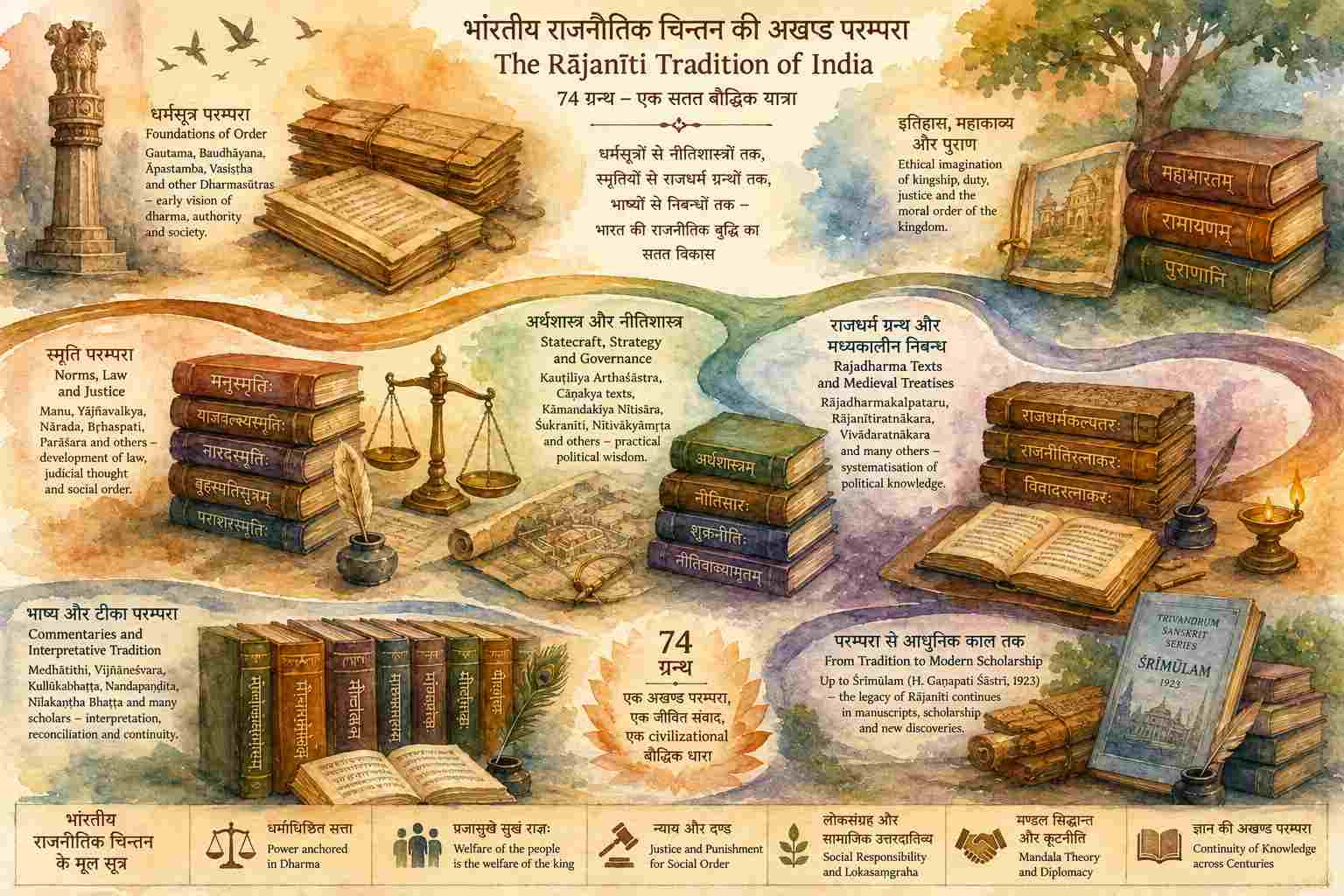
This question matters because Bharat did not develop political knowledge under one single title called “Political Science”. The concerns that we today distribute across political theory, political institutions, jurisprudence, public administration, international relations and political ethics were explored through Dharma, Rājadharma, Daṇḍanīti, Artha, Nīti and Vyavahāra. The seventy-four texts in the Rājanītikāṇḍa tradition allow us to see that journey—not as one fixed theory, but as a conversation that kept developing across centuries.
The story begins before the specialised treatise on statecraft.
(1) Gautama Dharmasūtra (Gautama; c. 2nd–1st century BCE) enters a world in which political authority is already embedded within dharma. The question is not simply who commands, but what order authority is supposed to protect. (2) Hārīta Smṛti (Hārīta; early centuries CE) and (3) Vṛddha Hārīta Smṛti (Vṛddha Hārīta tradition; early medieval tradition) continue this relationship between social obligation, law and authority. (4) Baudhāyana Dharmasūtra (Baudhāyana; c. 2nd–1st century BCE) and (5) Āpastamba Dharmasūtra (Āpastamba; c. 3rd–2nd century BCE) further develop rules of conduct, punishment and social regulation. (6) Vasiṣṭha Smṛti (Vasiṣṭha; c. 1st century BCE–2nd century CE) makes royal responsibility increasingly visible, while (7) Viṣṇu Smṛti (Viṣṇu tradition; c. 4th–7th century CE) brings law, punishment, judicial procedure and royal duty together.
Something important has already happened. Politics has not been separated from society. The ruler does not create dharma; the ruler is expected to protect it. Power therefore carries responsibility. But what happens when that responsibility is placed upon a human being? The answer comes through the great stories.
The (8) Mahābhārata (traditionally Vyāsa; c. 400 BCE–400 CE, with earlier layers) takes us to the ruins of Kurukṣetra. Yudhiṣṭhira has the throne, but victory has not answered the question of how a kingdom should be governed. His conversations with Bhīṣma in the Śāntiparva and Anuśāsanaparva become a vast reflection on rājadharma, daṇḍa, justice, taxation, administration, war and the obligations of the king. Political power is now seen through the difficult task of restoring order after its destruction.
The (9) Vālmīki Rāmāyaṇa (Vālmīki; early centuries BCE/CE) gives us Ayodhyā. Here the political question is embedded in the life of Rāma: What does a ruler owe to the prajā? What happens when personal interest collides with duty? What kind of conduct makes kingship worthy of obedience? The ruler’s character itself becomes politically consequential.
And then comes the question that changes the scale of the discussion: How does a kingdom actually function?
The (10) Kauṭilīya Arthaśāstra (Kauṭilya/Viṣṇugupta; traditionally c. 3rd century BCE; textual formation debated) answers with an extraordinary expansion of political knowledge. The king now stands within an elaborate system of ministers, officials, treasury, agriculture, taxation, trade, intelligence, forts, army, law, diplomacy and relations with other kingdoms. Artha and daṇḍa are examined as practical dimensions of governance, while the maṇḍala gives a systematic way of thinking about relations among states.
The Mauryan memory makes this moment particularly evocative. Magadha had become an imperial power; Chandragupta Maurya built a vast kingdom; and Cāṇakya entered Indian political memory as the strategist associated with that transformation. Whatever questions remain about the precise formation and dating of the surviving Arthaśāstra, the political world it describes is unmistakably one in which administration itself had become an object of systematic knowledge.
But Cāṇakya did not remain confined to one book.
(11) Cāṇakya Sūtrāṇi (Cāṇakya tradition; date uncertain) condenses political wisdom into aphoristic form. (12) Cāṇakya Nītidarpaṇa (Cāṇakya tradition; probably later compilation) turns toward political prudence, human behaviour and practical conduct. (13) Vṛddha Cāṇakya (Cāṇakya tradition; date uncertain) preserves another strand of this political memory. (14) Cāṇakya Nītiśāstra (Cāṇakya tradition; date uncertain) emphasises the psychological and ethical dimensions of political intelligence. (15) Cāṇakya Sārasaṅgraha (Cāṇakya tradition; date uncertain) condenses political principles into digest form, while (16) Laghu Cāṇakya (Cāṇakya tradition; date uncertain) demonstrates how political knowledge could become something memorable and portable. Finally, (17) Cāṇakya Rājanītiśāstra (Cāṇakya tradition; date uncertain) places the political vocation explicitly under the name Rājanīti.
The journey now moves between two complementary questions: How should a ruler behave? And how should the institutions of rule work?
The (18) Manusmṛti (Manu; c. 2nd century BCE–2nd century CE) gives extensive attention to kingship, daṇḍa, taxation, ministers, justice, war and diplomacy. (19) Yājñavalkya Smṛti (Yājñavalkya; c. 3rd–5th century CE) develops a particularly systematic framework through Ācāra, Vyavahāra and Prāyaścitta. The (20) Nāradiya Manusamhitā (Nārada tradition; date uncertain) and (21) Nārada Smṛti (Nārada; c. 4th–6th century CE) bring judicial procedure into sharper focus. (22) Bṛhaspati Sūtra (Bṛhaspati tradition; date uncertain) extends the field toward law, property, economic relations and practical statecraft. The (23) Parāśara Smṛti (Parāśara tradition; date uncertain), (24) Bṛhat Parāśara Saṃhitā (Parāśara tradition; date uncertain), (25) Vṛddha Smṛti (Vṛddha Smṛti tradition; date uncertain) and (26) Āśvalāyana Smṛti (Āśvalāyana tradition; date uncertain) remind us that political order continues to be understood through a larger normative world. The state is not floating above society; governance is intertwined with duty, law and social organisation.
But political memory is also preserved through the Purāṇicas.
The (27) Mārkaṇḍeya Purāṇa (Mārkaṇḍeya tradition; c. 4th–7th century CE, with later layers) connects kingship with dharma and social order. The (28) Matsya Purāṇa (Purāṇic tradition; c. 5th–7th century CE, with later layers) carries discussions of kingship and duties into a wider civilizational setting. The (29) Harivaṃśa (Harivaṃśa tradition; early centuries CE, with later layers) preserves political memory through dynasties, rulers and conflicts.
Then come the enormous Purāṇic worlds of the (30) Skanda Purāṇa (c. 7th–12th century CE, with later accretions), (31) Viṣṇudharmottara Purāṇa (c. 6th–8th century CE), (32) Garuḍa Purāṇa (early medieval, with later layers), (33) Brahmavaivarta Purāṇa (medieval, with later redaction), (34) Agni Purāṇa (c. 8th–11th century CE, with later layers) and (35) Kālika Purāṇa (c. 10th–12th century CE). Here kingship is connected with sacred geography, culture, military knowledge, law, social order and the wider life of the realm. Political education is no longer merely about ruling; it is about understanding the civilisation that is being ruled.
Then the Nīti tradition gathers force.
The (36) Kāmandakīya Nītisāra (Kāmandaka; c. 5th–7th century CE) takes the inheritance of statecraft into a compact framework of diplomacy, alliances, intelligence, war and political measures such as sāma, dāna, bheda and daṇḍa. The (37) Śukranīti (Śukra tradition; date uncertain; received text probably medieval) expands political knowledge into officials, taxation, military organisation, administration and public welfare. The (38) Yogayātrā (Varāhamihira tradition/author uncertain; probably early medieval) represents the technical and strategic side of political knowledge. The (39) Nītivākyāmṛta (Somadevasūri; c. 10th century CE) brings political prudence together with knowledge of human conduct, while the (40) Yuktikalpataru (author and date uncertain; medieval tradition) represents the practical importance of yukti—method, judgement and applied intelligence.
And then comes (41) Mānasollāsa (Someśvara III; c. 1129–1131 CE). Here, under a Western Chalukya king, political knowledge becomes almost encyclopaedic. Kingship is connected with administration, military affairs, economy, food, arts, leisure and courtly life. The ruler must understand not merely how to command an army, but how the kingdom actually lives. Governance becomes a civilizational responsibility.
But now another question demands attention: What happens when the king has to judge a real dispute?
This is where the commentator enters. (42) Viśvarūpa (Viśvarūpācārya; c. 8th–9th century CE) interprets the Yājñavalkya Smṛti. (43) Medhātithibhāṣya (Medhātithi; c. 9th century CE) brings sophisticated interpretation to Manu. (44) Govindarājīya (Govindarāja; c. 11th century CE) continues the interpretative tradition. (45) Mitākṣarā (Vijñāneśvara; c. 11th–12th century CE) makes law, property, inheritance and judicial principles central to the political order. (46) Aparārka (Aparāditya; c. 11th–12th century CE) reorganises inherited legal material, while (47) Rājadharmakalpataru (Lakṣmīdhara; c. 12th century CE) brings royal duties together into an organised rājadharma framework.
This is not merely commentary in the narrow sense. It is political reasoning.
(48) Maskaribhāṣya (Maskarī; c. 12th century CE) returns to Gautama. (49) Mitākṣarā (Haradatta; medieval period) represents the wider Haradatta commentarial network. (50) Ujjvalā (Haradatta; c. 12th century CE) returns to Āpastamba. (51) Manvarthavivṛti (Nandana/Nandananārāyaṇa; c. 12th–13th century CE) revisits Manu, and (52) Mānvarthamuktāvalī (Kullūka Bhaṭṭa; c. 15th century CE) becomes an influential later interpretation of the Manusmṛti.
The political tradition has now acquired a remarkable habit: it remembers by interpreting.
In Mithila, (53) Vivādaratnākara (Caṇḍeśvara; c. 14th century CE) systematically gathers material on disputes and judicial procedure. (54) Rājanītiratnākara (Caṇḍeśvara; c. 14th century CE) turns directly toward kingship, administration and political conduct. (55) Parāśaramādhava (Mādhavācārya; c. 14th century CE) reconciles earlier authorities into a usable legal framework. (56) Dīpikā (Śūlapāṇi; c. 14th–15th century CE) clarifies inherited normative material. (57) Madhvīyacandrikā (Rāghavānanda; after c. 1400 CE) continues the interpretation of Manu, while (58) Nāradiya Manusamhitā Bhāṣya (Bhavasvāmin; date uncertain) extends the Nārada-Manu interpretative stream.
By the time we reach (59) Vīramitrodaya (Mitramiśra; c. 17th century CE), centuries of śāstra have accumulated behind the commentator. Mitramiśra draws upon this enormous inheritance and reorganises it into a mature nibandha. (60) Rājanītiprakāśa (author uncertain; medieval/early-modern period) keeps Rājanīti itself visible as a recognised field of knowledge.
And the story continues.
(61) Vaijayantī (Nandapaṇḍita; c. 17th century CE) interprets the Viṣṇu Smṛti. (62) Nītimayūkha (Nīlakaṇṭha Bhaṭṭa; c. 17th century CE) reorganises political and legal knowledge within the Mayūkha tradition. (63) Rājadharmakaustubha (Anantadeva; c. 17th century CE) places rājadharma explicitly at the centre of inquiry. Kingship remains a specialised intellectual field.
Even as political circumstances transformed, Sanskrit scholarship did not simply disappear.
In the eighteenth and nineteenth centuries, (64) Bālavantī (Payagunde; c. 18th–19th century CE) represents the continued production of Sanskrit juridical scholarship. (65) Nandinī (Govindasvāmin; date uncertain) and (66) Manubhāvārthacandrikā (Rāmacandra; date uncertain) preserve the interpretative engagement with earlier texts. (67) Manubhāṣyādarśa (Govindasvāmin; date uncertain) continues the effort to read Manu as a living intellectual source rather than merely an ancient relic.
The Nīti traditions too continue to live.
(68) Nīlakaṇṭhī (Nīlakaṇṭha; c. 17th century CE) represents the continued interpretation of political and legal material. (69) Jayamaṅgalā (author uncertain; medieval period) preserves the commentary tradition around Kāmandaka’s Nītisāra. (70) Upādhyāyanirapekṣā (commentator uncertain; later period) develops that Kāmandakīya interpretative chain further. (71) Upādhyāyanirapekṣānusāriṇī (commentator uncertain; c. 19th century CE) shows the same conversation surviving into the age of print. (72) Nītivākyāmṛtaṭīkā (commentator uncertain; later period) demonstrates that even political aphorisms themselves became objects of sustained interpretation. And (73) Śukranītiṭīkā (later commentators; early-modern/modern publication tradition) continues the Śukra tradition of administration, kingship and state organisation.
Finally comes (74) Śrīmūlam (H. Gaṇapati Śāstrī; 1923).
Published in the Trivandrum Sanskrit Series, it represents a new stage in the life of the tradition. The old political world of kings, courts and Sanskrit advisers had changed dramatically, but the texts had not vanished. They entered the modern world through editing, publication and scholarship. The conversation moved from manuscript to press, from court to library, but it did not simply end.
And perhaps that is the most important thing this journey reveals. If we look at these seventy-four texts together, political study in Bharat does not appear as a single book waiting to be discovered. It appears as a long conversation.
The first question is dharma: what is the order that authority must protect? Then comes rājadharma: what does the ruler owe to that order and to the prajā? Then daṇḍa: how is order protected when persuasion is insufficient? Then vyavahāra: how is justice actually administered? Then artha: how does the kingdom sustain its material foundations? Then nīti: how does a ruler navigate friendship, enmity, diplomacy, uncertainty and strategy? And finally comes the great commentarial question: how should inherited knowledge be understood when circumstances change?
That is why the seventy-four texts matter. They are not seventy-four repetitions of the same idea. They are seventy-four points along a much longer intellectual journey—from Dharmaśāstra to kingship, from kingship to statecraft, from statecraft to jurisprudence, from jurisprudence to nīti, and from nīti to generations of interpretation.
The story begins long before the modern university created a department called Political Science. And it does not end with Kauṭilya.
It begins with a civilisation asking how political power can preserve order—and continues for centuries with successive generations asking the same question in their own circumstances.
That is the Indian journey of political studies.
Astu!
