
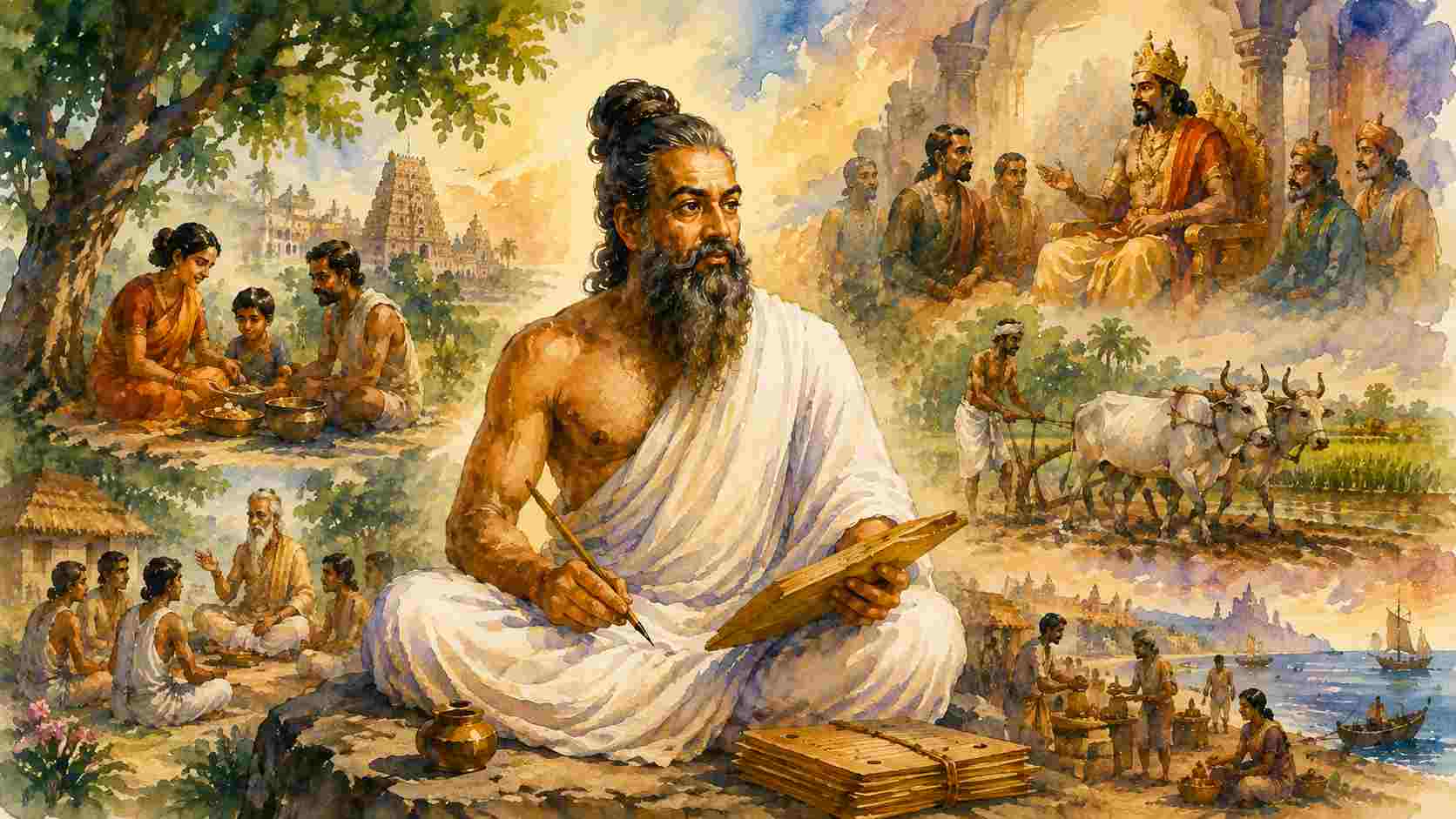
Before the State, There Is the Social World
After reading the Thirukkural as a whole, the first structural question that interested me was surprisingly simple: where does society begin? A modern political analysis might begin with the state, law or institutions. The Thirukkural does not. Before it discusses the king, the minister, the army, the fort or the economy in its great Poruḷ section, it turns to Aṟam.
But Aṟam should not be reduced to “morality.” Its chapters move through renunciation and household life, love, hospitality, gratitude, restraint, friendship, compassion, social obligation and conduct. The sequence suggests that virtue is not merely an inner quality possessed by an isolated individual. It becomes visible through relationships.
The first major social world of the Thirukkural is therefore not the kingdom. It is the household. This is evident in Kural 41, where the householder is defined through relationship:
இல்வாழ்வான் என்பான் இயல்புடைய மூவர்க்கும்
நல்லாற்றின் நின்ற துணைIlvāḻvān eṉpān iyaḷbuṭaiya mūvarkkum
nallāṟṟiṉ niṉṟa tuṇai.“The true householder is the good support of the three who depend upon the natural order of life.”
— Thirukkural, 41
Traditional commentators understand the “three” in different but related ways, referring broadly to those who have renounced worldly life, those in need and those who have died. The significant point is that the household is not imagined as a closed domestic unit existing only for itself. It sustains relationships beyond its own walls.
This becomes even clearer in Kural 43, which identifies several obligations of the householder, including ancestors, divine beings, guests and dependents. Whatever translation one adopts for every term, the structure is unmistakable: the household stands at the intersection of multiple relationships. It looks backward through memory and ancestry, outward towards guests and society, and inward towards those who depend upon it. The home is therefore not merely “private space.” It is an institution through which a larger social world is sustained.
The Thirukkural then gives one of its most important definitions of domestic life:
அன்பும் அறனும் உடைத்தாயின் இல்வாழ்க்கை
பண்பும் பயனும் அதுAṉbum aṟaṉum uṭaittāyiṉ ilvāḻkkai
paṇbum payaṉum atu.“If love and virtue dwell within it, domestic life has both its character and its purpose.”
— Thirukkural, 45
The significance of this verse is easily missed when it is treated simply as a moral quotation. The Thirukkural does not define the household through property, lineage or authority alone. Its quality and its purpose arise through aṉbu—love—and aṟam—right or virtuous conduct.
This is where an Indic Social Studies reading becomes particularly useful. The household is not placed outside society; it is one of the mechanisms through which society is reproduced. Before political order can function, people must learn how to live with one another.
Why Is Hospitality a Social Institution?
The importance of the household becomes even more striking in the chapter on விருந்தோம்பல் (Virundhōmbal), or hospitality. The Thirukkural does not treat the guest as a pleasant addition to domestic life. Hospitality is presented as one of its purposes.
Kural 81 states:
இருந்தோம்பி இல்வாழ்வ தெல்லாம் விருந்தோம்பி
வேளாண்மை செய்தற் பொருட்டுIruntōmpi ilvāḻvatu ellām viruntōmpi
vēḷāṇmai ceytaṟ poruṭṭu.“The whole purpose of maintaining a household and acquiring its means is to receive the guest and extend help.”
— Thirukkural, 81
The word vēḷāṇmai has received different translations, including benevolence, service and assistance. The verse therefore says something more expansive than simply “earn money to entertain visitors.” The material maintenance of the household is connected to the ability to receive and assist others.
This principle becomes more forceful in Kural 82:
விருந்து புறத்ததாத் தானுண்டல் சாவா
மருந்தெனினும் வேண்டற்பாற் றன்றுViruntu puṟattatāt tāṉuṇṭal cāvā
marunteṉiṉum vēṇṭaṟpāṟṟaṉṟu.“With a guest outside, it is not fitting to eat alone, even if what one eats is the nectar of immortality.”
— Thirukkural, 82
The contrast is deliberate. Even amṛta, the imagined food of immortality, loses its moral desirability when consumed in exclusion while another waits outside.
What interested me here was the social logic of the verse. Hospitality transforms food from a private possession into a social relationship. The moral question is not only what one possesses, but whether one can remain a social person while possessing it.
This is why I would hesitate to describe hospitality in the Thirukkural simply as charity. Charity usually implies a distinction between the giver who possesses and the receiver who lacks. Hospitality begins elsewhere. It is based upon the recognition that the household is not complete when it remains permanently closed to the social world.
The verse does not begin with the state redistributing wealth. It begins with the door of the house.
This does not mean that the Thirukkural is offering a modern theory of economic equality. It is not. But it does show that material possession is subjected to a social ethic. Wealth held only for the self is incomplete wealth.
From the Household to Society
The social world of Aṟam expands gradually. The text moves from household life towards gratitude, friendship, social obligation, giving and compassion. Society is not imagined as a collection of isolated individuals entering into a contract with the state. It is built through a dense network of remembered relationships.
This is particularly visible in the treatment of ஒப்புரவு (Oppuravu), often translated as social obligation, equity, reciprocity or duty to society. The very difficulty of translating the term should make us pause. The idea does not sit comfortably within one English category.
The Thirukkural places Oppuravu before the chapter on giving. This sequence is important. Giving is not the beginning of social responsibility; it is one expression of a larger recognition that human life is sustained through mutuality.
Kural 221 then makes a sharp distinction:
வறியார்க்கொன்று ஈவதே ஈகை மற்றெல்லாம்
குறியெதிர்ப்பை நீர துடைத்துVariyārkku oṉṟu īvatē īkai; maṟṟellām
kuṟiyetirppai nīratuṭaittu.“To give something to those in need alone is truly giving; all other giving expects something in return.”
— Thirukkural, 221
The distinction is striking because the verse separates genuine giving from exchange. Not every transfer of wealth is īkai. A gift made with the expectation of return may be useful, but it belongs to another moral category. (superprep)
This becomes one of the larger questions raised by Aṟam: Can society survive merely through exchange?
The Thirukkural suggests that it cannot. Exchange, interest and mutual advantage may have their place, but society also requires forms of relationship that cannot be reduced to calculation. Hospitality, gratitude, compassion and giving create bonds whose value cannot be measured simply through immediate return.
Kural 241 makes the distinction even more explicit:
அருட்செல்வம் செல்வத்துள் செல்வம் பொருட்செல்வம்
பூரியார் கண்ணும் உளAruṭcelvam celvattul celvam; poruṭcelvam
pūriyār kaṇṇum uḷ.“The wealth of compassion is wealth among wealth; material wealth may be found even among the lowly.”
— Thirukkural, 241
The contrast between aruṭcelvam—the wealth of compassion—and poruṭcelvam—material wealth—is important. Material possession is not denied. The Thirukkural is certainly not hostile to wealth. But wealth alone does not establish the quality of a person or society.
The question, then, is not whether society should possess wealth. It is what kind of relationships wealth should sustain.
What Does Aṟam Ask of Society?
By this point, the larger structure of Aṟam begins to emerge. Virtue is not presented as a private achievement detached from the social world. It appears in how one speaks, restrains oneself, receives a guest, remembers a kindness, treats the poor and participates in reciprocal obligations.
This is why the order of the Thirukkural matters. Before the text reaches the king in Poruḷ, it asks whether society possesses the moral capacities required to sustain itself. A ruler can build a fort, command an army and appoint ministers. But no state can easily manufacture hospitality, gratitude, trust or social responsibility after the destruction of the relationships through which they are cultivated.
The Thirukkural therefore begins its social imagination from below. The household precedes the palace. The guest precedes the subject. Reciprocity precedes administration. This does not mean that the household is superior to political life. Poruḷ will eventually make political order the subject of the largest section of the entire text. But the sequence suggests that political power does not create society from nothing. It enters a world already constituted through relationships, obligations and material practices.
This may be one of the most important insights of the Thirukkural for contemporary social studies. Modern disciplines often divide the world into separate fields: ethics belongs to philosophy, the household to sociology, the state to political science and wealth to economics. The Thirukkural moves differently. A household becomes ethical through relationships; hospitality becomes a social institution; giving becomes part of economic life; and compassion becomes a form of wealth.
The categories are distinct, but they are not isolated. That is the intellectual world we must carry into the next part. The Thirukkural will now move towards Poruḷ, its largest division, where the social world encounters political authority. But the question of kingship will look different once Aṟam has been read carefully. We can no longer ask only, who should rule? A prior question has already been established:
What exactly is the ruler ruling over? Not an abstract population. Not an empty territory. But a society already held together by households, relationships, production, obligation and the difficult work of living with others.
