
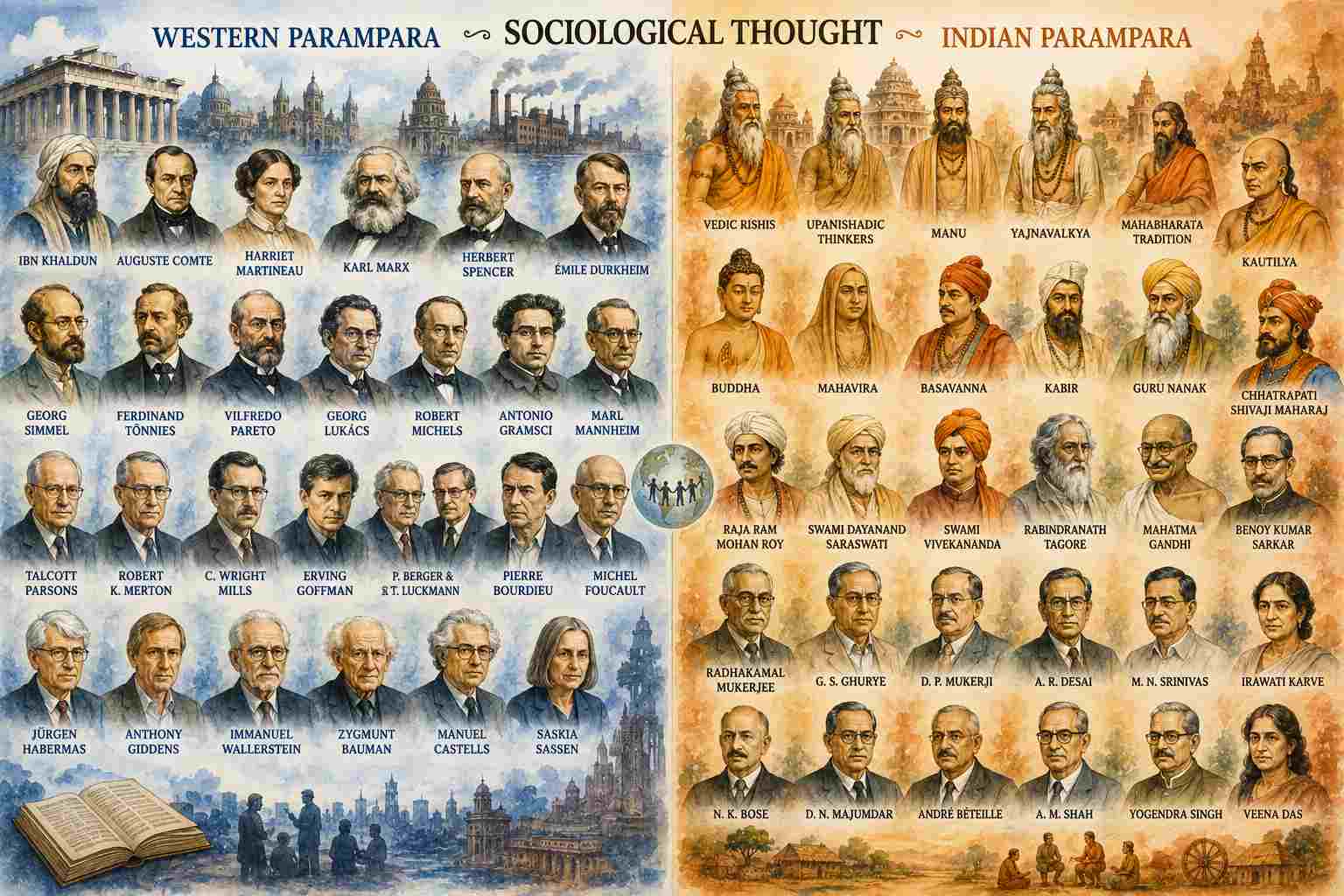
Sociology asks a deceptively simple question: how does society work?
Why do human beings form communities? How do families, castes, classes, religions and institutions emerge? Why does inequality persist? How does society change? Why do some communities remain stable while others transform rapidly?
Modern sociology emerged as a formal academic discipline primarily in nineteenth-century Europe, particularly in response to industrialization, urbanization, capitalism, revolution and the transformation of traditional social structures. However, systematic reflection on society, social order, family, community, inequality, law and collective life is much older.
This list therefore brings together two long paramparas. The Western sociological tradition traces the emergence of sociology as a formal discipline. The Indian tradition includes both classical thinkers and texts concerned with social organization, as well as modern scholars who developed the systematic study of Indian society.
This is not an attempt to claim that ancient Indian thinkers were “sociologists” in the modern university sense. They were not. Nor were the Greek philosophers working with modern disciplinary boundaries. Yet questions concerning society existed long before the discipline called sociology.
The Western Sociological Parampara
1. Ibn Khaldun
Ibn Khaldun is among the earliest major thinkers to develop a systematic explanation of social organization and historical change. His concept of asabiyyah, or group solidarity, explained how cohesive groups rise, establish political authority and eventually decline. He connected social cohesion with geography, economy, power and historical transformation. For this reason, he is frequently regarded as an important precursor to modern sociology.
2. Auguste Comte
Auguste Comte is commonly credited with coining the term sociology. He argued that society should be studied systematically and proposed a “positive” science of society based on observation and scientific inquiry. His theory distinguished between social statics, dealing with order, and social dynamics, dealing with social progress and change.
3. Harriet Martineau
Harriet Martineau was an early social theorist who studied society through institutions, everyday life, morality and inequality. She translated and interpreted Comte while also producing independent observations of social life. Her work is particularly important for bringing attention to women, slavery, morality and the actual social conditions behind formal political ideals.
4. Karl Marx
Marx developed one of the most influential theories of class and social conflict. He argued that social structures are deeply shaped by relations of production and the ownership of economic resources. His theory of historical materialism examined how economic contradictions and class conflict generate social and political transformation.
5. Herbert Spencer
Spencer applied evolutionary ideas to the study of society. He compared society with an organism composed of interdependent parts and studied social evolution and differentiation. Although many aspects of his thought are now criticized, his influence on early functionalism and evolutionary sociology was substantial.
6. Émile Durkheim
Durkheim established sociology as the study of social facts—forces that exist beyond individual preference and exercise influence over human behaviour. He studied division of labour, religion, suicide and social integration. His central concern was how societies maintain cohesion. He distinguished between mechanical and organic solidarity.
7. Max Weber
Weber developed an interpretive approach to sociology. He argued that sociology must understand the meanings individuals attach to their actions. His major contributions include theories of social action, authority, bureaucracy, rationalization, religion and the relationship between culture and economic behaviour.
8. Georg Simmel
Simmel focused on the forms of social interaction. Rather than studying only large institutions, he examined everyday relationships such as exchange, conflict, secrecy, fashion and sociability. His work contributed significantly to urban sociology and the study of small-scale social interaction.
9. Ferdinand Tönnies
Tönnies distinguished between Gemeinschaft and Gesellschaft. The first represented close, personal and community-based relationships, while the second referred to more impersonal and contractual modern society. His framework became central to understanding the transformation from traditional communities to modern social organization.
10. Vilfredo Pareto
Pareto developed important theories of elites and social circulation. He argued that societies are governed by organized minorities and that elites are continually replaced by new elites. His work contributed to the development of elite theory and the sociology of political power.
11. Georg Lukács
Lukács developed Marxist theories of class consciousness and reification. He examined how capitalist structures can make social relationships appear as fixed and impersonal things. His work influenced critical theory and the sociology of ideology.
12. Robert Michels
Michels developed the “iron law of oligarchy.” He argued that large organizations, even those committed to democracy, tend to produce concentrated leadership. His work raised an enduring question: Can large-scale organization remain genuinely democratic?
13. Antonio Gramsci
Gramsci expanded the study of power beyond direct political coercion. His concept of cultural hegemony explained how dominant groups sustain power through institutions, culture, education and common beliefs. He transformed the sociological understanding of ideology and consent.
14. Karl Mannheim
Mannheim developed the sociology of knowledge. He argued that ideas are shaped by social location and historical context. His work examined ideology, utopia and the relationship between knowledge and social structures.
15. Norbert Elias
Elias studied long-term social processes and the transformation of behaviour. His “civilizing process” examined how changing structures of power shaped manners, emotions and self-control. He connected individual behaviour with broader historical processes.
16. Talcott Parsons
Parsons developed structural functionalism as a major sociological framework. Society was understood as a system of interconnected institutions that perform functions necessary for stability and continuity. His work became highly influential in mid-twentieth-century sociology.
17. Robert K. Merton
Merton refined functionalist theory and introduced concepts such as manifest and latent functions. He also developed influential theories of reference groups, strain and middle-range theory. He argued that sociology should develop empirically testable theories rather than rely exclusively on grand abstractions.
18. C. Wright Mills
Mills connected personal experiences with larger social structures through the concept of the sociological imagination. He argued that private troubles often reflect wider public issues. His work also examined power elites and the concentration of institutional power in modern societies.
19. Erving Goffman
Goffman studied everyday social interaction and the presentation of self. His dramaturgical approach compared social life with performance, examining how individuals manage impressions in different situations. He made ordinary interaction a major field of sociological inquiry.
20. Peter Berger and Thomas Luckmann
Berger and Luckmann developed the theory of the social construction of reality. They examined how human practices become institutions and how institutions eventually appear objective and natural. Their work explained the processes through which societies create and reproduce shared realities.
21. Pierre Bourdieu
Bourdieu developed concepts such as habitus, field, social capital and cultural capital. He examined how social structures become embodied in individual behaviour and how inequality is reproduced across generations. His work connected class, culture, education and power.
22. Michel Foucault
Foucault influenced sociology through his analysis of power, knowledge, discipline and institutions. He argued that power does not operate only through the state but also through schools, hospitals, prisons and systems of knowledge. His work expanded sociological analysis beyond traditional political authority.
23. Jürgen Habermas
Habermas developed theories of communicative action and the public sphere. He examined how social coordination can occur through communication and rational dialogue rather than only through power or economic exchange. His work remains central to the sociology of democracy and modern public life.
24. Anthony Giddens
Giddens developed structuration theory. He argued that social structures shape human action, but human action simultaneously reproduces and transforms those structures. His central contribution was to challenge the simple opposition between individual agency and social structure.
25. Immanuel Wallerstein
Wallerstein developed world-systems theory. He argued that individual societies cannot be understood in isolation from a wider global system structured around core, semi-peripheral and peripheral regions. His work connected sociology with global capitalism and historical change.
26. Zygmunt Bauman
Bauman studied modernity, uncertainty and social change. His concept of “liquid modernity” described a world in which institutions, identities and relationships increasingly become fluid and unstable. His work examined the changing nature of social life in contemporary societies.
27. Manuel Castells
Castells studied the relationship between society, information technology and networks. His concept of the network society explained how communication technologies transform economies, power and collective identity. His work is central to the sociology of globalization and digital society.
28. Saskia Sassen
Sassen developed important theories of globalization, migration and global cities. She studied how economic and political processes concentrate in major urban centres while simultaneously producing new forms of inequality. Her work transformed the sociological study of global urbanization.
The Indian Sociological Parampara
Indian sociology requires a broader intellectual approach. The formal discipline emerged in modern universities during the twentieth century. Yet Indian intellectual traditions had long reflected upon social organization, family, kinship, occupation, community, inequality, law and collective order.
The Indian sociological parampara can therefore be understood through two broad streams: classical social thought and modern academic sociology.
Classical and Pre-Modern Indian Social Thought
1. Vedic Social Thought
The Vedic corpus contains reflections on collective organization, kinship, family, community and social differentiation. Terms such as jana, viś, kula, grama and gotra indicate multiple levels of social organization. Social life was understood within broader frameworks of ṛta, dharma, ritual obligation and collective responsibility.
2. The Upanishadic Tradition
The Upanishads explored the relationship between the individual and the larger order of existence. They asked whether human identity could be reduced to social status, bodily existence or external distinctions. Their importance for social thought lies in their deeper inquiry into the relationship between individual identity, consciousness and collective existence.
3. Manu
The Manusmriti provides one of the most systematic classical frameworks concerning family, marriage, inheritance, occupation, life stages and social responsibilities. Its sociological importance lies in its detailed classification of social institutions and norms, although its prescriptions and historical application must be distinguished from one another.
4. Yajnavalkya
The Yajnavalkya tradition dealt extensively with family, property, inheritance, law and social responsibilities. It contributed to the development of normative frameworks governing institutional relationships. Its significance lies in understanding how social institutions are connected with legal and ethical regulation.
5. The Mahabharata Tradition
The Mahabharata provides extensive reflections on kinship, family conflict, political power, social duty and moral dilemmas. The epic repeatedly examines what happens when different social obligations collide. It is particularly important for understanding society as a field of competing relationships rather than a mechanically fixed order.
6. Kautilya
Kautilya’s Arthashastra offers detailed observations concerning occupations, settlements, communities, taxation, migration, labour and social groups. Society is approached through the interaction of political, economic and administrative institutions. The work demonstrates a systematic concern with the practical organization of collective life.
7. Buddhist Social Thought
Buddhist traditions questioned inherited social hierarchy and emphasized the role of conduct rather than birth in evaluating individuals. Buddhist communities also developed distinctive institutional forms through the Sangha. Buddhist literature therefore provides important material concerning social mobility, ethical community and collective organization.
8. Jain Social Thought
Jain thought emphasized non-violence, restraint and the multiplicity of perspectives through anekantavada. Its communities developed distinctive forms of economic, religious and social organization. The tradition is particularly significant for understanding plural perspectives and ethical relationships.
9. Basavanna
Basavanna challenged inherited social hierarchies and emphasized the dignity of labour and equality. His movement also created new forms of community and collective identity. His thought remains significant for the sociology of social reform and occupational identity.
10. Kabir
Kabir strongly criticized caste rigidity, ritual hierarchy and sectarian identity. His thought examined the gap between formal social identity and lived human equality. He remains important for the sociology of popular religion and critiques of institutionalized hierarchy.
11. Guru Nanak
Guru Nanak emphasized equality, collective responsibility, labour and community. The institutions that developed within the Sikh tradition created distinctive practices of collective organization. The Sangat and Langar are particularly significant for the sociological study of community and social equality.
12. Chhatrapati Shivaji Maharaj
The state-building process associated with Shivaji Maharaj involved the mobilization of diverse communities, regions and institutions. His political project cannot be understood without its social foundations. It provides an important historical case of how regional identity, social networks and institutions interact with political power.
Modern Indian Sociological Thought
13. Benoy Kumar Sarkar
B.K. Sarkar was among the early scholars who attempted to develop social theory through engagement with Indian intellectual traditions. He wrote on civilization, social organization, nationalism and comparative sociology. His work represented an early effort to place Indian social thought within wider global sociology.
14. Radhakamal Mukerjee
Radhakamal Mukerjee made major contributions to social ecology, values and the relationship between society and environment. He studied the interdependence of human communities and their ecological surroundings. His work attempted to integrate sociology with broader questions of civilization and human values.
15. G.S. Ghurye
Ghurye was one of the foundational figures of Indian sociology. His research covered caste, tribes, kinship, family, religion and Indian social organization. He played a major role in institutionalizing sociology as an academic discipline in India.
16. D.P. Mukerji
D.P. Mukerji argued that Indian society could not be adequately understood by simply importing Western sociological categories. He emphasized history, tradition and the changing nature of Indian social life. His work remains important for debates about indigenous sociology and the study of social change.
17. A.R. Desai
A.R. Desai developed a Marxist approach to Indian society. He studied nationalism, class, the state and rural transformation. His work examined Indian social and political structures through the relationship between economic change and class formation.
18. M.N. Srinivas
M.N. Srinivas transformed the study of Indian society through detailed fieldwork. His concepts of Sanskritization, Westernization and dominant caste became central to understanding social mobility and power. He demonstrated that caste was neither entirely static nor reducible to formal textual categories.
19. Irawati Karve
Irawati Karve made major contributions to the study of family, kinship, caste and regional diversity. Her work demonstrated that Indian social structures vary significantly across linguistic and geographical regions. She played an important role in connecting anthropology and sociology in the study of Indian society.
20. N.K. Bose
N.K. Bose studied caste, tribes, Hindu society and processes of cultural integration. He was particularly interested in understanding how diverse social groups interacted within larger social and cultural frameworks. His work challenged overly simple assumptions of complete social isolation between communities.
21. D.N. Majumdar
Majumdar contributed to the study of tribes, caste, rural communities and social change. His work emphasized empirical field research and the complexity of social transformation. He helped establish the study of communities as an important component of Indian social science.
22. André Béteille
Béteille made major contributions to the study of caste, class and power. He examined how different forms of inequality intersect and cannot always be reduced to a single social structure. His work is particularly important for comparative analysis and social stratification.
23. Louis Dumont
Dumont’s work on hierarchy and caste generated one of the most influential interpretations of Indian social organization. His theory emphasized the ideological importance of hierarchy and the distinction between purity and impurity. His work remains influential but has also produced extensive criticism and debate.
24. A.M. Shah
A.M. Shah studied family, household, caste and kinship. He demonstrated that the actual structure of households must be distinguished from idealized assumptions about the Indian joint family. His work contributed to a more empirically grounded understanding of family change.
25. T.K. Oommen
Oommen studied identity, social movements, citizenship and pluralism. His work examined how caste, religion, language and ethnicity interact with modern political and social institutions.
He became an important scholar of Indian social diversity and collective identity.
26. Yogendra Singh
Yogendra Singh developed influential work on modernization and social change. He examined how modern institutions interact with inherited cultural and social structures.His concept of the “modernization of Indian tradition” emphasized transformation rather than simple replacement.
27. Ramkrishna Mukherjee
Mukherjee made important contributions to historical sociology and quantitative social research. He examined class, family and demographic change.His work combined empirical analysis with larger questions concerning social structure and historical transformation.
28. Veena Das
Veena Das has contributed significantly to the sociology and anthropology of violence, suffering and everyday life. Her work examines how extraordinary political events enter ordinary social relationships.She has expanded the study of society beyond institutions into the intimate experiences of households and communities.
29. Dipankar Gupta
Dipankar Gupta has written extensively on caste, class, democracy and contemporary Indian society. His work questions simplified assumptions about modernization and social hierarchy.He is particularly concerned with the changing relationship between traditional social categories and modern institutions.
30. Satish Deshpande
Deshpande studies caste, inequality, nationalism and contemporary social structures. His work has contributed significantly to debates about the continuing transformation of caste in modern India.He examines how old social structures persist while simultaneously taking new institutional forms.
Major Sociological Themes Across the Two Paramparas
The Western tradition developed modern sociology around questions generated by industrialization, capitalism, revolution, urbanization and secularization. Its major themes include class, social facts, social action, bureaucracy, capitalism, rationalization, institutions, power, knowledge and social change.
The Indian intellectual tradition encountered a different historical landscape. Social thought developed in relation to kinship, family, community, caste, occupation, dharma, religion, village life and plural social organization. Modern Indian sociology later added systematic study of tribes, caste, class, nationalism, modernization, urbanization, social movements and development.
This difference in historical experience matters. A society can be studied through a factory, a city and a class. But can that alone explain a society organized through family networks, kinship structures, pilgrimage systems, local communities, occupations and civilizational memory? Conversely, can older social categories explain a society transformed by industrialization, democracy, migration and digital networks?
Sociology must therefore continually ask: Which social categories actually emerge from the society being studied, and which are merely imposed upon it?
