A Journey Through the Indian Understanding of the Human Being
Anthropology is young. The university discipline that we know today—with its departments, fieldwork, ethnography, classifications and specialised branches—is largely a product of the modern age. It eventually learnt to divide the human world into societies, cultures, tribes, kinship systems, institutions and belief systems, and then developed methods to observe, compare and interpret them.
But let us pause for a moment. Did the people of Bharat wait for the word “Anthropology” to be invented before they began asking what a human being is and how human beings live together?
Obviously not. The Indian inquiry began somewhere else. It did not begin by placing the human being outside the world and observing him from a distance. It began with a more intimate question: what is this human being who is at once an individual, a member of a family, a participant in a community, a moral agent and a part of the larger order of existence?
That is where the Indic journey begins.
The Ṛgveda (c. 1500–1200 BCE) does not offer us an anthropological textbook. Yet its people are already there—jana, viś, families, kinship, occupations, rituals, relationships and communities. The Puruṣa Sūkta imagines society through the body of the cosmic Puruṣa. Human society is therefore not presented as a random collection of individuals. It is imagined as an interconnected whole. And then the question turns inward.
The Upaniṣads (c. 800–300 BCE) ask: Who am I? Is the human being merely the body? Is consciousness reducible to what can be seen? What is the relationship between the individual ātman and the larger reality? Suddenly, what we might call anthropology has become inseparable from philosophy. The human being cannot be understood merely by measuring his body or recording his customs. One must understand his conception of self.
Then another group of thinkers enters the story.
Gautama Buddha (c. 5th century BCE, Sutta Piṭaka) looks at the human being not primarily as a metaphysical puzzle but as a being caught in desire, attachment, suffering and action. And when the Buddha’s teaching becomes a community, the Saṅgha becomes a remarkable social experiment. Who can enter? How should members behave? What happens when someone violates a rule? How does a community deliberate? How does it preserve itself?
Mahāvīra (c. 6th century BCE, Āgamas) takes the inquiry in another direction. If every living being participates in existence, what does that mean for human conduct? Ahiṃsā, restraint and karma turn the relationship between human beings and other forms of life into a central question.
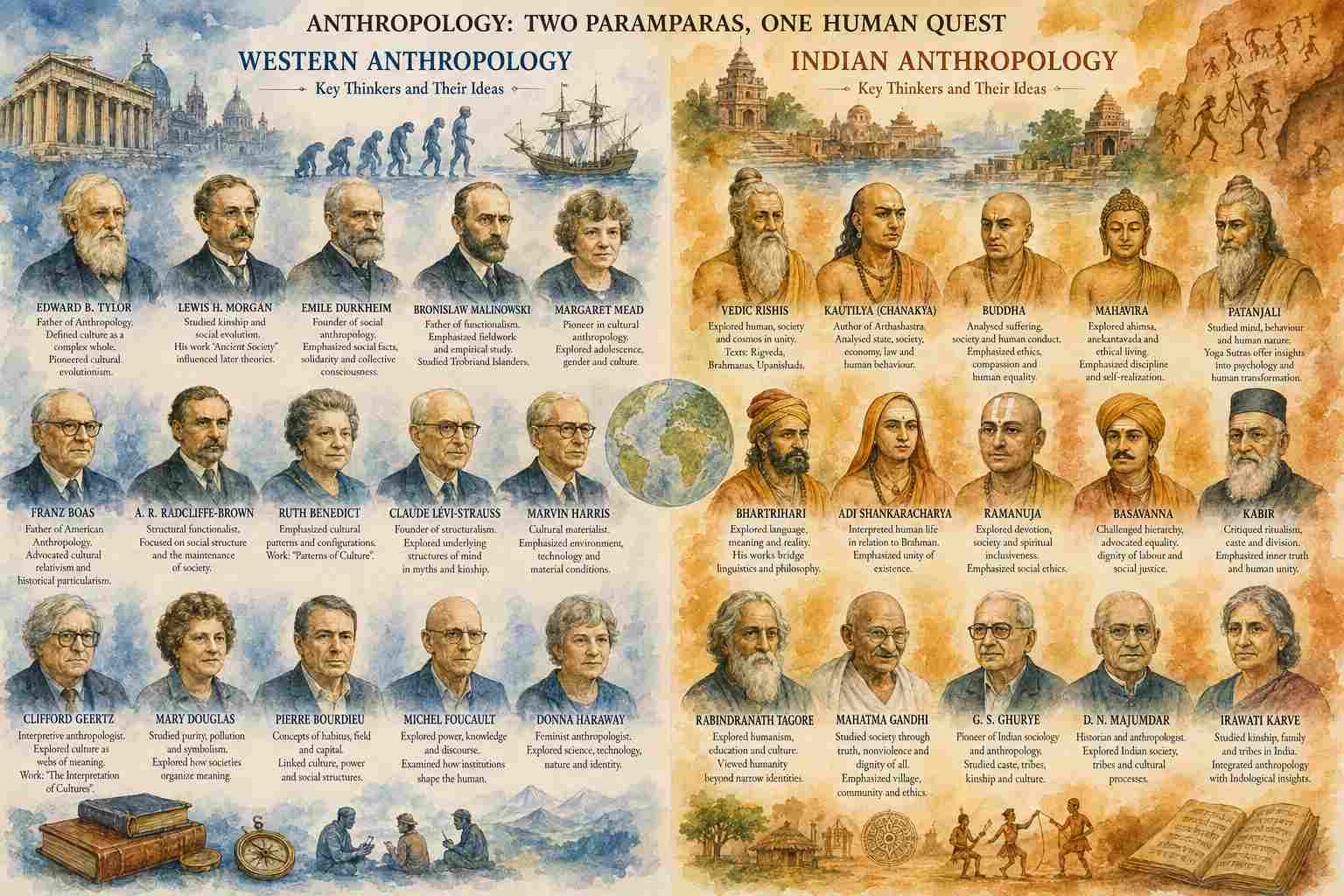
The Indian understanding of society was therefore already moving across several dimensions—self, consciousness, conduct, community and the relationship between human beings and the living world.
Then comes the question that every society eventually has to answer: How do we actually organise ourselves?
Here Kauṭilya (c. 3rd century BCE, Arthaśāstra) enters. And the landscape suddenly becomes extraordinarily concrete. There are villages. Cities. Markets. Farmers. Merchants. Artisans. Forest communities. Officials. Soldiers. Ascetics. Families. Guilds. Economic groups. Different occupations and institutions. Kauṭilya is not sitting outside society describing an imaginary population. He is looking at the machinery of an actually existing civilisation and asking how its different parts work together.
The question has moved from What is man? to How does society function? And then, unexpectedly, a grammarian enters the story. Patañjali (c. 2nd century BCE, Mahābhāṣya) is concerned with grammar. Yet his examples reveal people going about their ordinary lives—occupations, relationships, education, social distinctions and everyday practices.
Why is this important? Because sometimes a civilisation tells us more about itself through the examples it casually uses than through the books it explicitly writes about society.
Then comes Manu (c. 2nd century BCE–2nd century CE, Manusmṛti). Here the social world is drawn with much greater detail: family, marriage, inheritance, occupation, stages of life, duties and social relationships. The central idea is not simply that society exists. It is that society has an order, and that human beings exist within relationships carrying obligations.
Yājñavalkya (c. 3rd–5th century CE, Yājñavalkya Smṛti) continues the journey. Through ācāra, vyavahāra and prāyaścitta, everyday conduct, dispute, social norms and correction become part of a larger understanding of social life.
But the Indian inquiry does not stop with rules. It begins to ask something subtler: How does a society create a shared world of meaning?
For that, we return to language.
Bhartṛhari (c. 5th century CE, Vākyapadīya) takes us into the relationship between language, thought and social existence. Human beings do not merely live together physically. They inhabit worlds of meaning created and communicated through language. And now the story becomes larger than institutions.
The Mahābhārata asks what happens when dharma itself becomes difficult to determine. The Rāmāyaṇa explores family, kingship, loyalty, exile and community. The Purāṇas preserve memories of places, peoples, genealogies, rituals and sacred landscapes. Buddhist Jātakas and Jain narratives preserve another enormous record of occupations, settlements, relationships and social behaviour.
None of these texts calls itself Anthropology. But perhaps that is precisely the point. A civilisation does not need to name a discipline in order to possess knowledge belonging to that field. And then something remarkable happens.
The people being studied begin speaking back to the structures that describe them. In the twelfth century, Basavanna (12th century, Vachanas) questions social distinctions through devotion, work and community. The śaraṇa movement creates a social world in which occupation and spiritual worth are reimagined. Centuries later, Kabir (15th century, Bījak) asks us to look beneath inherited identities. What happens when a human being becomes so completely identified with a social label that the person disappears behind it? And Guru Nanak (1469–1539, Guru Granth Sahib) gives another answer through saṅgat, paṅgat, labour, devotion and seva. Community is not merely a population living in the same place. It can be deliberately created through shared practice.
The question of society has now become a question of how people experience belonging. Then Bharat encounters the modern world. The nineteenth century brings a new intellectual vocabulary. Society begins to be classified, measured and reorganised through modern disciplines. This is also the moment when the Indian tradition has to look at itself through increasingly unfamiliar eyes. Some respond by rejecting inherited practices. Some defend them. Some reform them. Some return to older sources.
Swami Dayananda Saraswati (1824–1883, Satyārth Prakāśa) looks back toward the Vedas and asks what is genuinely foundational and what is merely accumulated practice. Swami Vivekananda (1863–1902, Practical Vedanta) asks a different but related question: if every human being possesses an inner spiritual dignity, what should that mean for society? Service, social responsibility and spiritual realisation become connected. Then comes Rabindranath Tagore (1861–1941, Sādhanā: The Realisation of Life), concerned with the relationship between the individual, society, nature and civilisation. He worries about a society becoming mechanical, because a civilisation that organises human beings without understanding their inner life may become efficient without becoming humane.
And then Gandhi arrives. Mahatma Gandhi (1869–1948, Hind Swaraj) asks the question at the level of civilisation itself. What kind of human being does modern civilisation produce? What happens when progress is measured only through material expansion? What happens to the village, the community, manual work, self-restraint and moral responsibility? For Gandhi, swaraj is therefore not merely independence from a foreign ruler. It begins with the capacity of human beings and communities to govern themselves.
Now we are very close to modern Anthropology.
Sarat Chandra Roy (1871–1942, The Mundas and Their Country, 1912) enters the story as one of the pioneers of systematic ethnographic research in India. He does something crucial: he goes to communities and studies their social worlds closely. The Munda, Oraon and Birhor are no longer merely distant descriptions in administrative records. They become communities whose institutions, customs and lived realities demand serious study. The modern discipline has arrived. But here we must slow down. Because now comes the most important distinction in this entire journey.
Indian anthropology is not automatically Indic anthropology.
A scholar can be born in Bharat and still understand Indian society primarily through Marxism, Western functionalism, structuralism, modernization theory or other imported conceptual frameworks. Likewise, a scholar may use modern methods and still ask questions emerging from Indian categories and civilizational experience. So the criterion is not birthplace. It is the lens.
That is why G.S. Ghurye (1893–1983, Caste and Race in India, 1932), D.N. Majumdar (1903–1960, Races and Cultures of India), N.K. Bose (1901–1972, Culture and Society in India) and Irawati Karve (1905–1970, Kinship Organization in India) have to be read carefully rather than automatically placed into an “Indic” category merely because they studied Indian society.
Their empirical contribution is immense. But the question we must ask is always: what concepts are they using to make Indian society intelligible? That question becomes particularly important with N.K. Bose, whose engagement with Indian cultural integration and Gandhi opens a different route toward understanding Indian society. L.P. Vidyarthi (1931–1985, The Sacred Complex) similarly brings sacred geography, pilgrimage, ritual and social organisation into a common analytical frame. The sacred is not simply removed from social science as an irrational residue; it becomes part of the social world being understood. Surajit Chandra Sinha (1926–2002, Tribe, Caste and Nation) explores the relationship between tribal communities, caste and wider processes of social and political transformation. And then M.N. Srinivas (1916–1999, Religion and Society Among the Coorgs of South India, 1952) gives Indian social reality something particularly valuable: concepts generated from observing India itself.
Sanskritization. Dominant caste. These are not simply Indian examples inserted into somebody else’s theory. They emerged from trying to understand what was actually happening within Indian society. This is an important moment in the story. For if India can generate concepts, then India is no longer merely a field for Anthropology.
It can become a source of Anthropology. S.C. Dube (1922–1996, Indian Village) takes us deeper into village society, while T.N. Madan (1933–2021, Non-Renunciation: Themes and Interpretations of Hindu Culture) examines the relationship between household life, religion and renunciation. A.M. Shah (1939–2020, The Household Dimension of the Family in India, 1973) looks behind the familiar image of the “Indian joint family” and asks what households actually look like when we study them closely. And Veena Das (1945–, Structure and Cognition) takes us into the everyday. Violence, suffering, institutions and large historical processes do not remain in textbooks. They enter homes, relationships, memories and ordinary lives.
By now the journey has travelled an enormous distance. From the Vedic question of the human being within ṛta, to the Upaniṣadic search for ātman; from the Buddha’s examination of human conduct to the Buddhist Saṅgha; from Kauṭilya’s observation of institutions to Manu and Yājñavalkya’s ordering of social relationships; from Patañjali’s glimpses of everyday life to Bhartṛhari’s relationship between language and meaning; from the social questioning of Basavanna, Kabir and Guru Nanak to Vivekananda, Tagore and Gandhi; and finally into the empirical work of modern Indian anthropology. So what, then, is Indic anthropology? It is not simply anthropology conducted in India. It is not a list of Indian anthropologists. It is not the rejection of modern anthropological methods. It is an attempt to begin the study of human beings from an Indian understanding of the human being itself: the individual within relationships, the family within community, the community within civilisation, the human being within nature, and all of these within a moral and meaningful order.
And perhaps the most important question is the simplest. When an Indian village, family, tribe, caste, pilgrimage, ritual or tradition is placed before the anthropologist, must the explanation necessarily come from outside the civilisation being studied? Or can the civilisation itself provide some of the concepts with which it is understood? That is the unfinished journey of Indic anthropology. The modern discipline may have arrived in the nineteenth century. But the Indian conversation about what it means to be human had been going on for millennia.
