
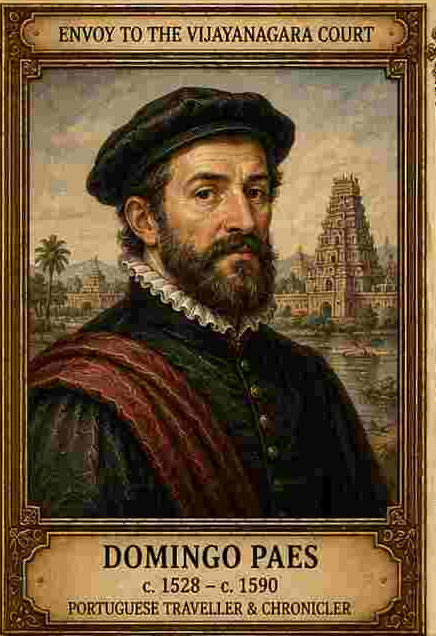
The Portuguese Traveller Who Saw Vijayanagara at the Height of Its Power
There are travellers who pass through a civilization and there are travellers who, almost without intending to, leave behind a description detailed enough for later generations to reconstruct an entire world. Domingo Paes belongs to the second category. He was a Portuguese traveller and merchant who visited the Vijayanagara Empire around 1520–1522, during the reign of Krishnadevaraya, and what he saw was not a declining or exhausted kingdom but Vijayanagara at one of the great peaks of its political, military, commercial and cultural power. His account survives as part of the Portuguese Chronica dos reis de Bisnaga and was translated and published by Robert Sewell in A Forgotten Empire: Vijayanagar. Sewell notes that Paes’s narrative was probably written around 1520–22 and consisted of things he had personally seen and things he had “contrived to learn” about the kingdom of Narsinga. The surviving manuscript is itself a copy rather than Paes’s original, which is an important reminder that even this extraordinary testimony comes to us through a chain of transmission.
What makes Paes extraordinary is the sheer range of things he noticed. He did not merely enter the capital and describe the king; he travelled through the landscape, crossed the mountain ranges separating the coast from the interior, noticed forests and agricultural plains, recorded ports connected to the kingdom, observed irrigation works and water channels, described temples and markets, watched the court of Krishnadevaraya, entered the city, observed its streets and bazaars, and tried to estimate its enormous scale. The result is one of the most valuable external descriptions of Vijayanagara as a living urban civilisation, rather than simply as an imperial capital. And perhaps this is why Paes deserves to be read somewhat differently from Barbosa and Pires: Pires mapped the commercial world; Barbosa recorded institutions; Paes walked through the city itself.
Major Source
Narrative of Domingos Paes
Paes’s account forms part of the Chronica dos reis de Bisnaga, alongside the later narrative of Fernão Nuniz. Robert Sewell published an English translation in A Forgotten Empire in 1900; the National Book Trust later published a separate edition, Vijayanagar: As Seen by Domingos Paes and Fernao Nuniz.
Paes begins his account with a remarkably revealing declaration:
“Of the things which I saw and contrived to learn concerning the kingdom of Narsimga.”
— Domingo Paes, Narrative, c. 1520–22.
That phrase is worth preserving. “I saw” and “contrived to learn.”
There is already a distinction between observation and information obtained from others. For researchers, that distinction is gold.
1. The Journey Begins With Geography
Paes does not begin his account with the king, the palace or even the capital. He begins with the land itself. Travelling inland from the coast, he first encounters the geographical structure through which the kingdom must be entered. He describes the mountain range that separated the coastal territories from the interior:
“This serra runs along the whole of the coast of India, and has passes by which people enter the interior; for all the rest of the range is very rocky and is filled with thick forest.”
After crossing this range, he describes a different geographical world:
“a plain country in which there are no more ranges of hills, but only a few mountains.”
These observations may initially appear to be nothing more than geographical description, but they are far more significant when read together. Paes is, perhaps unintentionally, describing the ecological architecture of the kingdom: the coast, the mountain barrier, the forests, the passes, the interior plateau and the agricultural plains. Movement between these zones was possible through particular corridors, which meant that political geography was shaped partly by physical geography. Vijayanagara did not exist upon an empty map waiting for political power to be drawn upon it. Its political system developed within a landscape that structured movement, defence, agriculture and access to the coast.
The point is worth emphasizing because political history often begins with the ruler, while Paes’s journey reminds us that the ruler himself governed within a geographical world that he did not create. Before the empire could organise territory, territory had already organised certain possibilities of movement. The passes connected the coast to the interior, the forests created barriers, and the plateau opened a different economic and agricultural landscape. Geography was therefore not merely the setting of history. It was one of the conditions through which history became possible.
2. Vijayanagara Was Connected to the Sea
Before Paes reaches the capital, he makes another observation that is essential for understanding the wider structure of the Vijayanagara Empire. He writes:
“The said kingdom has many places on the coast of India; they are seaports with which we are at peace, and in some of them we have factories.”
He then names places including:
“Amcola, Mirgeo, Honor, Batecalla, Mamgalor, Bracalor, and Bacanor.”
This is crucial because Vijayanagara is frequently imagined primarily as an inland power centred upon Hampi. Paes’s account reveals a much wider political and economic geography. The empire was connected through the interior plateau to coastal ports, and these ports linked it to wider networks of merchants, commodities and foreign powers. Goods could move between the coast and the interior, while Portuguese commercial establishments operated in parts of this maritime world.
The empire therefore cannot be understood merely through the ruins at Hampi. The capital was one powerful centre within a much larger territorial and commercial system. Political authority, agricultural production, inland markets, roads, ports and maritime exchange were connected to one another. The sea was not somewhere outside the Vijayanagara world. It was part of the wider network through which the empire acquired commodities, maintained commercial relationships and connected its inland power to the Indian Ocean.
3. The Landscape Was Intensively Cultivated
As Paes moves inland, he repeatedly notices cultivation and irrigation. His account reveals an agricultural landscape that was not simply dependent upon rainfall but had been transformed through human intervention, particularly through tanks, channels and other forms of water management. He records:
“There are many lakes and tanks in this country, and they are made by the kings.”
The precise wording varies across translations and editions, but Paes repeatedly emphasizes the importance of artificial water storage and irrigation. This is among the most important elements of his testimony because it shifts our attention away from the familiar monumental image of Vijayanagara. A civilization is not sustained only by temples and palaces. It is also sustained by the systems through which it captures, stores and distributes water.
The tank was therefore not an incidental engineering object. It stood at the centre of a larger relationship connecting rainfall, storage, irrigation, agriculture, food production, taxation, urban population, military capacity and state power. What appears as a single water structure can therefore become a civilizational institution because its consequences extend far beyond engineering. A large urban population cannot survive on architectural splendour, and an imperial army cannot operate on symbolism alone. Both ultimately depend upon food, while food depends upon ecological conditions and the institutions capable of managing them.
4. The City Was Surrounded by Water Infrastructure
As Paes approaches the capital, his descriptions increasingly reveal the importance of irrigation and water systems. He observes channels carrying water into cultivated areas and describes a landscape in which water had been deliberately managed around the city. This was particularly important because Vijayanagara was situated in a region where water management was not optional. The Tungabhadra and the wider landscape provided the basic geographical foundation, but the urban civilization did not simply accept that environment in its existing form. It modified it.
Water was captured, stored, channelled and distributed for multiple purposes. It supported cultivation and gardens, sustained urban life and formed part of the wider infrastructure of royal and civic spaces. This is where an Indic civilizational approach becomes particularly useful. Instead of asking only, “How rich was Vijayanagara?”, we can ask a deeper question: “What systems made that prosperity possible?” Paes gives us part of the answer by repeatedly directing our attention towards the management of water.
The prosperity visible in markets and palaces was therefore not self-generating. It rested upon systems of ecological adaptation and institutional coordination. Wealth was produced through the interaction of land, labour, water, technology and political organization. The capital’s splendour was visible, but the infrastructures that sustained that splendour were often less dramatic. Civilizational study must recover these systems if it wishes to understand how a city actually worked rather than merely what its monuments looked like.
5. Then He Sees Vijayanagara
When Paes finally reaches the capital, his descriptions become some of the most famous in the entire history of Vijayanagara. He writes:
“The city is as large as Rome.”
Yet this comparison was not his only impression. He also describes Vijayanagara as:
“very beautiful to the sight.”
He sees:
“great streets and many houses”
and observes that the city contains:
“many gardens and groves.”
These descriptions are important because Paes does not encounter a city made only of stone. He sees vegetation, gardens, water, streets, houses, temples, markets and fortifications as parts of the same urban environment. The city is therefore better understood as a combination of built and ecological environments rather than as an accumulation of monuments.
This matters particularly when we encounter Vijayanagara today. The ruins naturally direct our attention towards stone architecture because stone is what survived. Paes, however, encountered a living landscape in which gardens, groves, water, streets and people were inseparable from the built environment. His account reminds us that the visual reality of the city in the sixteenth century was profoundly different from the archaeological landscape through which we now walk.
6. The City Was Not One Fort
Paes’s description of the fortifications is equally important because it reveals that Vijayanagara was not a single compact fortified city in the modern sense. The urban system extended through a complicated landscape of hills, valleys, cultivated areas, settlements and fortified zones. The defensive architecture incorporated the terrain itself.
Rocks could become part of defensive barriers, hills could become defensive positions, valleys could be enclosed and roads could pass through controlled gates. The city did not simply sit upon the landscape while walls were constructed around it. Instead, the landscape itself became part of the military architecture. This was an important advantage because the natural features of the region could be integrated into systems of movement and defence.
Such an urban form again challenges the assumption that a city must be understood as a clearly bounded collection of buildings. Vijayanagara was a territorial urban system extending through multiple ecological and topographical zones. Its military architecture, agricultural landscape and settlements were connected to one another. To study the city only through its monumental centre would therefore be to misunderstand the scale of the system that Paes actually encountered.
7. The Bazaar Was Alive
One of Paes’s greatest contributions is his description of the marketplaces. He encountered long streets filled with shops and merchants, selling commodities that ranged from food and livestock to textiles, jewels and precious stones. He describes one such commercial street in remarkable terms:
“Going forward, you have a broad and beautiful street, full of rows of fine houses … In this street live many merchants.”
He then adds:
“there you will find all sorts of rubies, and diamonds, and emeralds, and pearls, and seed-pearls, and cloths, and every other sort of thing there is on earth and that you may wish to buy.”
This description reveals a city that was not simply a royal capital. It was a commercial organism. The bazaars contained specialised markets, wealthy merchants and high-value commodities, while the streets themselves were animated by economic activity.
This is why Paes is so useful for the study of Hampi. Where we now see ruins, he saw people conducting business. Where we see stone pillars, he saw commercial activity. Where we see empty streets, he saw merchants, customers, animals and crowds. Archaeology gives us the structure that survived, but Paes gives us movement within that structure. His testimony allows us to imagine the economic life that once animated spaces which are now silent.
8. The Jewellers Were Selling in Public
One of the most memorable features of Paes’s description is his account of merchants dealing openly in precious stones. He describes the commercial availability of:
“diamonds, rubies, emeralds, and pearls.”
The significance lies not merely in the presence of luxury commodities. Precious stones existed in many royal treasuries across the world, but Paes was describing their circulation through commercial spaces. Luxury was visible in the bazaar, merchants specialised in particular commodities and customers could participate in markets capable of sustaining high-value exchange.
This tells us something important about the structure of Vijayanagara’s urban economy. The bazaar was not simply a place for subsistence goods. It also contained specialised commercial communities dealing in luxury commodities. Such markets depended upon networks extending far beyond the immediate city because precious stones, textiles and other goods had to move through systems of extraction, production, transport and exchange before they appeared in the streets described by Paes. The public display of such commodities was therefore evidence not only of wealth but also of the commercial complexity that made their circulation possible.
9. The City Had an Extraordinary Density of Activity
Paes repeatedly describes Vijayanagara as a place of extraordinary activity. Its streets contained merchants, artisans, religious specialists, soldiers, women, foreigners, farmers and officials. The urban landscape was therefore socially heterogeneous. This is important because a city becomes a civilizational centre not merely when it possesses many buildings, but when those buildings and institutions create sustained interactions among different social and occupational groups.
The bazaar was one such institution, while the temple was another. The royal court created a different form of interaction, and the street itself functioned as a social space through which different groups moved. The water system connected rural and urban life, while the larger agricultural system sustained the population that filled these spaces. Together these institutions created an urban ecosystem.
Paes therefore allows us to understand Vijayanagara as a dense field of social interaction rather than simply as an imperial administrative headquarters. The city brought together producers, consumers, religious communities, military personnel, merchants and political authorities. Its importance emerged from the relationships between these groups and institutions.
10. Krishnadevaraya
At the centre of this system stood Sri Krishnadevaraya, whom Paes describes in unusually personal terms. He writes:
“The King is of medium height, and has a good figure and a good appearance.”
He further describes him as:
“a man of much justice, but subject to sudden fits of anger.”
These observations illustrate both the value and the limitations of traveller accounts. An inscription may praise a king and a court poem may celebrate his virtues, but a traveller can preserve a more immediate and sometimes idiosyncratic impression. Paes encountered Krishnadevaraya as a visible human figure and recorded characteristics that would rarely appear in the formal language of royal eulogy.
At the same time, his description must not be mistaken for a modern psychological assessment. It is an impression formed by a particular observer under particular circumstances. That is precisely why the source is valuable and why it must be handled carefully. Paes gives us a human image of the emperor, but his testimony remains subjective. Civilizational history becomes stronger when such observations are placed alongside inscriptions, court literature and other forms of evidence rather than allowing one traveller’s impression to become the entire personality of a historical figure.
11. The King Was Accessible to His Nobles
Paes also describes the king’s interactions with nobles and officials, as well as the elaborate ceremonial arrangements of the court. He observed the ruler receiving visitors, conducting affairs and appearing in public. The court therefore functioned as far more than a royal residence. It was an institutional theatre through which political authority was displayed and recognised.
The visibility of the king mattered because political hierarchy had to be communicated through ceremony. The ruler appeared before his nobles, rank was displayed, gifts were exchanged and audiences were granted according to established arrangements. Political authority was therefore embodied in ritual and visibility. The court made the structure of power perceptible.
This reminds us that pre-modern sovereignty depended partly upon what might be called ritual visibility. Authority was not communicated primarily through newspapers, bureaucratic files or electronic media. It had to be experienced through audiences, processions, ceremonies, gifts, spatial arrangements and public appearances. Paes’s descriptions allow us to see these processes in operation.
12. The King Was a Religious Patron
Paes describes Krishnadevaraya’s patronage of temples and his participation in religious ceremonies. This relationship between the king and sacred institutions should not be reduced to the modern category of private religion. Temple patronage involved land, labour, craft, food distribution, ritual, music, art, pilgrimage and multiple forms of economic activity.
The temple could therefore function simultaneously as a religious, economic, cultural and institutional centre. Its importance extended beyond the sanctum and into systems of patronage, employment, landholding and social organization. A ruler’s relationship with temples was thus connected to wider networks of legitimacy and resource distribution.
Paes does not develop a theoretical model of this institutional interconnectedness, but his observations make it visible. The task of civilizational analysis is to place such observations together and ask how these institutions operated as parts of a larger social system.
13. The Festival of Mahanavami
One of the greatest treasures in Paes’s account is his description of the Mahanavami festival. He describes immense public celebrations associated with the royal court, including processions, military displays, elephants, horses, dancers, musicians and offerings. He records that:
“the king is seated on a throne very richly decorated.”
The importance of the festival, however, lies in more than its visual splendour. Mahanavami brought together religious practice, royal ceremony, military display and public spectacle. The army appeared before the population, nobles participated in the ceremony, elephants and horses demonstrated military capacity, performers contributed to the scale of the event and the king occupied the symbolic centre of the entire arrangement.
The festival therefore transformed political authority into a public civilizational performance. It made visible a world in which sacred order, royal power, wealth and military strength were interconnected. The festival was not simply something that happened beside politics. It was one of the ways in which political authority became publicly intelligible.
14. Mahanavami Was Political Theatre
Paes’s description becomes particularly valuable when we examine the political function of Mahanavami. The festival communicated a series of ideas simultaneously: the king was powerful, the kingdom was prosperous, the army was strong, the gods were honoured, the social order was functioning and the court possessed wealth. These messages were not necessarily delivered through a single speech or written declaration. They were communicated through ritual, spectacle, procession, gift, military display and sacred association.
The festival connected Dharma, kingship, military power, wealth and public life. This does not mean that Mahanavami was simply equivalent to a modern political rally, since the institutions and cosmological assumptions were profoundly different. Yet both illustrate a broader principle of political communication: power must become visible in forms that a society can collectively recognise.
Mahanavami did not merely display the ruler to the population. It presented an image of an ordered world in which royal authority occupied a central position. The political function of the festival cannot therefore be separated from its ritual form. Its meaning emerged precisely from the connection between sacred order and public power.
15. The Women of the Court
Paes also describes women associated with the royal household and records their participation in courtly life, religious activity and ceremonial occasions. His testimony should be interpreted carefully because European observers often approached Indian gender relations through assumptions formed within their own social worlds. Nevertheless, the account remains valuable because women appear in his description as participants in visible institutions rather than merely as passive inhabitants of the palace.
They are associated with music, dance, ritual, courtly ceremony and religious institutions. This material should not be used in isolation to construct a complete history of women’s lives in Vijayanagara. Instead, Paes’s observations should be compared with inscriptions, literary sources, architectural evidence and other forms of historical material.
The methodological point is important. A traveller can show us social visibility that an inscription may not emphasize, while inscriptions may provide institutional details absent from a traveller’s narrative. Neither source is complete. Together, however, they allow us to ask more sophisticated questions about the presence and roles of women within royal, ritual and cultural institutions.
16. The City Was Connected to Agriculture
One of Paes’s most important observations is that the prosperity of Vijayanagara rested upon a productive agricultural hinterland. He repeatedly describes cultivation and irrigation around the city. Food was abundant, markets were supplied and the capital could sustain a large population. The relationship between city and countryside was therefore fundamental.
The palace depended upon the farmer, the bazaar depended upon agricultural surplus, the army depended upon food and temples depended partly upon land and donations. The city itself depended upon water. The apparent splendour of the capital was not produced inside palace walls. It was created through an enormous urban-rural system that connected agricultural production to markets, taxation, institutions and consumption.
This is one of the clearest lessons available from Paes. The capital was visible, but the countryside made that visibility possible. Any account of Vijayanagara that focuses only upon royal architecture while ignoring irrigation, agriculture and rural production risks mistaking the visible centre for the entire system that sustained it.
17. Vijayanagara Was Not an Urban Island
This may be one of the most important lessons from Paes’s account. When we see Hampi today, its monumental ruins can tempt us to imagine an isolated imperial city. Paes describes something much more interconnected. Villages, agricultural fields, irrigation systems, markets, roads, ports, the capital, temples and military centres were connected within a much larger network.
The capital was the visible centre of this system, but its existence depended upon relationships extending far beyond it. Agricultural communities produced food, water infrastructure supported cultivation, roads connected different regions, markets redistributed goods and ports connected inland political power to maritime exchange. Temples and military centres were also embedded within this wider geography.
This is why Civilizational Analytics must move beyond the study of monuments. A monument tells us something about what a civilization built, but a network tells us how it lived. The latter question requires us to trace relationships between ecological systems, economic institutions, sacred centres and political power rather than studying each one in isolation.
18. He Saw the Sacred Landscape
Paes visited important temples and sacred spaces around Vijayanagara and records the importance of centres associated with Virupaksha, Vittala and other forms of religious activity. The sacred sites were not isolated buildings standing outside the life of the city. They were connected to roads, markets, festivals and pilgrimage.
A sacred centre could therefore also function as a commercial, cultural and social centre. It could hold land, attract pilgrims and generate forms of economic activity around itself. The modern category “temple” can consequently become too narrow when we attempt to understand its civilizational function. A temple was a sacred institution, but its effects could extend into landholding, patronage, markets, craft production, pilgrimage and cultural activity.
Paes’s account helps us recognise this integration because he encountered a living sacred landscape rather than a collection of archaeological monuments. The sacred and the urban were deeply connected.
19. The Temple and the Bazaar Could Exist Together
One of the most interesting features of Paes’s Vijayanagara is the proximity between sacred and commercial activity. The temple was not necessarily separated from the marketplace in the manner suggested by many modern distinctions between religion and economy. Pilgrims created demand, merchants supplied pilgrims and festivals brought large numbers of people into particular spaces. These people required food, flowers, textiles and ritual objects, while artisans produced goods connected to both ordinary and ceremonial life.
The temple economy therefore interacted continuously with the wider urban economy. This allows us to examine a relationship that is often obscured when modern analytical categories are imposed too rigidly upon earlier societies. Sacred life and economic life were not necessarily separate spheres. They could be institutionally distinct while remaining deeply interconnected through land, patronage, pilgrimage, consumption and production.
The evidence from Vijayanagara therefore encourages us to ask how institutions interacted rather than assuming in advance that each belonged to an entirely separate social domain.
20. The City Was Beautiful Because It Was Alive
Paes repeatedly draws attention to the beauty of Vijayanagara, but what makes his description powerful is that the city’s beauty is not merely architectural. It emerges from the presence of water, trees, gardens, temples, markets, streets, people, animals, music, rituals and movement. The city appears as an ecosystem of human and ecological activity.
This is significantly different from a modern understanding of the city as an arrangement of concrete, roads and administrative zones. Vijayanagara’s beauty emerged partly from the relationship between built and natural environments and partly from the density of life moving through those environments. Gardens were not empty decorative spaces, markets were not abstract economic institutions and temples were not isolated monuments. They existed within a living urban ecology.
Perhaps this is why Paes’s account still feels alive five centuries later. He did not encounter ruins. He encountered life. The stones that dominate our experience of Hampi today were only the physical framework within which an immense social, ecological, sacred and commercial world was moving.
21. He Compared Vijayanagara With Rome
Paes’s comparison with Rome is frequently repeated:
“The city is as large as Rome.”
It is tempting to turn this statement into a literal measurement and debate whether Vijayanagara was actually equal to Rome in area or population. That misses much of its historical value. What matters is that Rome represented a scale available within Paes’s own intellectual world for describing an enormous imperial city.
He needed a familiar point of comparison, and Vijayanagara was sufficiently large, complex and impressive for Rome to become that reference. The comparison therefore tells us something important about the impression the city made upon a European traveller. It should be treated as an observer’s comparison rather than as a modern demographic statistic.
In this sense, the statement is historically valuable precisely because it reveals the limits and structure of Paes’s own geographical imagination. Rome was the scale through which he could communicate the magnitude of Vijayanagara to readers who had not seen it.
22. The Traveller Was Impressed, But He Was Not Neutral
It would be a mistake to treat Paes as a completely neutral observer simply because his account is so valuable. He was a Portuguese traveller moving through a world in which Portuguese commercial and political interests were deeply connected to the larger rivalries between Vijayanagara and the Deccan Sultanates. He had relationships with Portuguese merchants and moved within wider networks of Portuguese activity.
He was therefore not a detached anthropologist recording an unfamiliar society without prior interests or assumptions. His account has a political and commercial context, and that context matters. He selected what he considered important, interpreted unfamiliar institutions through his own vocabulary and wrote for audiences shaped by a different cultural world.
Yet recognizing this does not make his testimony useless. It makes source criticism necessary. The strongest use of Paes is neither blind acceptance nor cynical dismissal. It is comparative reading: asking what he saw, what he misunderstood, what other sources confirm and what his own position enabled him to observe.
23. Yet His Account Is Invaluable
Despite these limitations, Paes remains one of the most important external observers of Vijayanagara because he gives us something that inscriptions cannot easily provide: movement. He tells us how people travelled, what the roads looked like, how the markets functioned, how the city felt, how the king appeared, what occurred during festivals, how water was distributed, what goods were sold and how temples interacted with urban life.
In other words, he gives us a civilization in motion. This is why his account cannot be reduced to a few famous quotations about Rome or royal wealth. His greatest contribution lies in the cumulative picture created when his observations are read together. Mountains lead towards the interior, passes structure movement, water supports cultivation, cultivation sustains urban life, roads connect markets, markets circulate commodities, temples organize sacred activity and festivals bring political power into public visibility.
Paes therefore allows us to reconstruct relationships that would remain difficult to perceive if we relied upon one kind of evidence alone. His narrative moves through the civilization, and that movement itself becomes an analytical advantage.
Why Domingo Paes Matters for Civilizational Studies
Domingo Paes is perhaps the traveller in this series who comes closest to providing a civilizational portrait of a living city. Through him, Vijayanagara emerges not merely as the capital of an empire but as a system in which mountains shaped movement, forests structured geography, water sustained agriculture, agriculture supported the city, markets enabled commerce, temples organized ritual and cultural life, festivals displayed political authority, the army demonstrated imperial power and the king stood at the intersection of these systems.
This is why Paes should not be read merely for his famous statement that Vijayanagara was “as large as Rome.” That is perhaps one of the least interesting things he tells us. The greater treasure lies in the relationships visible throughout his narrative. He allows us to ask how the city worked. What exactly was the source of Vijayanagara’s greatness? Was it simply Krishnadevaraya? Was it the army, the wealth of the bazaar, the temples, the agricultural surplus, the irrigation system, access to the coast or the political organization of the empire?
The answer is uncomfortable for any explanation that seeks a single cause. Vijayanagara’s greatness emerged from all these systems because they were connected to one another. The emperor required revenue, revenue depended upon production, production required water and water management required institutions. The city required food, food required the countryside and the army required resources, including horses that connected inland power to maritime trade. Trade required ports, ports required political security, temples required patronage and patronage sustained cultural institutions. Festivals then brought this wider system into public visibility.
This is precisely the kind of interconnectedness that Civilizational Analytics seeks to recover. Paes did not have this vocabulary, and he did not need to. He simply travelled through Vijayanagara and recorded what he saw. Our task, centuries later, is to ask what those observations reveal when placed together. When we do so, the most striking conclusion is that Vijayanagara was not merely a great city because it possessed great monuments. It was a great city because an enormous network of water, agriculture, commerce, sacred institutions, political authority, military power and cultural life converged there.
The stones are what survived. Paes allows us to see the civilization that once moved among them.
Primary Reference
The quotations in this article are based primarily on the English translation of Domingos Paes’s narrative in Robert Sewell’s A Forgotten Empire (Vijayanagar): A Contribution to the History of India (London, 1900), which presents Paes’s account as written probably between 1520 and 1522. The surviving manuscript tradition and the publication history of the translated chronicle are discussed in Sewell’s prefatory material.
Reference: Robert Sewell, A Forgotten Empire (Vijayanagar): A Contribution to the History of India (London: Swan Sonnenschein & Co., 1900), “Narrative of Domingos Paes,” pp. 235 onward in the original edition. A digitized edition is available through Project Gutenberg while the original-page sequence is also preserved in digitized scans.
