The Traveller Who Moved Through Bharat’s Commercial World Before Becoming Part of the Portuguese Intervention
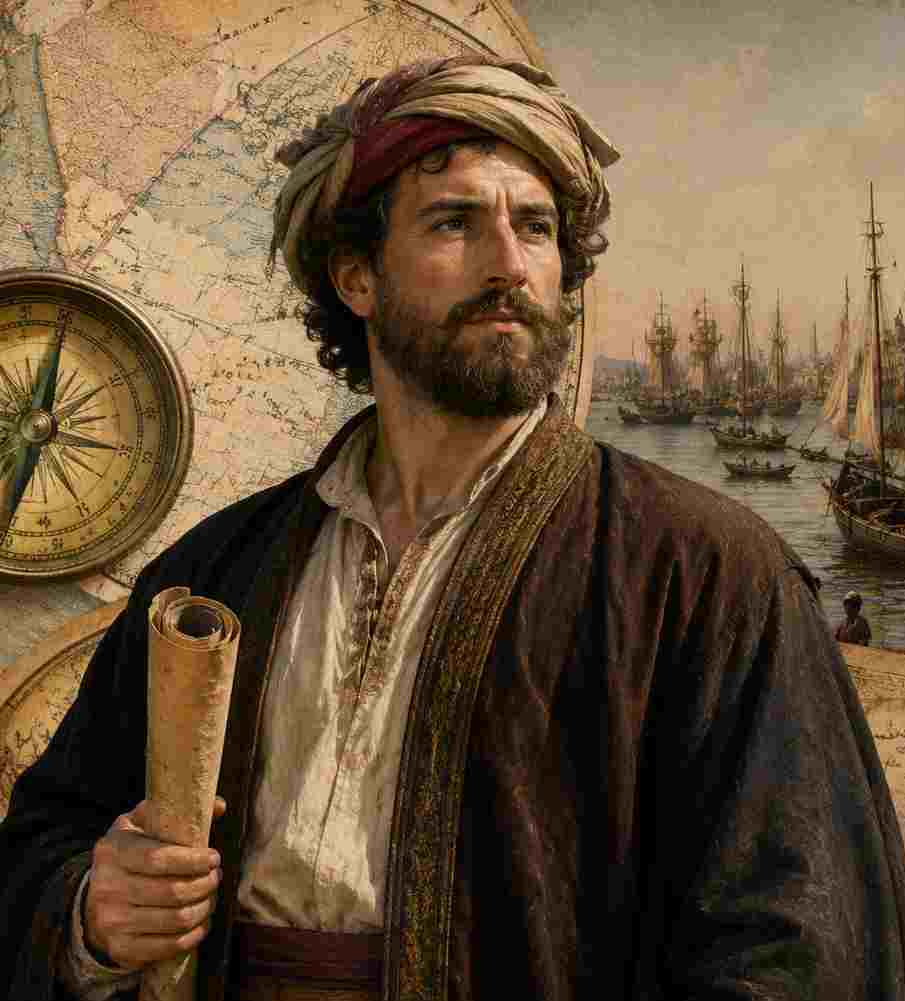
There is something almost cinematic about the journey of Ludovico di Varthema, but the real importance of his travels lies beyond the drama. He did not simply arrive in Bharat as a European observer, pass through a few cities and return home with stories of an unfamiliar land. During his wider journey, he moved through Islamic commercial networks, travelled under an assumed Muslim identity, entered territories and communities through which an openly Christian European might have moved with greater difficulty, visited the world of Vijayanagara, Cambay, Goa, Cannanore and Calicut, and eventually became connected with the Portuguese themselves. A Bolognese traveller and adventurer, Varthema left Europe around 1502–03, travelled through the Middle East and Persia, crossed into the Indian Ocean and reached western India during the first decade of the sixteenth century. His Italian account appeared in 1510, and the major English translation by John Winter Jones was published by the Hakluyt Society in 1863.
What makes Varthema particularly valuable for this series is that he did not remain entirely outside the societies he described. He entered commercial networks, travelled with Muslim merchants, moved between ports and inland political centres, visited Vijayanagara and spent considerable time in and around Calicut. His observations range across elephants, coinage, shipping, spices, ports, trees, agriculture, courts and political alliances. This breadth matters because different observers reveal different dimensions of a civilization. Abdur Razzaq saw Vijayanagara through diplomatic experience, Niccolò de’ Conti through commercial travel, Tomé Pires through the circulation of commodities and information, and Duarte Barbosa through institutions. Varthema, however, gives us the perspective of an unusually mobile traveller who crossed boundaries and, in doing so, encountered the practical systems through which the Indian Ocean world actually functioned.
Yet Varthema also presents a methodological difficulty that cannot be ignored. His mobility was partly enabled by an assumed identity, and his position changed again when he later entered Portuguese service. He therefore appears first as an observer moving through the networks of Bharat and the Indian Ocean and later as a participant in the wider European intervention that was beginning to reshape those networks. His account must consequently be read both for what it reveals and for the position from which it was written. That tension does not diminish the value of the source. It makes the source more historically interesting.
Major Work
The Travels of Ludovico di Varthema in Egypt, Syria, Arabia Deserta and Arabia Felix, in Persia, India, and Ethiopia
Varthema’s principal work was originally published in Italian in 1510. The standard nineteenth-century English edition, translated by John Winter Jones and edited with an introduction and notes by George Percy Badger, appeared as a publication of the Hakluyt Society in 1863. The work is often cited through the shortened title The Travels of Ludovico di Varthema or, in later editions, The Itinerary of Ludovico di Varthema of Bologna from 1502 to 1508. The surviving Hakluyt text remains especially important because its Indian sections move from Cambay and western India through the Deccan and Cannanore towards Vijayanagara and Calicut, before continuing through Ceylon and the eastern Indian Ocean.
The structure of the work itself tells us something important. Varthema was not attached to a single court or city. His itinerary moved through several political and commercial worlds, allowing us to compare Gujarat with the western coast, inland kingdoms with maritime ports and Vijayanagara with the Malabar coast. His account therefore becomes particularly useful when Bharat is studied not as an isolated territorial unit but as a civilizational geography connected simultaneously through land routes, ecological systems and the Indian Ocean.
1. He Came to India Through the Sea
Varthema’s Indian journey followed the wider route that had already connected western India with the Persian Gulf and the Arabian Sea for centuries. After travelling through Persia, he reached Hormuz and crossed towards the western coast of India, moving through commercial centres such as Cambay and ports further south. His route itself is historical evidence. The Bharat he encountered was not approached through a closed frontier beyond which civilization suddenly began. He entered through one of the great corridors of the Indian Ocean, a maritime world through which merchants, horses, spices, textiles, precious goods, travellers and information had long circulated.
This becomes important because the modern map can sometimes make the coastline appear to be the edge of a civilization. For the commercial societies of western and southern Bharat, however, the sea often functioned in the opposite way. The coast was not simply a boundary separating India from the world. It was a zone of connection. Ports opened inland production to overseas markets, while overseas merchants carried goods, technologies and information into the subcontinent. When we begin to look at Bharat from the sea as well as from the land, its historical geography changes. Gujarat appears in relation to Hormuz, Malabar in relation to Arabia and the Red Sea, Cannanore in relation to the horse trade and Calicut in relation to commercial networks stretching far beyond the subcontinent.
Varthema’s journey therefore begins with a basic civilizational lesson: the sea did not make Bharat peripheral to the world; it made large parts of Bharat central to an interconnected world.
2. He Travelled Under an Assumed Muslim Identity
One of the most remarkable features of Varthema’s journey is his adoption of a Muslim identity, including the name Yūnus, during parts of his travels. His assumed identity enabled him to move within Muslim commercial and political networks and travel in the company of Muslim merchants. The implications of this are considerable because the identity under which an observer travels affects what that observer can see. A clearly identifiable European Christian and a traveller accepted as part of a Muslim mercantile world would not necessarily encounter the same people, hear the same conversations or gain access to the same spaces.
This creates a fascinating methodological problem. How much of what Varthema observed was available to him precisely because he was not moving under his real identity? Quite possibly, a great deal. His disguise allowed him to enter social and commercial spaces that might otherwise have been closed or more difficult to access. In this sense, his assumed identity became an unusual and ethically complicated method of observation. It enabled him to travel across boundaries, but it also means that his account must be read with awareness of the particular circumstances under which he acquired information.
The larger point is that knowledge is shaped by access. What a traveller can observe depends partly upon who he is understood to be. Varthema’s testimony is therefore not merely the record of an individual European seeing Bharat. It is the record of a European temporarily moving through Bharat and the Indian Ocean under another social identity.
3. Cambay Revealed a Commercial India
When Varthema reached Cambay, he entered one of the great commercial worlds of western India. His account draws attention to merchants, goods, ships and social practices, while the wider structure of his itinerary makes clear that Cambay was not an isolated port serving a local hinterland. It belonged to a much larger system linking inland production with the Arabian Sea and markets beyond it. In the 1863 Hakluyt edition, the section on “Combeia, a city of India” begins at page 105, placing it within the traveller’s transition from Persia into the commercial geography of western India.
For Varthema, therefore, India could not simply be understood as a land of rulers and monuments. He encountered a commercial system in operation. Goods moved from productive regions towards markets and ports, merchants purchased and redistributed them, ships carried cargoes across the sea and political authorities participated through regulation and customs. Different communities entered the same economic process from different points. Producers, transporters, merchants, sailors, rulers and foreign traders all belonged to the wider chain through which value circulated.
The port was therefore more than a place where ships happened to arrive. It was an institutional meeting point between land and sea, local production and foreign demand, political sovereignty and merchant mobility. This is one of the recurring insights of the traveller accounts: the port was a civilizational institution because it connected worlds that otherwise appear separate on a map.
4. Goa Before Portuguese Goa Became What We Know
Varthema passed through the western coast at a moment of profound transition. His observations belong to the period before the Portuguese conquest of Goa in 1510, but his later journey also brought him into the world of Portuguese military expansion. This chronological position makes his account particularly valuable. He saw the Indian Ocean system before Portuguese power had achieved the position with which it would later become associated, while also witnessing the first stages of Portuguese intervention.
The older commercial order was still functioning. Arab and Persian merchants remained active, Indian ports retained their importance and the commercial networks linking the western coast to the Persian Gulf and beyond were already deeply established. At the same time, Portuguese naval power was beginning to challenge the political arrangements through which commerce had long operated. Varthema therefore stands close to the historical threshold between two maritime orders: one in which commercial power was widely distributed across multiple merchant communities and political authorities, and another in which an expanding European power increasingly attempted to place armed naval force behind commercial ambition.
This is why the familiar phrase that Europeans “discovered” India’s maritime world is historically inadequate. Varthema’s own journey demonstrates the opposite. The Portuguese entered an ocean already filled with routes, ports, merchants and knowledge. What they increasingly attempted to do was control an already functioning system.
5. The Road to Vijayanagara
From Cannanore, Varthema travelled inland towards Vijayanagara, a journey that he describes as taking roughly fifteen days. Once he reached the imperial world of the Raya, his attention moved towards areas that distinguish him from earlier travellers. He did not provide the same kind of extensive architectural description associated with Abdur Razzaq. Instead, he was especially interested in elephants, military practices and currency.
This difference is not a weakness of the evidence. It demonstrates why travellers should be read comparatively. One observer may record urban architecture, another commercial wealth and another military institutions. The same civilization appears differently depending on where the observer stands and what attracts his attention. Three travellers can encounter the same political world and produce three different descriptions because each is looking through a different dṛṣṭi.
For Civilizational Studies, this is methodologically important. No traveller should be treated as the complete representation of Bharat. A source is not the civilization itself. It is a particular window into the civilization. Varthema becomes most useful when his evidence is placed alongside other windows rather than treated as a solitary and complete view.
6. The Elephant Captured His Imagination
Varthema devoted considerable attention to the elephants maintained by the ruler of Vijayanagara, describing their training, uses and importance in warfare. The Hakluyt edition places his discussion of elephants in the chapters around pages 129–131, immediately before the beginning of the work’s second book concerning India.
Yet the elephant is important here for more than its dramatic visual presence. A war elephant represented a large institutional system. It had to be acquired, fed and trained. It required specialized handlers, veterinary knowledge, equipment and substantial resources. A state that maintained elephants for war was not merely possessing unusual animals. It was sustaining a complex relationship between ecology, knowledge, military organization and political power.
When Varthema observed war elephants, therefore, he was indirectly observing state capacity. The animal itself stood at the intersection of several domains. Forest and ecology made the elephant possible, specialized knowledge enabled its training, the economy sustained its maintenance and political institutions converted it into an instrument of war. This is precisely why apparently narrow observations can become important for civilizational analysis. A single elephant can lead us towards the study of an entire system.
7. Vijayanagara’s Currency
Varthema’s observations on the coinage of Vijayanagara are equally significant. The editorial apparatus of the Hakluyt edition compares his monetary observations with those of Abdur Razzaq, who had visited Vijayanagara decades earlier, and points to changes and continuities in the monetary world of the empire, including the continuing importance of the gold varāha or pagoda tradition.
This matters because coins take us beyond travel impressions. A traveller may misunderstand a custom, exaggerate a crowd or rely upon information acquired from others, but coinage can often be compared with surviving material evidence. Numismatics allows us to ask whether the traveller’s description corresponds with objects that still exist. The historian can move from the narrative source towards inscriptions, coins and archaeology and then back again.
This is where Civilizational Studies becomes methodologically stronger. A traveller’s observation does not need to carry the entire weight of an argument. Instead, evidence can be triangulated across different forms of historical material. The traveller describes; the coin survives; the inscription records; archaeology reveals; comparison tests the narrative. The result is more rigorous than simply believing or rejecting the traveller.
8. The King of Vijayanagara and the Portuguese
Varthema makes an intriguing observation about the ruler of Vijayanagara, writing:
“This king is a very great friend of the Christians, especially of the King of Portugal, because he does not know much of any other Christians.”
— The Travels of Ludovico di Varthema, Hakluyt Society edition, 1863, in the section concerning Vijayanagara.
This statement must be read carefully. It does not mean that Vijayanagara had become a Christian state, nor does it suggest that political alliance was determined simply by shared religious identity. What Varthema appears to be describing is the strategic logic of a new political relationship. Vijayanagara possessed powerful rivals in the Deccan, while the Portuguese were emerging as a naval and commercial power whose capabilities could become politically useful.
This is a useful corrective to simplistic civilizational binaries. Political systems often cooperate across religious boundaries when strategic interests converge. The relevant question is not whether two rulers belonged to the same religious category, but what each could gain from the relationship. The Portuguese could provide maritime access and commercial connections, while Vijayanagara possessed territorial power and an interest in balancing rival political forces.
The broader lesson is clear: political history cannot be reduced to religious labels alone. States operate within strategic environments, and those environments often produce alliances that appear contradictory when viewed only through abstract civilizational categories.
9. Calicut: “The Most Noble City”
Varthema devoted more sustained attention to Calicut than to almost any other Indian city in his itinerary. He described it as:
“the very noble city of Calicut”
and referred to the region in language that placed it at the centre of commercial and political importance:
“Having nearly arrived at the head of India, that is to say, at the place in which the greatest dignity of India is centred.”
His language reflects his own geographical imagination and should not be treated as an objective ranking of all of Bharat. Yet it clearly demonstrates the extraordinary importance that Calicut had acquired in the commercial world encountered by a traveller arriving through the Arabian Sea.
The city mattered because it was not merely a coastal settlement. It was a major point of convergence between merchants, ships, rulers, commodities and maritime knowledge. Varthema stayed long enough to describe its court, navigation, trade, religious institutions, military practices and everyday material environment. The 1863 edition devotes extensive sections to Calicut and its society, including chapters on the city, administration, royal palace and the coconut palm.
Calicut therefore becomes a useful reminder that commercial geography can produce forms of urban importance that do not correspond simply to territorial size. A port may become globally significant because it connects multiple worlds, even if its physical territory is far smaller than that of an inland empire.
10. Calicut Was a Maritime Civilization in Miniature
Varthema’s Calicut chapters range across navigation, ships, timber, sails, anchors, seasons of travel, spices, fruits, trade and the social world of the port. The sheer diversity of these subjects is significant. What emerges is not merely a city containing a port. We encounter a maritime society whose different institutions were shaped by one another.
The monsoon shaped the rhythm of navigation. Forests and other ecological resources supplied materials for ships. The sea provided the route of movement. The hinterland produced commodities such as pepper and ginger. Merchants organized exchange and political authority regulated the larger order within which trade occurred. The port became the place where these systems converged.
This is exactly why Calicut cannot be understood adequately through a single category such as “economy” or “city.” Its commercial importance depended upon relationships between ecology, technology, agriculture, navigation, institutions and political authority. Remove one element and the system changes. A port without ships is not a maritime network. Ships without timber and knowledge cannot sustain navigation. Trade without agricultural production has no commodities to exchange. Political authority without the ability to manage commercial relationships may lose the advantages that commerce creates.
Varthema’s Calicut therefore offers a miniature model of civilization as a system of relationships rather than a collection of isolated institutions.
11. The Coconut Tree Was an Entire Economy
One of Varthema’s most revealing descriptions concerns what he calls:
“the most fruitful tree in the world.”
He is referring to the coconut palm, to which the Hakluyt edition devotes a separate chapter beginning around page 163.
The observation may appear ordinary, but it is historically significant because the coconut demonstrates how ecological resources become embedded within a society. Food, drink, oil, fibre, timber, thatching material, rope and containers could all emerge from the same ecological resource. The tree therefore connected the coastal environment with household life, maritime activity and local production.
This is where an ecological perspective becomes essential. The economy does not float above nature as an independent sphere. It emerges through relationships with land, water, climate, plants, animals and human knowledge. The coconut palm became economically significant because generations of communities developed knowledge about how to use it across multiple domains of life.
Varthema therefore provides us with an apparently simple description that opens a much larger civilizational question: how do societies transform ecological abundance into a distributed system of material life?
12. Pepper, Ginger and the Geography of Wealth
Varthema’s attention to the spices of Calicut, especially pepper and ginger, places his account directly within the larger history of the Indian Ocean. Pepper was not merely another agricultural crop. It was a commodity with demand across distant markets, and that demand connected producers in the Malabar hinterland with merchants, ports, ships and commercial communities across Arabia, Persia, Africa and eventually Europe.
This is why the history of a single commodity can become the history of a larger political system. Pepper production connected ecology with agriculture, agriculture with labour and labour with commercial demand. Merchants then connected productive regions with ports, while maritime routes carried the commodity into wider networks of exchange. The desire of European powers to participate in and eventually control these profitable circuits became one of the major factors behind Portuguese intervention in the Indian Ocean.
A pepper vine growing in Kerala could therefore become connected to global politics. That is not a metaphorical exaggeration. The commodity’s journey linked local ecology to international competition. Varthema’s account allows us to see the beginning of that chain, while the later history of Portuguese intervention reveals how commercial demand could become entangled with military and imperial power.
13. Ship-Building Was Indigenous Knowledge
Varthema discusses:
“the manner of navigating in Calicut”
and records the materials and conditions associated with maritime travel, including vessels, timber, sails, anchors and seasonal navigation.
This is particularly important because it challenges the old assumption that the Indian Ocean became historically navigable only after European arrival. The sea was already a space of accumulated knowledge. Communities had developed traditions of ship-building, knowledge of seasonal winds, familiarity with maritime routes and commercial institutions capable of organizing long-distance exchange.
The Portuguese entered this world with their own technologies and military capabilities, but they did not enter an empty technological or navigational space. Varthema’s descriptions are valuable precisely because they record an existing maritime knowledge system at the moment when European powers were beginning to intervene more aggressively within it.
The distinction matters enormously. European arrival introduced a new actor into the Indian Ocean; it did not create the Indian Ocean world.
14. Trade Was Widely Distributed
The wider evidence surrounding Varthema’s itinerary also points towards the importance of smaller ports and intermediate commercial centres. His route does not reveal a world in which all commerce was concentrated in a few giant cities. Instead, it suggests a dense network through which local production could move towards regional markets and from there towards larger maritime centres.
This is important for contemporary civilizational analysis because we often assume that economic development naturally requires increasing concentration into a handful of dominant centres. The historical geography encountered by Varthema suggests another possibility: a polycentric commercial system in which large and small nodes performed different but interconnected functions.
Major ports depended upon smaller ports and inland centres. Smaller centres connected local production with regional exchange. Regional markets then connected with larger maritime routes. The system was integrated not because everything was concentrated in one place but because different places remained connected.
This raises a wider question. Could economic resilience sometimes emerge from the maintenance of many interconnected centres rather than from the concentration of everything into one? Varthema’s journey does not give us a modern economic theory, but it does preserve evidence of a historical geography in which distributed connectivity mattered enormously.
15. The Traveller Became an Actor
Varthema’s historical significance changes further when his journey eventually brought him into Portuguese service. He had begun as an outsider travelling through unfamiliar societies, at times under disguise and through the protection of mercantile networks. Later, however, he became connected with Portuguese operations and the expanding European presence on the Malabar coast. The traveller was no longer only observing history. He was becoming part of one of the forces changing the world he had described.
This gives his account two different historical positions. First, we encounter Varthema as an observer moving through the existing Indian Ocean world. Then we encounter him as someone increasingly connected to Portuguese power. The transition is important because the Indian Ocean was itself undergoing a transition. Merchant networks that had long operated through distributed relationships were now encountering an expanding power increasingly willing to combine commercial ambition with naval force.
Varthema’s biography therefore mirrors, in miniature, a larger historical transformation. He entered Bharat through its existing networks, learned from them, travelled through them and eventually became associated with a power attempting to intervene more directly within them.
16. And Here We Must Read Him Carefully
There is always a temptation to admire an early traveller’s observational ability and then quietly forget the assumptions through which that traveller interpreted the world. Varthema must be read critically because he was a European Christian writing in the intellectual and religious vocabulary of the early sixteenth century. His descriptions of Muslims, Hindus and other communities are valuable, but they can also be shaped by categories and assumptions that belonged to his own world. His later association with the Portuguese adds another layer of complexity.
The right response is neither blind acceptance nor automatic dismissal. We must ask what Varthema observed directly, what he learned from merchants and other informants, what he inferred and what he may have misunderstood. We should also ask how his assumed identity altered his access to information and how his later connection with Portuguese power may have changed his perspective.
These questions do not diminish the source. They make the source more useful because source criticism is not an obstacle to historical knowledge; it is the method through which historical knowledge becomes stronger.
A traveller’s identity is itself part of the evidence. The historian must therefore study not only what Varthema says about Bharat, but also how Varthema became capable of saying it.
Why Ludovico di Varthema Matters for Civilizational Studies
Varthema is important because he arrived at a genuine civilizational crossroads. Vijayanagara remained a powerful political centre. The ports of western and southern Bharat were deeply integrated into the Indian Ocean. Arab and Persian merchants remained active. Indian merchant networks continued to connect regions and communities. Calicut remained a major commercial centre, while the spice trade was thriving. At the same time, Portuguese naval power was beginning to force its way into this existing world.
He therefore gives us evidence not only of what Bharat was but of the world that Europeans were beginning to enter and reshape. His account makes it impossible to sustain the fantasy that Portuguese arrival created connectivity where none had previously existed. What did the Portuguese encounter? They encountered ports, merchants, ships, navigational knowledge, agricultural systems, political alliances, religious institutions and commercial routes that had developed over centuries.
Perhaps the most interesting aspect of Varthema’s own life is that his encounter with Bharat was not one-directional. He came to observe, but the world he entered changed his own journey. He travelled under another identity, moved through its commercial routes, depended upon its merchants, entered its cities, observed its institutions and eventually became entangled with the political forces seeking to transform its maritime world.
This is why the most useful question is not simply, “What did Varthema say about India?” The deeper question is: what did his journey reveal about a Bharat that already possessed the networks, institutions, ecological knowledge and commercial capabilities that arriving European powers first encountered and later attempted to control?
That is where Varthema becomes more than an adventurous traveller. He becomes a witness to a profound historical transition. His account records an Indian Ocean world that was already alive, connected and commercially sophisticated before European maritime dominance had fully transformed its political economy. The Portuguese did not create that world. They entered it, studied it, competed within it and increasingly attempted to control it. Varthema’s importance lies precisely in the fact that he allows us to observe that transition from unusually close range.
Primary Reference
Ludovico di Varthema, The Travels of Ludovico di Varthema in Egypt, Syria, Arabia Deserta and Arabia Felix, in Persia, India, and Ethiopia, A.D. 1503 to 1508, translated by John Winter Jones and edited by George Percy Badger, Hakluyt Society, 1863.
For readers using the Hakluyt edition, the sections on Cambay begin around p. 105, Cannanore around p. 123, elephants around pp. 129–131, the second book concerning India begins at p. 135, the Calicut administration and palace are discussed through the 140s and 150s, and the famous chapter on the coconut as “the most fruitful tree in the world” begins around p. 163. These page locations provide useful anchors for further comparison with the other travellers in this series. (Book)
For Varthema’s place within Civilizational Studies, however, the most important feature of his account remains its movement across different systems. He takes us from the Persian Gulf to western Indian ports, from commercial networks to Vijayanagara’s elephants and currency, from Calicut’s navigation to its coconut ecology and from the existing Indian Ocean order towards the beginnings of Portuguese intervention. Through that movement, he reveals a Bharat that cannot be understood merely through a list of kingdoms. It was a connected civilizational world in which ecology, trade, maritime knowledge, military power, political strategy and social mobility continuously interacted with one another.
