
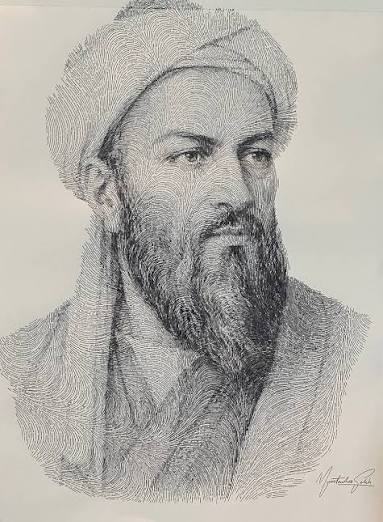
Al-Bīrūnī and the Problem of Understanding Bharat
Among the travellers who came to Bharat, Abū Rayḥān Muḥammad ibn Aḥmad al-Bīrūnī occupies a distinctive place. He was not simply recording unfamiliar customs or describing kingdoms for a distant audience. He attempted to understand Indian civilization through its own intellectual categories. His Kitāb taḥqīq mā li-l-Hind, generally known as Kitāb al-Hind, composed around 1030 CE, covers Indian religion, philosophy, literature, social organisation, law, geography, astronomy, mathematics and customs. His project was therefore much wider than travel writing. It was an attempt to understand how a civilization understood the world and itself.
This makes al-Bīrūnī particularly valuable for Indic Cultural and Social Studies. He understood a problem that remains central to civilizational research: information about a civilization is not the same thing as understanding it. One must engage with its language, concepts, texts and assumptions. Al-Bīrūnī therefore studied Sanskrit and worked with Indian scholars and texts rather than depending entirely upon second-hand reports. His work repeatedly engages with Sanskrit terminology and intellectual traditions.
That methodological choice is perhaps more important than any individual observation he made about India. If we study another civilization only through categories created elsewhere, are we really studying that civilization—or merely studying our own categories projected upon it? Al-Bīrūnī at least understood that the first task was to enter the intellectual world of his subject.
A Civilization Must Be Understood Through Its Ideas
Al-Bīrūnī did not reduce Indian civilization to temples, rituals or social customs. He discussed God, creation, the soul, rebirth, liberation, philosophy, mathematics and astronomy. In his discussion of Indian belief in God, he describes the learned Indians as believing in a Supreme Being who is:
“One, eternal, without beginning and without end, acting freely, all-wise, living, and knowing.”
— Kitāb al-Hind, Chapter II, trans. Edward Sachau.
The importance of this passage is not simply theological. Al-Bīrūnī was attempting to explain an Indian intellectual position to readers who did not share its conceptual vocabulary. He was therefore engaged in an early form of comparative intellectual history. He was asking not merely what Indians believed, but how their beliefs fitted into a larger system of thought.
The same approach appears in his treatment of Indian science. He discusses mathematics, astronomy, measurement and Sanskrit scientific literature, including works such as the Brahmasphuṭasiddhānta. What matters here is that he did not place Indian religion and Indian science into completely separate compartments. Astronomy, mathematics, philosophy, cosmology, calendrical knowledge and religious practice appeared to him as parts of a larger intellectual world.
For civilizational studies, this is an important lesson. The question should not only be, “What did India discover?” It should also be, “Within what larger conception of knowledge did these discoveries acquire meaning?”
When Civilizational Confidence Becomes Insularity
Al-Bīrūnī was not an admirer in the simplistic sense. He could be deeply critical of the people he studied. In one of his most famous observations, he writes:
“The Hindus believe that there is no country but theirs, no nation like theirs, no kings like theirs, no religion like theirs, no science like theirs.”
— Kitāb al-Hind, Chapter I.
This passage should neither be dismissed nor accepted uncritically. It tells us something about al-Bīrūnī’s encounter with particular Indian intellectual circles, but it also reflects his own position as an outsider trying to understand them. Still, the observation raises a question that remains relevant: when does civilizational confidence become civilizational insularity?
A civilization needs confidence in its own categories. Without that confidence, it cannot preserve or develop its intellectual inheritance. But confidence can become a weakness if it turns into an inability to learn, compare or communicate beyond one’s own world. Al-Bīrūnī’s observation is therefore useful not because it proves some permanent characteristic of Indian civilization, but because it invites us to examine the relationship between civilizational self-confidence and intellectual openness.
Text and Society Are Not the Same Thing
His account of varṇa is particularly important for this reason. Al-Bīrūnī describes the four varṇas through the familiar body metaphor, beginning with the Brahmana:
“The highest caste are the Brahmana … created from the head of Brahman.”
He then describes the Kṣatriya, Vaiśya and Śūdra in relation to other parts of the body. But he also makes an observation that complicates any simple reading of the textual model:
“Much, however, as these classes differ from each other, they live together in the same towns and villages, mixed together in the same houses and lodgings.”
— Kitāb al-Hind, Chapter IX.
This is one of the most useful features of the text. Al-Bīrūnī gives us both normative categories and observations about social life. They should not automatically be treated as identical. This distinction is fundamental to the study of Indian society. A text tells us what an author, school or tradition considered desirable, legitimate or normative. Society may follow it, modify it, ignore it or develop practices alongside it. To equate the two is to confuse prescription with practice.
Al-Bīrūnī himself was not a modern sociologist, and his observations are selective. He depended considerably upon Sanskrit texts and learned informants. Yet his account occasionally allows us to see precisely this tension between the ideal described in texts and the society encountered in practice.
The Difficulty of Translating a Civilization
Perhaps the deepest problem in Kitāb al-Hind is the problem of translation. How does one explain mokṣa to someone who has no equivalent concept? How does one explain karma, ātman, varṇa or Indian cosmology without reducing them to categories already familiar to the reader?
Al-Bīrūnī constantly faced this problem. His work is therefore not simply a description of India; it is an encounter between two intellectual vocabularies. Sometimes his comparisons illuminate Indian ideas. At other times they inevitably introduce the assumptions of his own intellectual background.
This is why his work should not be treated as a transparent mirror of medieval India. It is better understood as a mediated encounter. He tells us about India, but he also tells us how an eleventh-century Muslim scholar from Central Asia attempted to make India intelligible to another intellectual world.
That distinction is crucial. Translation is never only about words. It is about worlds of meaning.
Read Al-Bīrūnī, But Read Him Critically
Al-Bīrūnī is sometimes described as an unusually objective observer of India. His intellectual seriousness certainly deserves recognition, but “objective” is not enough. He arrived in India in the context of Ghaznavid expansion. His access to Indian scholars was shaped by the political circumstances of the period, and his understanding depended upon particular Sanskrit texts and informants. Moreover, some of the older translations of his work, including Sachau’s, have been revised by later scholarship, especially in technical passages concerning Indian science.
This is why the right way to use al-Bīrūnī is not as a certificate of truth. A quotation from him should never end an argument. It should begin one.
What exactly did he observe? Which Indian text was he discussing? Was he describing a normative rule or a social practice? Was the passage based on his own observation or on information received from a scholar? What assumptions did he bring to the interpretation? And where does his interpretation differ from the Indian source itself?
These questions do not diminish al-Bīrūnī. They make him more valuable.
The Larger Lesson
Al-Bīrūnī’s greatest contribution may therefore not be any single statement about Indian religion, caste, science or society. It is the methodological problem he leaves behind. He shows that understanding a civilization requires more than collecting facts. It requires language, texts, comparison, conceptual sensitivity and an awareness of the position of the observer.
He studied Indian philosophy as philosophy, Indian mathematics as mathematics, Indian astronomy as astronomy and Indian social organisation through both textual and observational evidence. He tried to understand why Indians thought as they did rather than merely recording what they did.
Yet he also demonstrates the limits of such an undertaking. Even after learning Sanskrit and engaging with Indian intellectual traditions, he remained an outsider. His account is therefore neither simply “the truth about India” nor merely a foreign description to be rejected. It is a historical encounter between two civilizations, and it becomes most valuable when we study both sides of that encounter.
Perhaps that is the question al-Bīrūnī leaves for contemporary Indic Cultural and Social Studies: if understanding a civilization requires learning its language, reading its texts, entering its categories and questioning our own assumptions, why should we expect to understand Bharat through a handful of theories and translated concepts borrowed from elsewhere?
Al-Bīrūnī spent years trying to enter India’s intellectual world. We should take that effort seriously—not by accepting everything he wrote, but by adopting the intellectual discipline that his work demands: first understand the civilization on its own terms; then begin the argument about it.
