
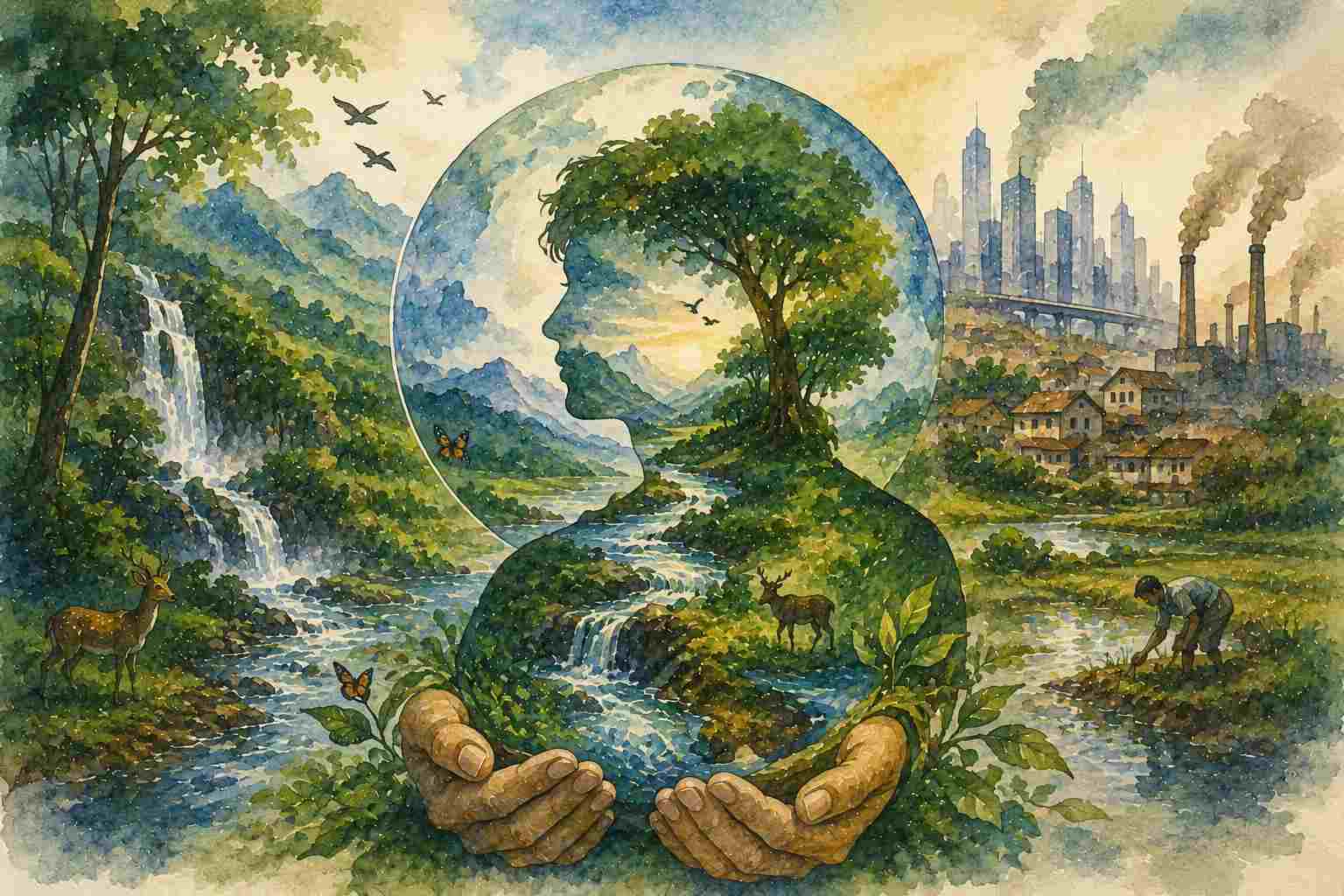
Beyond the Human–Nature Divide
One of the strangest features of modern Environmental Studies is that it often begins with a division that it is later required to overcome: human society is placed on one side and nature on the other. We study forests, rivers, wildlife, biodiversity, climate and natural resources as parts of “the environment”, while cities, economies, industries and institutions belong to the human world. Environmental problems then appear as the consequences of interaction between these two separate spheres. Human beings affect nature; nature provides resources; policy must balance development with environmental protection. But before we discuss how to repair this relationship, should we not first ask whether the original separation itself is intellectually adequate?
After all, where exactly does nature end and human society begin?
A human being is not biologically outside nature. We depend upon air produced through ecological processes, water moving through hydrological systems, food grown from soil, microorganisms, sunlight, plants and other forms of life. Even the most technologically advanced city remains dependent upon ecological systems extending far beyond its concrete boundaries. Yet modern education often creates an artificial distinction: there is human development, and then there is nature, which must be managed, protected or conserved against the consequences of development. This language makes ecological destruction appear to be a conflict between two separate interests when, in reality, the destruction of ecological systems is also the gradual destruction of the material conditions upon which human societies depend.
The American ecologist Aldo Leopold captured this problem in a remarkably simple observation: “We abuse land because we regard it as a commodity belonging to us.” His argument in A Sand County Almanac was not that human beings should withdraw from nature, but that the relationship itself needed to change. He proposed a “land ethic” in which humans would see themselves not as conquerors standing above the ecological community but as “plain member and citizen” of it. This distinction remains deeply relevant. Modern societies have become extraordinarily capable of controlling particular ecological processes, but technological control can create the illusion that dependence has disappeared. We can pump groundwater, genetically alter crops, redirect rivers, build climate-controlled cities and transport food across continents. Yet none of this means that we have escaped nature. It may simply mean that our dependence has become more complex and less visible.
This is one reason the environmental curriculum requires critical examination. Students are often introduced to nature through categories of management: natural resources, resource utilisation, environmental impact, conservation, carrying capacity and ecosystem services. These are useful concepts, but they can also reinforce the idea that the human being is the central actor and nature is the object upon which human intelligence operates. A river becomes primarily a source of water, irrigation, energy and transport; a forest becomes timber, biodiversity, carbon storage or land value. The scientific categories may accurately describe particular functions, yet they can still reduce a living ecological system to the benefits it provides to human society.
The question, therefore, is not whether human beings use nature. Every civilisation does. The deeper question is whether use becomes the principal framework through which nature is understood.
Rachel Carson warned about the dangers of treating ecological systems as though human intervention could be planned without wider consequences. In Silent Spring, she wrote that “nature has introduced great variety into the landscape, but man has displayed a passion for simplifying it.” This passion for simplification is visible not only in ecological destruction but also in education itself. Complex systems are divided into manageable objects: water, forest, soil, minerals, wildlife and atmosphere. Each is assigned to a discipline, ministry or policy framework. But ecological reality does not operate through our academic boundaries. A forest affects water; water shapes agriculture; agriculture affects soil; soil sustains biodiversity; cities depend upon all of them. We can divide these systems intellectually, but the consequences of our actions eventually reunite them.
An alternative ecological starting point is therefore required: human beings are not outside nature but situated within it. This does not mean abandoning the distinction between human society and other ecological processes. Human beings possess distinctive capacities, including technology, language and institutions. Nor does it mean romanticising nature as something automatically harmonious or benign. Nature includes disease, death, competition and ecological disruption. The point is more precise: human civilisation possesses the ability to transform nature, but it does not possess the ability to abolish the ecological conditions of its own existence.
Indic thought offers one important vocabulary for rethinking this relationship. The category of Prakriti cannot simply be translated as the modern “environment”. In philosophical traditions such as Samkhya, it refers to the larger material and dynamic order within which embodied existence occurs. This does not provide a ready-made environmental policy, but it challenges the assumption that nature is merely an external field surrounding human activity. The human being exists within Prakriti, not simply opposite it.
Other civilizational traditions have developed similar insights in different languages. Daoist thought questioned excessive attempts to impose human will upon the natural order, while many Indigenous traditions in Africa and elsewhere understood land through relationships involving community, ancestry, livelihood and responsibility rather than merely through individual possession. These traditions should not be romanticised, nor should they be treated as a single category called “Eastern ecological wisdom”. Every society has transformed its environment. The more important point is that modern Western industrial thought does not possess a monopoly over the intellectual categories through which humanity can understand its relationship with nature.
A genuinely comparative Environmental Studies curriculum should therefore begin not with the assumption that there is one universal relationship between humans and nature, but with a question: how have different societies understood the place of human beings in the larger world? The Western distinction between nature and culture is one intellectual tradition. It should be studied, but not quietly converted into the universal structure of reality. Students should also encounter Prakriti, Daoist ideas of alignment, African ecological worldviews and Indigenous concepts of land and responsibility as intellectual frameworks in their own right.
The consequences of this shift are practical. If human beings are understood as external users of nature, policy will focus primarily on management and efficiency. If human beings are understood as participants within ecological systems, policy must also ask whether those systems can regenerate. Urban planning cannot begin only with how many buildings a city requires; it must ask where its water comes from and what ecological systems make urban life possible. Agriculture cannot be judged only by yield; the condition of the soil and water that sustain future production must also matter. Development cannot be measured only by what it creates while ignoring the systems it consumes in the process.
Perhaps the central problem of the human–nature divide is that it gives us a false picture of environmental responsibility. It suggests that protecting nature is something we do for nature. In reality, protecting ecological systems is also a condition of human continuity. As Carson observed, “In nature nothing exists alone.” Human civilisation is no exception.
The question, then, is not whether humanity should choose between development and nature. That framing has already accepted the idea that they are separate worlds. The deeper question is whether we can create forms of development that recognise a basic reality we have tried to intellectually escape:
Human beings can transform nature, but we can never transform ourselves into beings who no longer depend upon it.
