
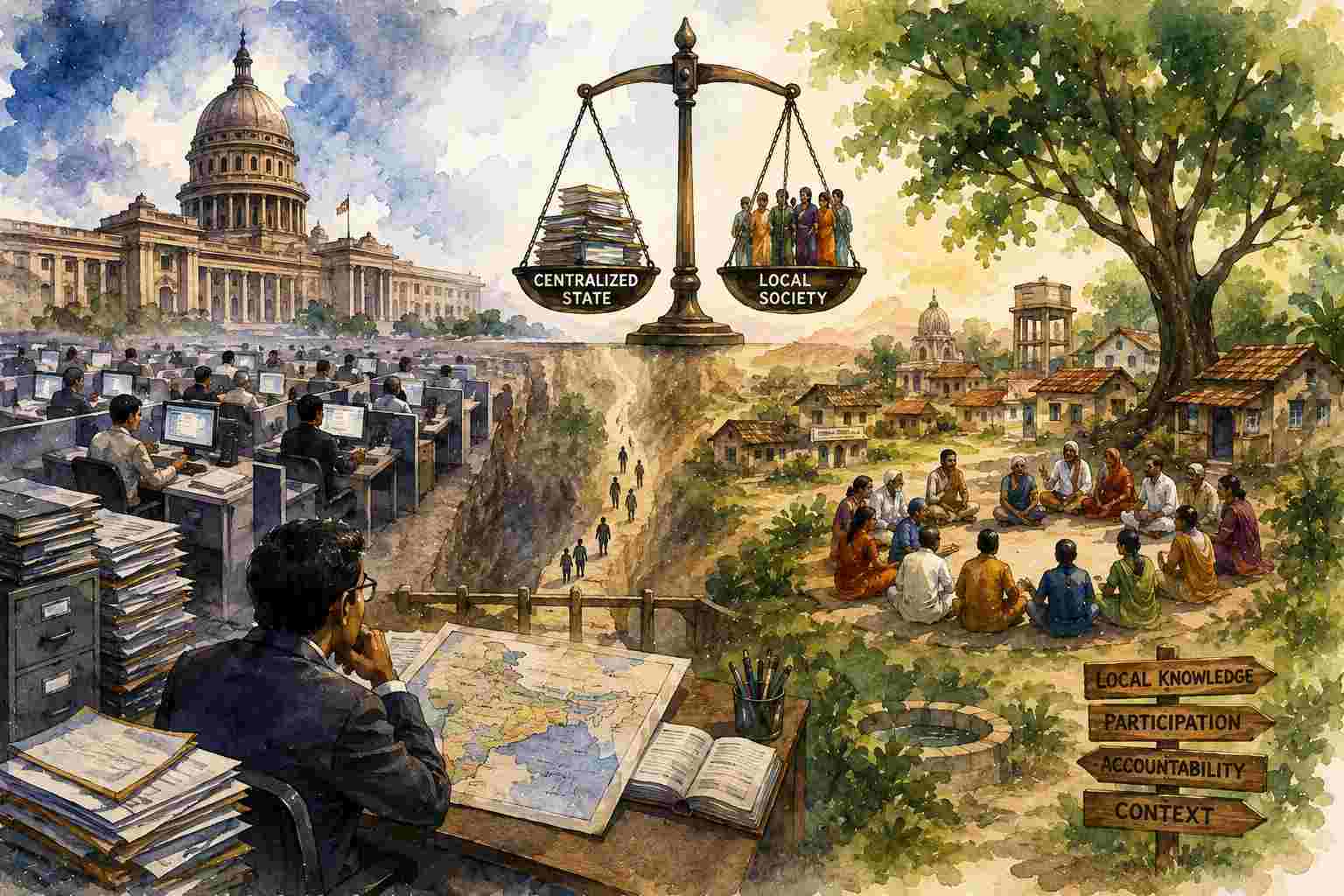
Rethinking the Architecture of Administration
Public Administration emerged as a discipline alongside the rise of the modern state, and its curriculum still carries the intellectual imprint of that history. Woodrow Wilson’s call for a science of administration, Max Weber’s analysis of bureaucracy, Frederick Taylor’s concern with efficiency, and later developments in organisation and management theory all addressed a common problem: how can increasingly large and complex societies be governed systematically? The answer, in different forms, was the creation of administrative structures capable of acting across large territories through rules, hierarchy, expertise and standardised procedures.
These ideas remain indispensable. But the curriculum has often inherited their starting point without sufficiently questioning it. Administration is usually studied from the perspective of the state looking at society. What happens if we also begin with society looking back at the state?
The Administrative Imagination of the Modern State
The modern state cannot function only through personal relationships and local arrangements. It must collect taxes, maintain records, deliver welfare, coordinate infrastructure and respond to crises across large populations. Weber’s bureaucracy provided a powerful model for this task: clearly defined offices, specialised functions, written rules and impersonal decision-making. Such arrangements were meant to replace arbitrary personal authority with predictable administration.
There is a reason bureaucracy became central to modern governance. A state of hundreds of millions cannot administer every case through personal knowledge. It needs categories. Citizens become records, households become units, land becomes survey data and social needs become measurable indicators. Without some degree of abstraction, administration would be impossible.
Yet abstraction creates another problem. The more successfully the state makes society legible, the greater the danger that the administrative description of society begins to replace society itself.
When the Administrative Map Replaces Society
James C. Scott’s idea of “seeing like a state” is particularly important here. States make complex societies governable by simplifying them. This is not necessarily wrong. Administrative action requires simplification. But simplification can become dangerous when officials assume that what can be seen in a register is the whole of social reality.
A village may appear in government records as a population of particular households, landholdings, occupations and income categories. Yet the same village may also contain informal institutions, kinship networks, religious associations, occupational relationships, shared water arrangements and local knowledge that cannot easily be captured in an official form. A policy may therefore be perfectly rational according to administrative data while being poorly adapted to the social world in which it is implemented.
This is one of the central weaknesses of the way Public Administration is often taught. Students learn the machinery of administration, but insufficient attention is given to the limits of administrative knowledge. More data does not automatically mean more understanding. A government may possess detailed statistics about a population and still fail to understand how that society actually functions.
Why Centralization Was Necessary
A critique of centralisation should not become a romantic defence of localism. Centralised administration has clear advantages. It can establish common standards, redistribute resources across unequal regions, coordinate disaster response, protect constitutional rights and prevent local elites from monopolising authority. Some functions simply require action beyond the local level.
B. R. Ambedkar’s critique of the village is essential here. The village cannot automatically be treated as a democratic or harmonious institution merely because it is local. Local society can reproduce caste hierarchy, exclusion and concentrated social power. A higher level of political authority may therefore be necessary precisely to protect individuals against the limitations of local institutions.
This is an important corrective to any simplistic celebration of decentralisation. Local knowledge does not guarantee local justice.
At the same time, centralisation does not guarantee understanding. The question is therefore not whether authority should permanently belong to the centre or the locality, but whether different levels of governance are being assigned functions according to their knowledge, capacity and responsibility.
Gandhi, Ambedkar and the Problem of Local Society
The debate between Gandhi and Ambedkar offers a remarkably rich starting point for a decolonised Public Administration curriculum. Gandhi’s idea of Gram Swaraj imagined political and social life through strong local self-governing communities. His concern was that an excessively centralised state would distance political authority from the people whose lives it governed.
Ambedkar warned that such a romantic image ignored the realities of oppression within village society. For him, democracy could not simply mean transferring power to existing local communities when those communities themselves might deny equality to some of their members.
The importance of this debate is not in deciding who was entirely correct. Its value lies in showing that administrative decentralisation and social justice are separate questions. Public Administration should therefore move beyond the mechanical assumption that decentralisation is always democratic and centralisation is always authoritarian. Both can produce benefits and failures depending upon institutional context.
What Does the Local Actually Know?
The modern administrative tendency towards standardisation creates a persistent problem: a policy designed for everyone may actually understand no one in particular. Bharat is not a socially or ecologically uniform space. Agricultural practices, water conditions, settlement patterns, occupations and social institutions vary enormously across regions. A centrally designed policy may have a legitimate national purpose while still requiring substantial local adaptation.
This is where the principle of subsidiarity becomes useful. Decisions should be taken at the smallest level capable of handling them effectively, while higher institutions should intervene where the problem exceeds local capacity. The question is therefore not merely, “Should power be centralised or decentralised?” but which institution is actually capable of understanding and resolving this particular problem?
Such an approach also requires Public Administration to study institutions that exist outside the modern bureaucratic state. Panchayats, municipalities, community organisations, occupational associations and other forms of collective organisation should not appear merely as examples of “traditional administration”. They should be studied as institutions through which societies have historically organised cooperation and responsibility.
The state does not create society. It governs societies that already possess relationships, institutions and forms of knowledge.
A Decolonized Curriculum of Administration
The deeper problem with the existing curriculum is therefore not that Weber, Wilson or Taylor should be discarded. Their insights remain necessary for understanding the modern state. The problem is that the discipline often begins and ends with the administrative perspective. Society appears as something to be administered rather than as a source of institutional knowledge.
A decolonised curriculum should retain the study of bureaucracy, public policy, organisation theory and governance while asking a wider set of questions. What forms of collective organisation existed outside the modern state? How did different societies manage water, land, conflict and public goods? When should administration standardise, and when should it adapt? How can the state recognise local knowledge without romanticising local power?
These are not questions of nostalgia. They are questions about the limits of administrative distance.
A distant administration can know a society’s population, income, land records and welfare requirements. But can it know how relationships actually function? Can it understand local consequences before they appear in official statistics?
Perhaps the real challenge of Public Administration is not to choose between the state and society, or between centralisation and decentralisation. It is to create an architecture in which the state has the capacity to act at scale without losing the ability to understand the particular societies within which its policies must work.
The strongest administration may not be the one that sees the whole society from the centre, but the one intelligent enough to know what the centre cannot see.
