
When the Past Is Not Stored in One Archive
History asks what happened in the past, when it happened, what evidence survives and how that evidence should be interpreted. Memory asks a different set of questions. What did people choose to remember? How did an event remain meaningful after those who experienced it had died? Why do some ancestors, places, journeys and conflicts remain alive in collective consciousness while others disappear?
Modern historical education often treats these two domains as sharply separate. History belongs to the archive, while memory belongs to the community. History is expected to establish facts; memory is considered subjective, emotional and unreliable. This distinction is useful because memory can indeed transform the past, simplify complex events and occasionally preserve things that cannot be historically verified. Yet the separation becomes problematic when the historian begins to treat memory as though its value ends where documentary certainty becomes difficult.
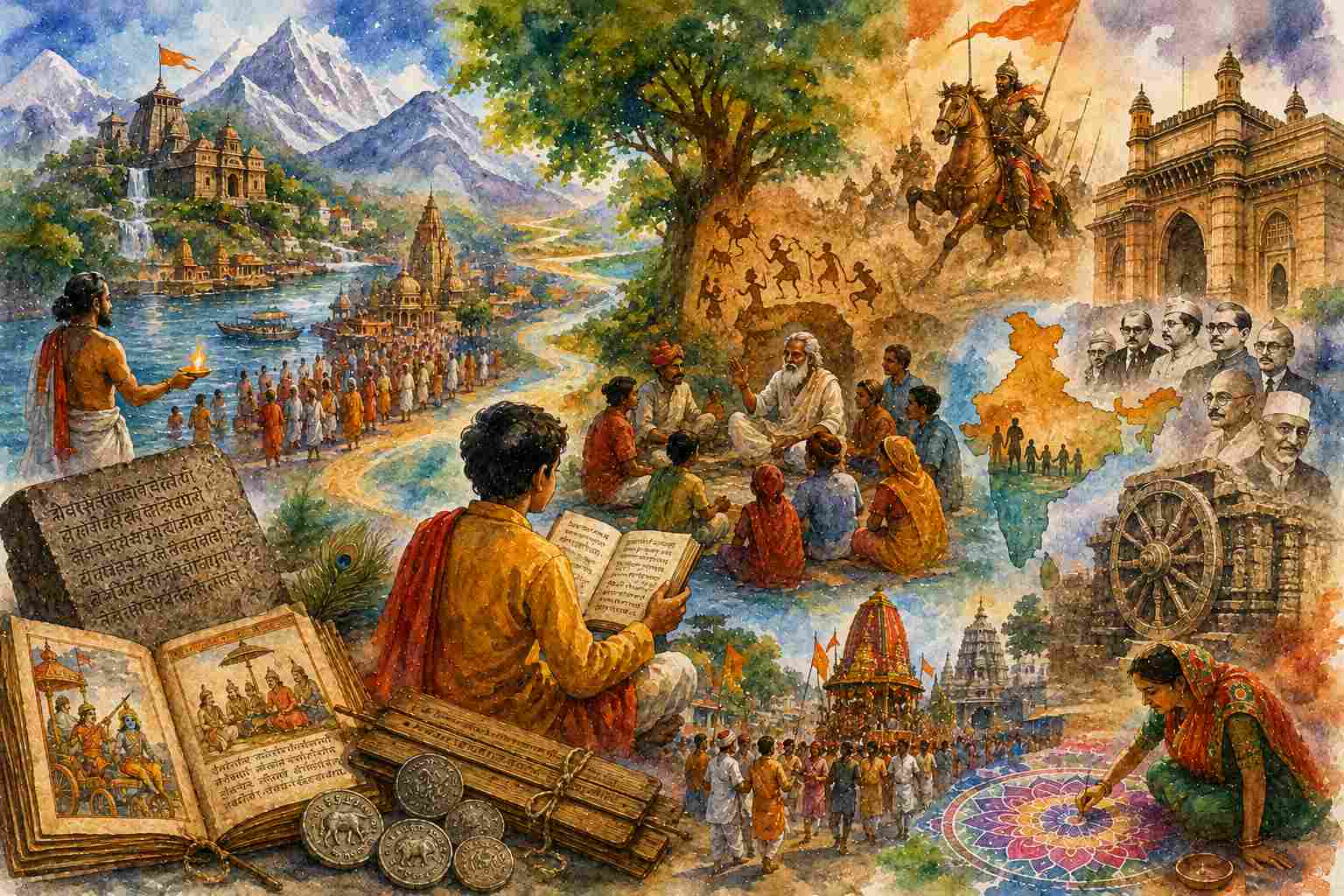
A civilization does not remember itself only through written records. It remembers through stories told to children, journeys repeatedly undertaken, rituals performed across generations, names attached to places, songs sung in moments of crisis, genealogies preserved by communities and landscapes that continue to carry historical meaning. If history asks what happened, memory asks what the past continued to mean. Both questions are essential to understanding civilizational life.
The Indic category of smriti allows us to approach this relationship with greater depth.
Smriti Is More Than Recollection
The Sanskrit word smriti, derived from the root smṛ, literally relates to remembering, but its intellectual significance is much broader than the ordinary act of recollection. In the classical distinction between shruti and smriti, smriti refers to remembered, transmitted and interpreted knowledge. It belongs to a living process of continuity in which knowledge is preserved, taught, reformulated and applied across changing contexts. The Dharmashastra literature is conventionally included within smriti, but the larger idea is important because it shows that memory in Indic thought was not understood merely as a private psychological faculty.
Memory could become social transmission.
This is where smriti becomes useful for thinking about historical consciousness. A civilization does not preserve its past merely by depositing information in an archive. It must remember that past through institutions and practices capable of transmitting it. If a text survives but nobody can read it, the physical object remains but its cultural memory may disappear. If a tradition continues through performance, ritual and collective participation, its historical memory may remain active even when its original written form is lost.
The difference between preservation and transmission is therefore crucial.
The ruins of an ancient city may preserve material history without remaining part of living memory. By contrast, a river, pilgrimage or festival may remain part of collective consciousness for centuries even as its precise historical origins become difficult to establish. The historian must study both without confusing them.
A Community Can Remember What the Archive Does Not
Maurice Halbwachs, one of the major theorists of collective memory, argued that memory is sustained within social frameworks. Individuals remember, but they remember through families, communities and institutions. Later scholars such as Jan Assmann distinguished between everyday communicative memory and forms of cultural memory preserved through texts, monuments, rituals and symbolic practices. These frameworks are useful, but they should not become the only intellectual vocabulary through which we understand memory.
Indic civilization had long developed practices through which memory travelled across generations and geographical space. The Ramayana and Mahabharata, for example, have not survived merely because manuscripts were copied. They survived because they entered performance, ritual, theatre, local traditions, pilgrimage, language and regional retellings. A written text could disappear in one location while the narrative remained alive in performance elsewhere.
This is precisely why simply asking whether an epic is “history” or “mythology” is sometimes methodologically inadequate. The historian must ask a more complex question: what kind of historical memory has this tradition preserved, how has that memory changed and what social worlds has it helped to connect?
The Ramayana is not one archive. Its memory has travelled through Sanskrit, Tamil, Awadhi, Bengali, Assamese, Kannada, Telugu and countless other literary and oral worlds. The historical significance of this continuity cannot be dismissed simply because every element cannot be verified like a modern administrative record. The tradition itself is a historical phenomenon. Its changing versions tell us about language, political imagination, regional identities, devotional movements and civilizational connectivity.
The historian does not need to accept every remembered event literally in order to take memory seriously.
Sacred Geography as Memory
One of the most powerful forms of Indic historical memory is geographical. A river, mountain, temple, kshetra or tirtha can become a site where memory is repeatedly renewed. The geography itself becomes an archive, but not an archive that can be understood by simply reading a document.
Consider a pilgrimage route. Millions of people may travel through the same geographical network over centuries, carrying stories, rituals and memories from one region to another. The physical route changes, political boundaries change and local institutions rise and decline, yet the network continues to create connections.
The Char Dham, the Kumbh Mela, the Jyotirlinga networks and numerous regional pilgrimage circuits illustrate how geographical movement can preserve civilizational memory. The traveller does not merely visit a location. The journey places that location within a larger remembered world.
A river such as the Ganga is similarly more than a geographical feature. It possesses ecological, historical, cultural, religious and social meanings that have accumulated over centuries. A purely physical geography can explain its basin and hydrology; a historical study can examine settlements and political developments; yet neither approach is sufficient if it ignores the immense civilizational memory through which the river has been understood.
This is where the category of smriti becomes useful. The landscape is remembered not because people possess a scientifically exact record of every past event associated with it, but because repeated cultural practices have made the past socially present.
Memory Preserves, but Memory Also Changes
There is, however, a danger in romanticizing collective memory. Memory is not a perfect recording device.
Communities forget. Victories become exaggerated. Defeats are reinterpreted. Heroes are transformed into symbols. Complex conflicts are simplified into stories of good and evil. Later political interests can reshape older memories. The historian must therefore neither accept collective memory uncritically nor dismiss it merely because it is not archival.
The Sindhi experience provides a powerful example of how migration and displacement can create this complex relationship between history and memory. Partition involved a historically documented process of displacement, violence and demographic transformation, but the experience of Partition also survived through family stories, remembered places, religious practices, community institutions and narratives of migration. The community’s memory contains facts that historians may corroborate through documents, but it also contains emotional and cultural meanings that official records cannot fully capture.
A census may record where people lived.
It cannot always record what it meant to lose a homeland.
This distinction is particularly important when communities experience rupture. The Jewish memory of exile, the Armenian memory of displacement, African memories of the slave trade and Indigenous memories of dispossession all demonstrate that historical events continue to exist within communities long after the original event has passed. Their memory may contain transformation and political interpretation, but its continued presence is itself historically significant.
The question is not whether memory should replace evidence. It is how memory should become part of the evidence.
The Colonial Disruption of Memory
Colonialism did not merely conquer territories. It also intervened in the way societies remembered themselves. Colonial knowledge classified communities, translated indigenous categories, divided historical periods and frequently presented the colonized civilization as a people whose past required interpretation through European scholarship.
The result was an extraordinary paradox.
Indians could remember their own historical landscapes, genealogies, pilgrimage networks and cultural traditions, yet the modern academic system often taught them that these forms of memory were not proper historical knowledge until validated through colonial methods.
This did not mean that colonial scholars discovered nothing. Many produced valuable translations, catalogues and archaeological surveys. The problem was one of authority. Indigenous memory became an object to be examined, while European historical categories became the instruments of examination.
Later Marxist historiography challenged colonial political history by focusing on material conditions, class, production and social structures. This produced important scholarship, especially by moving beyond kings and dynasties. Yet a different reduction could occur when memory, religion and civilizational continuity were interpreted primarily as ideological expressions of material relations.
The problem is not that historians should study material conditions. They must. The problem arises when civilizational memory is treated as historically significant only if it can be reduced to another structure.
A pilgrimage is not merely economic exchange, although economies develop around it. A sacred narrative is not merely political ideology, although it can have political consequences. A ritual is not merely social control, although institutions can use it to regulate behaviour.
Historical phenomena often have several dimensions simultaneously.
The decolonization of History requires us to resist every intellectual framework that begins by deciding in advance what a civilization is allowed to mean.
When a Civilization Forgets
What happens when a civilization forgets its past?
It does not necessarily become free from the past. The past remains embedded in language, geography, institutions and inherited social structures. What disappears is the ability to understand those inheritances.
This produces what might be called historical dependence. A society that loses its own categories of memory becomes increasingly dependent upon external narratives to explain who it has been. Its history may continue to be written, but the fundamental vocabulary of interpretation may no longer emerge from its own civilizational experience.
This is not an argument for living permanently in the past. Civilizations must also forget certain conflicts, reform unjust institutions and reinterpret inherited traditions. Memory can become destructive when it turns every past grievance into a permanent political weapon. A civilization cannot live only through memory.
But neither can it survive without memory.
A person who loses memory loses continuity between past and present. A civilization that loses memory experiences something similar. It may retain territory and population while losing the ability to explain why its institutions, symbols and cultural relationships exist.
Historical consciousness therefore requires a balance. We must remember critically, not blindly; examine tradition without contempt; and distinguish between historical evidence and civilizational memory without pretending that only one of them matters.
Perhaps that is the deepest significance of smriti.
The past is not always something behind us. Sometimes it survives within us—transmitted through language, stories, places, rituals and relationships that connect one generation with another. The historian must investigate that survival critically, because memory can distort. But the historian must also investigate it seriously, because a civilization that dismisses every inherited memory as irrational may eventually discover that it has preserved the archive while losing the consciousness of what the archive was meant to remember.
The real question, therefore, is not simply what happens when a civilization remembers.
It is who teaches it what is worth remembering, who decides which memories are legitimate and whether the civilization still possesses the intellectual confidence to examine its own memory before another tradition explains that memory for it.
