
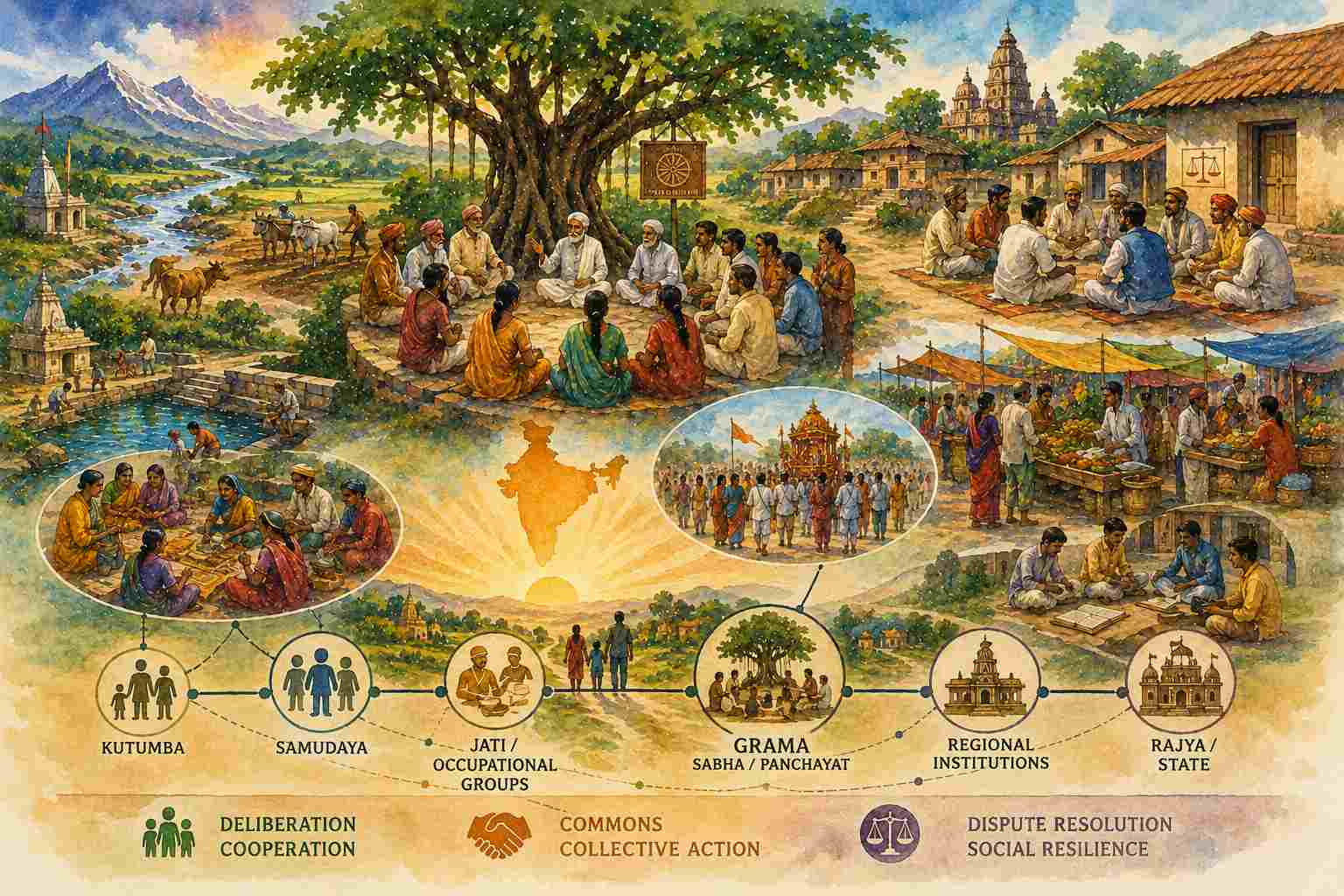
The Sociology of Distributed Social Institutions
When Sociology introduces society, it often begins with a familiar structure: the individual, the group, and the larger institutions of society and the state. This framework has produced valuable insights, but it can become inadequate when applied mechanically to Bharat. Between the individual and the state exists an enormous social world—family networks, occupational groups, neighbourhood associations, religious institutions, caste and jati bodies, village assemblies, commons, markets and countless forms of collective organization.
The question is simple: what happens to Sociology when these intermediate institutions are treated as merely “traditional” residues rather than as active mechanisms of social organization?
This is where grama, sabha and samudaya offer a different sociological drishti.
The Village as a Social System
Modern sociology inherited a powerful narrative of modernization. Rural society was often imagined as traditional, local, kinship-based and relatively static, while the modern world was urban, mobile, individualised and institutionally differentiated. This contrast shaped generations of sociological textbooks.
The Indian village was therefore frequently studied through a simple question: how will modernization transform the village? But this question assumes that the village is primarily an earlier stage of society.
A sociological reading of grama requires a different approach. A village is not merely a settlement containing individuals. It can be understood as a social system, containing relationships of kinship, occupation, authority, cooperation, conflict, ritual and ecological dependence. Its boundaries may not correspond exactly to a revenue map because its actual social world may extend through marriage networks, caste networks, markets and pilgrimage.
This does not mean that every village was harmonious. Villages contained hierarchy, exclusion and unequal power. A serious sociology must study these realities rather than replace romanticized rural India with civilizational nostalgia. But the opposite mistake is equally serious: reducing the village to hierarchy and therefore failing to see the institutions through which collective life was organised.
A grama was not simply an underdeveloped city. It was a different form of social organization.
Beyond the Individual–State Model
A central sociological problem emerges when we imagine society through only two major actors: the individual and the state. Once this becomes the dominant analytical framework, every social problem appears to require either individual freedom or state intervention.
But where does samudaya fit? A community can create norms without becoming the state. It can mobilise collective action without becoming a bureaucracy. It can manage resources, resolve disputes and organise social welfare without requiring every relationship to pass through a government institution.
Sociology already possesses concepts such as civil society, social capital, informal institutions, intermediate associations and collective action. These are useful. Yet they often emerge from historical questions specific to modern Western societies. The category of civil society, for example, frequently develops in relation to the state and the market.
Indian social life presents a more complex field. Many institutions do not easily fit the categories of state, market or civil society. A jati organisation, temple institution, community panchayat, grama body or local religious network may perform multiple functions simultaneously.
It may provide identity, welfare, moral regulation, dispute resolution and social support. This is why Indian Sociology requires institutional pluralism. The question should not be: Which modern Western category does this institution resemble? The better question is: What does this institution actually do within its social world?
Sabha: Sociology of Deliberation
The idea of sabha is particularly interesting because it directs attention towards the sociology of deliberation. A society does not become organized merely because it possesses rules. People must also possess spaces through which collective matters are discussed. A sabha represents, in its broadest sense, an assembly—a gathering in which individuals or representatives come together.
But assemblies are not automatically democratic in the modern electoral sense. Participation may be limited by social status, occupation, gender or other forms of authority. Sociology must therefore examine who participates, who is excluded and whose voice becomes authoritative. Yet we should not confuse the absence of universal modern suffrage with the absence of collective deliberation.
The modern curriculum often creates precisely this confusion. It tends to search for modern political institutions in the past and then concludes that because ancient institutions were not modern legislatures, they possessed no political significance.
That is bad comparative sociology. Sabha, samiti, local councils and community assemblies should be studied as institutions of deliberation, norm formation and collective decision-making, each within its own historical context. Their importance lies in demonstrating that social order was not produced exclusively from above.
Society could organize itself.
Panchayat and the Sociology of Conflict
One of the most important functions of intermediate institutions is dispute resolution. The modern state often imagines justice through formal courts. Yet every society also develops mechanisms of informal social regulation. Families mediate conflicts. Communities negotiate settlements. Occupational bodies establish norms. Local elders intervene. Informal sanctions maintain social expectations.
The panchayat can be studied sociologically within this wider framework of social control.
This does not mean that every panchayat decision was just. Informal institutions can reproduce local prejudice, unequal authority and coercion. Their decisions must therefore be examined critically, particularly where they violate individual dignity and constitutional rights. But modern Sociology should resist another simplification.
The question is not whether formal law should replace all informal institutions. The question is: how do multiple institutions interact in regulating society? The relationship between law and society has always been plural. A person may simultaneously be subject to constitutional law, family expectations, community norms, religious obligations and local social relationships. Sociological reality is therefore more complex than the legal hierarchy of the state.
Commons and Collective Action
The sociology of grama also becomes important when we study commons. Water bodies, grazing land, forests and shared spaces cannot always be understood through the binary of private property and state ownership. Communities frequently develop rules of access, responsibility and restraint.
This is what Sociology calls collective action.
The crucial question is not merely who owns a resource. It is also how people cooperate in maintaining it. Who decides access? What happens to those who violate norms? How is responsibility distributed? A functioning social institution can produce what may be called social resilience. A community facing drought, conflict or economic difficulty does not always begin with the state. Family networks, neighbourhoods, religious institutions and local associations may mobilise assistance first.
Modern development sometimes unintentionally weakens these capacities. When every collective responsibility is transferred upwards, society may gain state services but lose the capacity for self-organization.
The answer is not to withdraw the state. It is to recognise that a strong state and a strong society need not be opposites.
Distributed Institutions and Sociological Resilience
This is the deeper argument.
Indian society historically contained multiple institutional layers between the individual and political authority. These included kutumba, jati, samudaya, grama, occupational associations, religious institutions and local councils. They did not always function harmoniously, and their historical forms changed considerably across regions and periods. But their existence challenges the simplistic idea that society is structured only through individuals and the centralized state.
A Sociological Map of Distributed Institutions
The individual existed within relationships, but these relationships were not necessarily absorbed into the state. The state governed, protected and exercised authority, while many aspects of social life remained organised through distributed institutions. This creates a different sociological imagination.
Instead of asking only “How does the state organize society?”, we can ask: “How does society organize itself?”
Instead of treating community institutions merely as remnants of tradition, we can study them through concepts such as institutional capacity, social capital, norm formation, collective action and social resilience.
The Need for a Sociological Drishti
The purpose of an Indic sociological drishti is not to claim that every institution of the past should be revived. Sociology is not a restoration project. Its purpose is to expand the range of questions.
Why did certain social institutions emerge? How did they acquire legitimacy? How did they cooperate with or resist political authority? How did they change? Who benefited? Who was excluded? Which institutions survived modernization and which were weakened by colonial administration, urbanization and state centralization?
These are better sociological questions than simply asking whether an institution was “traditional” or “modern.” Grama, sabha and samudaya ultimately remind us that society has an institutional life of its own. A society is not simply a population waiting to be administered. It contains its own capacities for deliberation, cooperation, welfare, conflict and adaptation. When these layers are ignored, Sociology becomes strangely dependent on the very institutions it is supposed to study.
Perhaps the deepest question is therefore not whether society needs the state.
It clearly does. The question is: can a society remain truly resilient when every social function must eventually be performed by the state?
The answer may lie in rediscovering the institutional world that exists between the individual and political authority—a world that Indian Sociology has often described, but has not always fully understood on its own terms.
