
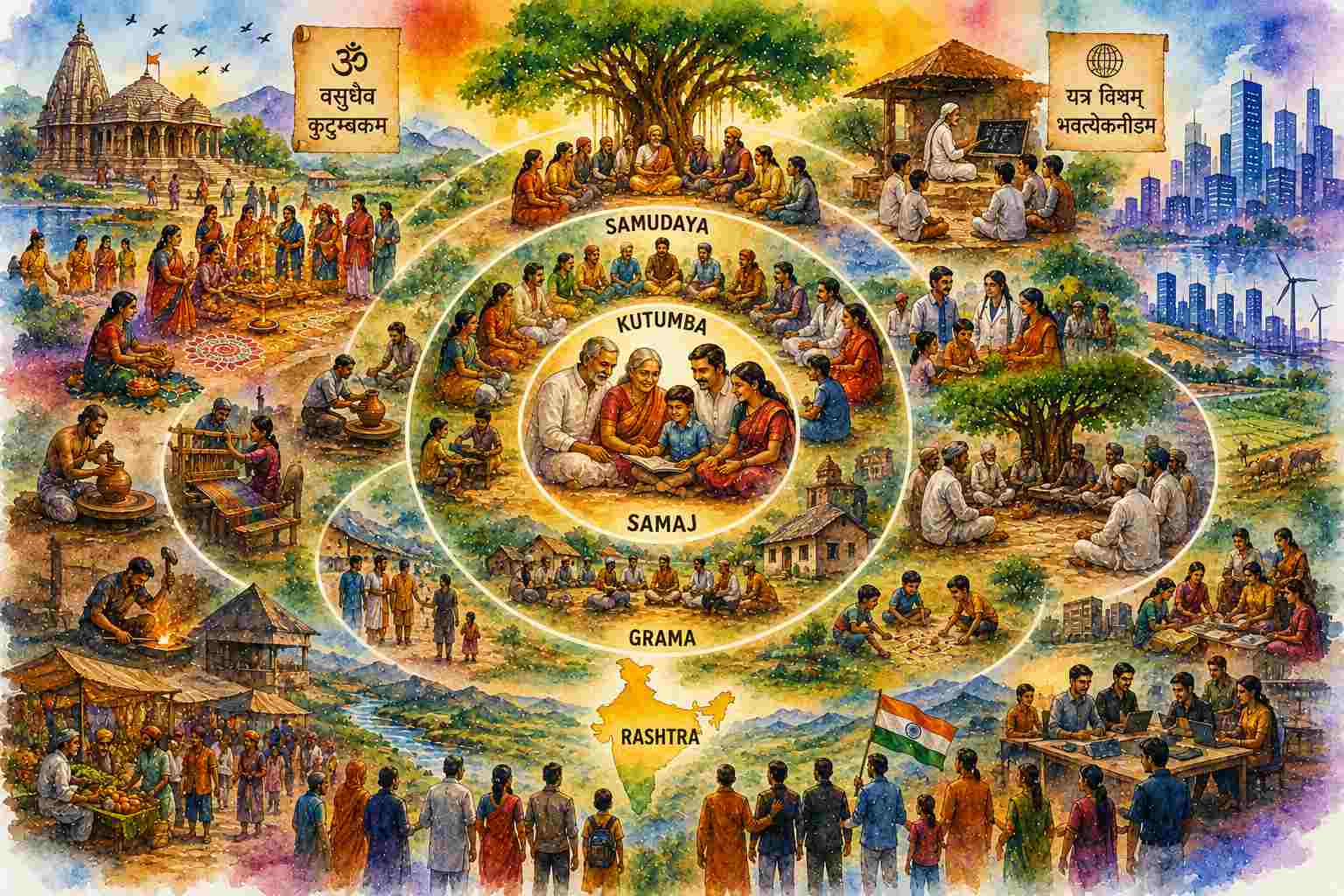
Beyond the Individual–Society Binary
What if the basic unit of sociology is not the individual?
Modern sociology has spent considerable intellectual energy explaining the relationship between the individual and society. Hobbes, Locke and Rousseau imagined political order through the problem of individuals and their relationship to authority; Durkheim examined how society constrains and integrates individuals; Weber began from meaningful social action; later sociology explored identity, institutions, networks and structures. These traditions are indispensable. But they share a recurring analytical architecture: the individual is placed on one side and society on the other.
The Indic question can begin somewhere else.
What if the person is formed through relationships before we even begin to speak about “society”?
This is where Samaj offers a different sociological entry point. Samaj should not be treated simply as the Indian translation of “society”. It points towards collective life as experienced through relationships, associations, shared practices and belonging. Alongside it stand other categories—Kutumba, Kula, Samudaya, Grama, Shreni and Rashtra—each drawing attention to a different form and scale of social organisation.
The distinction is important because modern sociology often moves analytically from individual → society. An Indic sociology can instead begin with relationship → person → community → institution → larger collective order.
Two Sociological Starting Points
| Modern Western emphasis | Indic analytical possibility |
|---|---|
| Individual and society | Person within relationships |
| Society as structure | Collective life as lived relationships |
| Rights and interests | Rights, duties and obligations |
| Social contract | Social bonds and reciprocal responsibilities |
| Institution as external structure | Institution as embedded in relationships |
| Individual autonomy | Relational agency |
| Society constrains the individual | Relationships constitute and enable the person |
| Society as an analytical object | Samaj as lived collective reality |
| Structure → individual | Relationship ↔ person ↔ institution |
The difference should not be exaggerated. Western sociology itself moved far beyond methodological individualism. Durkheim’s social facts, Mead’s socially constituted self, symbolic interactionism, phenomenology and contemporary network sociology all demonstrate that the individual cannot be understood in isolation. The important point is that Indic categories provide another starting vocabulary for this relational insight rather than merely reproducing the individual–society binary in Indian terminology.
Consider the family.
In much modern social analysis, the family is an institution that performs particular functions—socialisation, reproduction, economic cooperation and emotional support. This is analytically useful. But Kutumba allows us to ask a different question:
What kind of person is produced through a network of intergenerational relationships?
A child is not merely an individual who happens to belong to a family. The relationship with parents, grandparents, siblings and kin helps constitute identity, obligation, memory and responsibility. The family is therefore not simply an institution acting upon an already complete individual. It is one of the spaces through which the individual becomes a social person.
The same logic can be extended outward.
Kutumba → Samudaya → Samaj → Grama → Rashtra
These should not be imagined as concentric bureaucratic levels. They represent overlapping fields of relationship.
- A Grama is not merely a geographical settlement.
- A Samudaya is not merely a demographic category.
- A Samaj is not merely a population.
Each involves relationships, expectations, practices, institutions and forms of belonging.
From Contract to Reciprocity
Here the contrast with classical Western political thought becomes especially interesting.
Hobbes begins from individuals whose insecurity necessitates political authority. Locke places individual rights at the centre of political legitimacy. Rousseau asks how political association can reconcile individual freedom with collective sovereignty. Their questions are fundamentally political and remain extraordinarily influential.
The Indic starting point is less dependent upon imagining society as something that must first be contracted into existence. The relationship is already there. Dharma creates obligations. Rna—the idea of indebtedness—imagines human life as already situated within relationships of receiving and giving.
The Taittiriya Upanishad instructs the student: “मातृदेवो भव, पितृदेवो भव, आचार्यदेवो भव, अतिथिदेवो भव”—revere the mother, father, teacher and guest. These are not simply private moral instructions. They reveal a conception of social life in which identity is inseparable from relationships of responsibility.
This produces a different sociological question.
Instead of asking only: “What does society owe the individual?”
we can also ask: “What relationships make the individual capable of belonging to society, and what does the individual owe those relationships?”
That is not the rejection of rights. It is the addition of reciprocity.
Samaj Is Not Mere Harmony
An Indic sociology must also avoid another trap: romanticising Samaj as naturally harmonious. Communities contain conflict. Families contain inequalities. Institutions can exclude. Traditions can become oppressive. Groups compete for resources and status. Therefore, Samaj cannot simply mean “collective harmony”. The sociological task is to examine how relationships are negotiated, contested and transformed.
This is where Kautilya becomes particularly useful. His Arthashastra does not describe an idyllic society. It deals with conflict, property, economic interests, occupational groups, disputes, punishment, political power and institutional regulation. The existence of Dandaniti itself recognises that collective life requires mechanisms for managing competing interests.
Thus an Indic sociology does not have to choose between community and conflict. It can study how communities produce mechanisms for cooperation despite conflict.
The Methodological Difference
This changes how sociology should conduct research. Instead of entering a village and immediately asking: “What social structure determines individual behaviour?”
we might ask: Who relates to whom? Through what institutions? What obligations connect them? How is trust produced? How are disputes resolved? How does knowledge travel across generations? What happens when these relationships weaken? What new relationships emerge when migration, technology, markets or the state intervene?
The unit of analysis consequently becomes relational rather than merely individual or structural. This also changes the sociological imagination itself. The researcher is not standing outside “society” observing an object called Samaj. The researcher is also located within family, language, region, institutions and communities. The observer is socially constituted by the same relational world being studied. That is a major methodological correction to the idea of sociology as simply studying “others”.
A Different Question for Sociology
The Western sociological tradition has given us powerful questions:
- How does society constrain the individual?
- How do institutions reproduce social order?
- How does modernity transform relationships?
The Indic perspective can add:
- How do relationships constitute the person?
- How does reciprocity sustain collective life?
- How do different layers of belonging interact?
- What happens when obligations weaken?
- How does a Samaj reproduce itself without remaining unchanged?
This is why Samaj should not be introduced as merely an “Indian alternative to society”. It is an invitation to rethink the unit of sociological analysis itself. Perhaps the individual is not the starting point from which society must be explained. Perhaps the relationship is. Because before a person becomes a citizen, worker, consumer, voter or demographic unit, that person is already someone’s child, sibling, student, neighbour, member, teacher, friend or ancestor-in-the-making.
The social does not merely surround the individual. The social helps produce the individual.
And that is the deeper Indic proposition:
Society is not simply where individuals live. It is the web of relationships through which individuals become who they are.
That is Samaj—not society as an abstract structure, but collective life as lived, inherited, negotiated and continuously recreated through relationships.
