
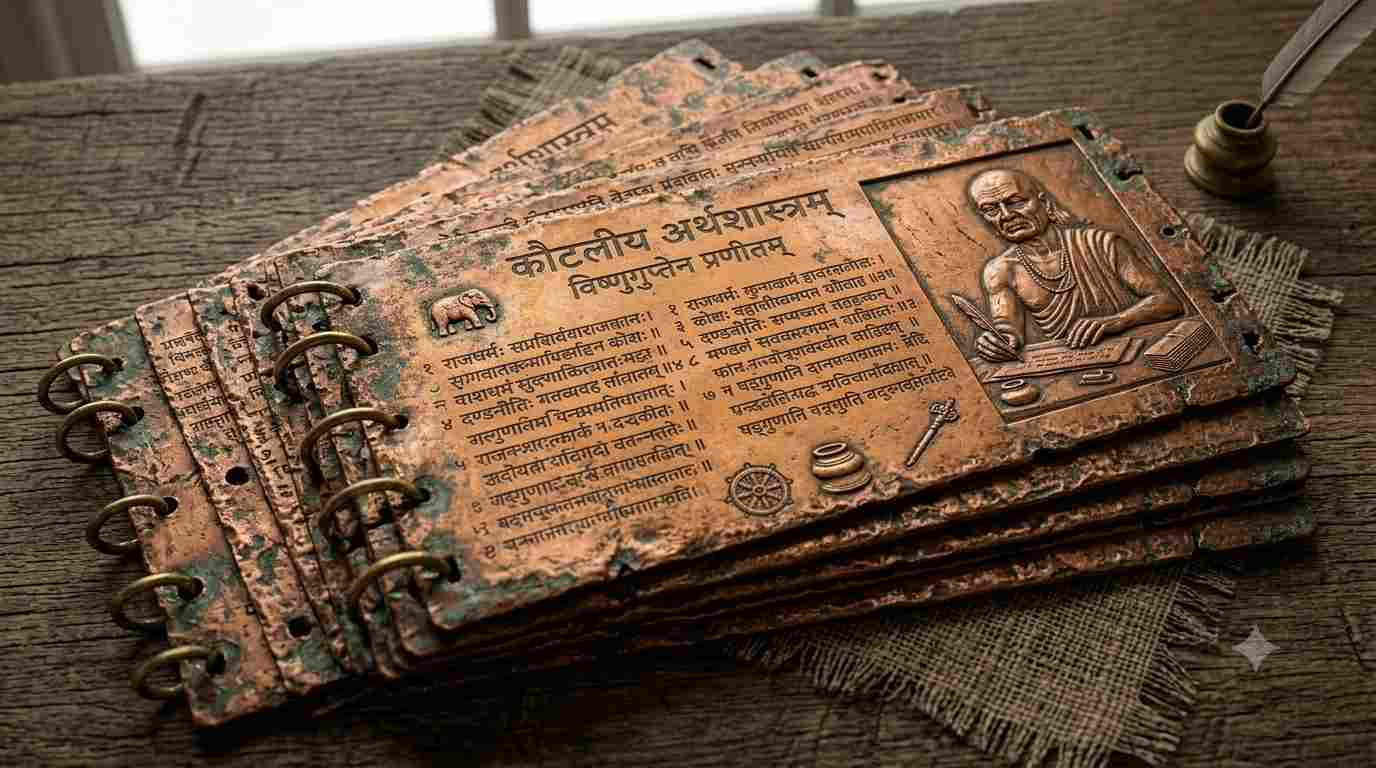
Understanding Artha
When I first encountered the Arthaśāstra, I made the mistake that many modern readers probably make. I saw the word artha and instinctively associated it with wealth, money and economics. The title seemed to promise an ancient Indian treatise on material prosperity. It was only as I moved deeper into the text that I began to understand how much larger the idea of artha actually was.
Artha is one of the four puruṣārthas—dharma, artha, kāma and mokṣa. It certainly includes wealth and material resources, but it also encompasses livelihood, security, prosperity and the material conditions necessary for human life to flourish. When the concept moves into the political sphere, it becomes even broader. A kingdom requires productive land, a functioning economy, revenue, security, institutions and the capacity to preserve what it has acquired.
I therefore began to understand artha not simply as wealth but as the material foundation of an ordered life. This also explains why translating the Arthaśāstra merely as the “Science of Economics” can be misleading. The work is concerned with administration, law, agriculture, taxation, diplomacy, intelligence, military affairs and the organisation of political power. Economics is certainly present, but it is part of a much larger conception of governance.
The more I read, the more I came to see that the central concern is not wealth for its own sake. It is the creation and preservation of the material conditions within which society can remain secure, productive and orderly.
What Is the State For?
This brings me to one of the concepts that has remained particularly important to me: yogakṣema. I understand yoga in this context as the acquisition of what is needed and kṣema as its preservation or secure enjoyment. Together, the terms point towards a condition in which people can acquire the resources necessary for life and remain secure in what they possess.
This idea becomes especially significant when Kautilya describes the relationship between the king and his subjects. In one of the best-known passages of the Arthaśāstra, he writes:
“In the happiness of his subjects lies his happiness; in their welfare his welfare.”
— Arthaśāstra 1.19
I keep returning to this sentence because it complicates the popular image of Kautilya as merely a theorist of political cunning. The king certainly has to govern, collect revenue, maintain order, defend the kingdom and, when necessary, wage war. Yet the purpose of this machinery is not exhausted by the preservation of royal power. The welfare and security of the subjects remain part of the ruler’s responsibility.
I would not describe this as a modern welfare state, because that would impose categories from a very different political world onto the ancient text. What I do find important is the underlying political principle: the ruler’s success is connected to the well-being of those over whom he rules. Political authority is therefore not presented simply as possession of power but as the performance of responsibilities.
This is where artha and rājadharma begin to meet. Material prosperity, political security and the obligations of the ruler form part of the same larger conception of order.
The Seven Limbs of the State
My understanding of the Arthaśāstra changed considerably when I reached its theory of the saptāṅga, the seven limbs or constituent elements of the state. Kautilya identifies the svāmin, or ruler; the amātya, consisting of ministers and administrative personnel; the janapada, meaning the territory together with its population; the durga, or fortified centre and defensive infrastructure; the kośa, the treasury; the daṇḍa or bala, representing the army and coercive power; and the mitra, or allies.
What struck me was not merely the list but the way these elements depend upon one another. A ruler cannot maintain an effective army without a treasury, and a treasury cannot remain strong without productive territory and effective administration. A prosperous territory is vulnerable without defence, while military strength becomes difficult to sustain without economic resources and administrative capacity. Even a powerful kingdom benefits from reliable allies.
This is why I find the saptāṅga framework interesting when viewed alongside contemporary discussions of state capacity. Modern political science speaks about fiscal, administrative, territorial, coercive and diplomatic capacities. I would not claim that Kautilya anticipated modern political science, because the historical and conceptual contexts are fundamentally different. Yet the analytical instinct is strikingly familiar: the strength of a state depends upon several interconnected capacities rather than upon the personality of the ruler alone.
That was an important moment for me as a reader. I had expected to encounter a theory centred on the king, but I found instead a theory in which the king himself was only one component of a larger political organism.
The Administrative State
This systemic understanding becomes even clearer in the discussion of the adhyakṣas, the superintendents responsible for different branches of administration. The Arthaśāstra describes officials concerned with agriculture, mines, forests, trade, weights and measures, manufacturing, ports, armaments and numerous other activities.
Revenue administration receives equally detailed treatment. Land revenue is an important source, with the king’s share commonly described around one-sixth of produce, although the actual assessment could vary according to circumstances. Revenue also comes from trade, mines, forests, ferries, crafts and other economic activities.
What particularly caught my attention was the concern with supervision. Officials are not simply appointed and then left to operate without scrutiny. Accounts are to be examined, activities supervised, and misconduct detected. Spies can be used to investigate officials, while punishments exist for various forms of corruption and abuse.
This made me reconsider the assumption that an ancient administration must necessarily have been institutionally primitive. The scale and complexity of the administrative apparatus described in the Arthaśāstra are certainly not evidence of a modern bureaucracy, but they do reveal a sophisticated awareness of departmental specialisation, revenue management, record-keeping, supervision and accountability.
The interesting question for me is therefore not merely who governs. It is how government is actually made to function, and how the ruler can prevent the administrative machinery from becoming a source of leakage, corruption or private enrichment.
Economic Governance
The same pragmatism appears throughout the economic sections. Agriculture receives considerable attention because productive land is fundamental to both livelihood and state revenue. The state is concerned with cultivation, settlement, irrigation and the development of new productive areas. Water management therefore becomes a political and economic concern rather than something outside the sphere of governance.
Trade is also subject to regulation. Officials oversee markets, prices, weights and measures and commercial practices. The state seeks revenue from commerce while attempting to prevent fraudulent practices and excessive manipulation. Again, I find it difficult to place this neatly into modern ideological categories. It is neither laissez-faire capitalism nor a modern command economy. Strategic sectors receive strong state supervision, while merchants, producers and occupational groups continue to operate within regulated spaces.
The treatment of mines and forests is particularly revealing because natural resources are understood as important components of state power. The state maintains supervision over these sectors, while different arrangements, including leasing, allow productive activity to continue.
The role of śreṇis, or guild-like occupational associations, also complicates any simple picture of an all-powerful state. Merchants and artisans could organise collectively, regulate aspects of their professional life and participate in the settlement of disputes. The text also discusses wages, contracts and labour disputes.
I therefore read the economic model of the Arthaśāstra as a pragmatic combination of state supervision, private activity and corporate self-regulation. It does not begin with the modern question of whether the state or the market should dominate. Instead, it asks how productive activity can be organised so that wealth is generated, revenue secured and economic disorder contained.
Justice, Law and Daṇḍa
When I reached the legal sections, another dimension of the Arthaśāstra became visible. The text distinguishes between judicial proceedings concerned with disputes and matters of law, associated with dharmasthīya, and the suppression of threats to public order, associated with kaṇṭakaśodhana.
The legal apparatus deals with contracts, debts, property, theft, assault, witnesses, evidence and other disputes. Witness testimony and documentary evidence have an important place, while ordeals appear in particular circumstances. Punishment, or daṇḍa, includes fines, confiscation and corporal penalties, and punishments can vary according to the nature of the offence and, in some cases, the social status of the offender.
This is one of the places where my response to the text becomes deliberately uncomfortable. I find the procedural sophistication fascinating, but I cannot ignore the hierarchical assumptions within which that procedure operates. The Arthaśāstra does not present a modern principle of universal equality before law. Its legal order reflects the stratified social world in which it developed.
That tension is important because it prevents me from turning the text into either an idealised ancient constitution or a simple catalogue of oppressive practices. Its achievement lies in the systematic organisation of legal and administrative processes, but those processes serve a social order that contains inequalities and distinctions that are difficult to reconcile with modern ideas of equality.
Diplomacy and the Maṇḍala
The political imagination of the Arthaśāstra becomes even more expansive when Kautilya turns from internal administration to relations among states. The famous maṇḍala theory, or circle of states, begins with the recognition that no kingdom exists in isolation. A ruler is surrounded by neighbouring powers whose interests may conflict or converge with his own.
From this follows the doctrine of the ṣaḍguṇya, the six measures of foreign policy: saṃdhi, making peace or entering into a treaty; vigraha, hostility or war; āsana, remaining quiet or maintaining neutrality; yāna, marching or preparing for military action; saṃśraya, seeking protection or shelter; and dvaidhībhāva, pursuing a dual policy in which a ruler may maintain peace with one power while opposing another.
What changed for me while reading these sections was my understanding of the character of ancient Indian foreign-policy thought. The text is strikingly attentive to relative power, strategic timing, alliances and changing circumstances. A policy that makes sense for a stronger ruler may be disastrous for a weaker one. A temporary alliance may be useful today and unnecessary tomorrow.
This is why the Arthaśāstra can appear remarkably close to what modern scholars call political realism. Even so, I prefer not to reduce it to that category. Kautilya’s concepts emerge from their own intellectual and political context. The usefulness of the maṇḍala lies precisely in seeing how an Indian political tradition developed its own vocabulary for understanding interstate competition.
Intelligence: The State That Watches
The sections on intelligence are among the most striking in the entire work. The Arthaśāstra describes networks of agents operating within the kingdom and beyond its borders. Spies may assume different identities and social roles, gathering information about officials, potential conspiracies, public sentiment and enemy states. Intelligence is also used to detect hostile agents and test the loyalty of those serving the ruler.
I find these passages ethically uncomfortable, particularly because modern readers naturally bring expectations about privacy and limits on state surveillance. The Arthaśāstra operates in a very different environment, one in which rulers faced assassination, rebellion, court intrigue and continuous rivalry with neighbouring states.
Yet intelligence is not treated as an isolated secret activity. Information feeds into administration, internal security, diplomacy and military strategy. Kautilya appears to understand that a ruler who does not know what is happening inside his own administration or beyond his borders is governing with incomplete information.
For me, this is another indication of how closely the different parts of the Arthaśāstra are connected. Administration, intelligence, diplomacy and military affairs are not separate worlds; information moves between them.
War and Strategy
The Arthaśāstra discusses open warfare, siege operations, fortifications, terrain and different methods of weakening an opponent. It also considers covert and psychological methods, including attempts to create divisions among enemies, spread misinformation and use secret agents against important targets.
Economic resources are similarly treated as instruments of strategy. Trade routes, supplies and the productive capacity of an enemy can affect the outcome of a conflict just as much as battlefield strength.
This is one reason I hesitate to describe Kautilya simply as a theorist of ruthless warfare. The larger logic is considerably more calculating. War consumes resources, damages productive territory and can weaken the treasury. If diplomacy can achieve an objective at lower cost, diplomacy may be preferable. Military action becomes one instrument among several rather than an end in itself.
The text therefore asks a more complicated question than whether war is good or bad. It asks what political objective is being pursued, what resources are available and which combination of diplomacy, force, intelligence and economic pressure is most likely to achieve that objective.
Society: Regulated, Productive and Hierarchical
The society described in the Arthaśāstra is highly regulated. Women appear in discussions of marriage, property, inheritance, labour and sexual conduct. There are provisions that provide certain forms of protection and recognise particular property rights, but these operate within a clearly patriarchal social framework.
Merchants and guilds occupy an important economic position, while villages form the basic productive units of the countryside and towns function as centres of administration and commerce. The text also regulates associations, wandering groups and ascetics and places restrictions on certain forms of movement and residence.
This is not a liberal conception of society. The state seeks to regulate economic activity, social conduct and associations because it understands social order as essential to political stability.
I think acknowledging this is necessary if we are going to read the Arthaśāstra seriously. Its sophistication in administration and statecraft does not make every social norm contained within it acceptable by contemporary standards. At the same time, its hierarchical character should not prevent us from studying how it connected social regulation, economic productivity and political authority.
Where Does the Arthaśāstra Stand in the World?
Whenever I discuss the Arthaśāstra, comparisons with other political classics inevitably arise. I find these comparisons useful when they help illuminate the text, but dangerous when they replace the text itself.
With Aristotle, I see a shared impulse towards systematic political analysis. Aristotle, however, embeds his political thought much more explicitly within ethical and philosophical questions, while the Arthaśāstra is often more operational in its treatment of administration, security and political advantage.
With Sun Tzu, the resemblance becomes particularly visible in the importance assigned to intelligence, deception, strategy and knowledge of the opponent. Yet The Art of War is fundamentally concerned with military strategy, whereas the Arthaśāstra encompasses the wider machinery of government.
The comparison with Machiavelli is perhaps the most familiar. Both thinkers are willing to confront uncomfortable realities of political power, including deception, force and strategic calculation. Yet calling Kautilya the “Indian Machiavelli” can become misleading if it encourages us to overlook the extraordinary breadth of the Arthaśāstra. It deals not only with the acquisition and preservation of political power but also with taxation, agriculture, markets, law, bureaucracy, natural resources, intelligence and administration.
I therefore prefer to treat Aristotle, Sun Tzu and Machiavelli as comparative windows rather than equivalents. They help me situate the Arthaśāstra within a global history of political thought while allowing its distinctive intellectual vocabulary to remain visible.
Why Does It Matter Now?
The modern relevance of the Arthaśāstra becomes clearer when I stop asking what we can directly copy from Kautilya. The more useful question is what categories he gives us for thinking about governance.
In public administration, his concern with specialised departments, supervision, auditing and corruption raises questions that remain familiar to modern states. In national security, the integration of intelligence, diplomacy, military capacity and economic resources suggests a holistic way of thinking about security rather than treating defence as an isolated sector.
His economic discussions also invite reflection on the relationship between state capacity and productive infrastructure. Agriculture, irrigation, strategic resources, markets and revenue are treated as interconnected elements of political strength. His foreign-policy theories similarly encourage attention to geography, relative power, alliances and changing strategic interests.
The saptāṅga framework may be especially useful as a conceptual starting point. It asks us to look at the state as a system whose different capacities reinforce or weaken one another. A powerful army cannot compensate indefinitely for an empty treasury; economic prosperity cannot guarantee security without effective administration and defence; diplomatic isolation can weaken even a materially powerful state.
I would not turn any of this into a claim that the Arthaśāstra provides a ready-made blueprint for modern India. It does not. It emerged from a very different political and social world and contains assumptions that cannot simply be transferred into a democratic constitutional order. Its value lies elsewhere. It gives us categories with which to ask difficult questions about the relationship between power, prosperity, administration, security and responsibility.
That distinction matters because intellectual recovery is different from textual recovery. The manuscript of the Arthaśāstra was recovered in 1905. The text was edited, translated and eventually made available to scholars around the world. In that sense, the historical recovery has already happened. But I am not convinced that the intellectual recovery is complete. We have recovered the words, but have we recovered the way of thinking behind those words? Have we understood how artha, yogakṣema, saptāṅga, daṇḍa, maṇḍala and the machinery of administration fit together into a distinctive Indian conception of governance?
The rediscovery of the Arthaśāstra solved one historical mystery: it brought a lost manuscript back into the intellectual world. The larger question is whether we have done enough with what that manuscript returned to us.
Have we truly rediscovered its intellectual tradition, or have we merely recovered a text while leaving its methods, categories and civilizational understanding of governance unexplored?
