
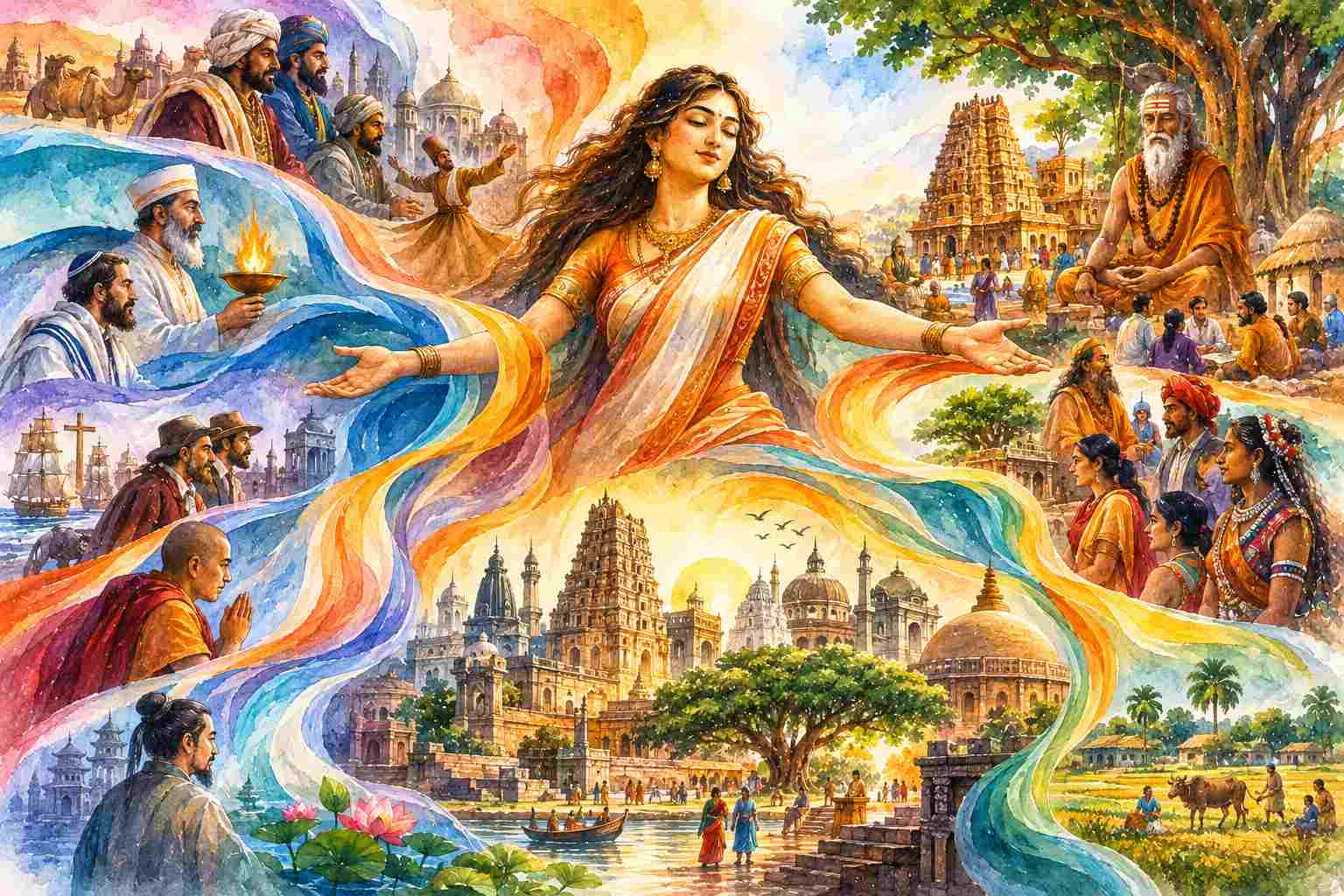
How Does a Civilization Encounter the Other?
Every civilization eventually confronts the same historical reality. People migrate. Traders arrive. Conquerors enter. Ideas travel across borders. Languages interact. New religions emerge. Technologies transform social life. No civilization exists in complete isolation.
The real question, therefore, is not whether an external influence will enter a civilization. The real question is: what happens after it enters?
Does the new community retain its identity? Does it gradually adopt the host culture? Does the host civilization absorb selected elements from the newcomer? Does one culture replace another? Or does prolonged contact create a population that becomes detached from its own cultural foundations without developing a secure relationship with the new ones?
These outcomes should not be collapsed into a single idea called “cultural diversity.” They represent different processes. The Cultural Spectrum Framework proposes that civilizational encounters move across a range of possibilities:
| Process | What happens? | Civilizational result |
|---|---|---|
| Coexistence | Communities live together while remaining distinct | Difference is preserved |
| Acculturation | Groups borrow and adapt cultural practices | Mutual change without complete identity loss |
| Assimilation | New elements become integrated into a larger cultural order | Continuity through adaptation |
| Syncretism / Integration | Different traditions produce new cultural forms | A composite cultural expression emerges |
| Appropriation | Cultural elements are taken without their original context or relationship | Meaning may be detached from tradition |
| Replacement | An older system is displaced by another | Civilizational rupture |
| Alienation | A community loses connection with inherited meanings and institutions | Psychological and civilizational detachment |
| Rejection | An external influence is refused | Boundary and continuity are preserved |
These categories are not fixed stages. A civilization may assimilate food but reject theology, borrow a language while preserving its metaphysics, accept a technology while resisting the civilization that produced it, or welcome a community without requiring it to surrender its religious identity.
This is where the Indic Cultural Spectrum begins.
Assimilation Is Not the Same as Absorption
The first conceptual distinction must be made carefully. Assimilation does not always mean uniformity.
In contemporary sociology, assimilation often refers to a minority increasingly resembling the dominant culture. Acculturation is broader: different cultural groups interact and adopt certain elements from one another while maintaining aspects of their distinct identities.
The Indic civilizational experience requires a third possibility. A tradition can become civilizationally integrated without becoming culturally identical.
The Parsis provide a powerful example.
The historical details of their early migration remain debated, and the famous milk-and-sugar story associated with the Qeṣṣa-ye Sanjān belongs to a later literary tradition and must not be treated as simple archival fact. What is historically significant is that Zoroastrian refugees from Iran established a durable community in western India and preserved their distinct religious identity.
Yet the Parsi community did not remain culturally frozen. It developed within Gujarat and later Bombay, adopted Indian languages and local social forms, and participated deeply in Indian society. At the same time, its religious continuity remained remarkably strong.
This is not complete assimilation. Nor is it complete separation.
It is civilizational accommodation.
The same pattern can be seen among Jewish communities in India. Jewish presence on the Malabar Coast is historically documented through medieval evidence, including copper-plate grants and other sources. Cochin Jews maintained Judaism while developing forms of social organization deeply shaped by their Kerala environment. Their identity was simultaneously Jewish and Indian rather than a simple choice between one or the other.
This gives us an important insight. A civilization can integrate a community without demanding that it cease to be itself.
The community remains Jewish or Zoroastrian. The larger civilization does not become Jewish or Zoroastrian. Yet both participate in shared languages, territories, economic networks and cultural relationships.
This is one of the central features of the Cultural Spectrum Framework: belonging can be layered.
Bharat’s Cultural Grammar: Expansion Through Relationship
Indic civilization historically possessed no single institution that could universally determine cultural membership. There was no centralized ecclesiastical authority capable of deciding for the entire civilization who belonged and who did not.
This did not mean that every community was automatically treated equally. Bharat historically contained hierarchy, conflict, exclusion and religious competition. A foundational framework must acknowledge this honestly. Cultural plurality is not the same as social equality.
Yet the absence of a single universal religious gatekeeper produced a distinctive civilizational pattern. Different sampradayas, philosophical schools, regional traditions and local sacred practices could develop simultaneously.
A person could belong to a family, caste or jati, locality, linguistic region, temple tradition, philosophical lineage and broader civilizational geography at the same time.
This created a cultural grammar capable of layered identity.
A local deity did not always need to disappear before a wider sacred tradition could recognize it. Regional traditions could enter broader networks without becoming identical to one another. Shaiva, Vaishnava, Shakta, Buddhist, Jain and other traditions disagreed profoundly, but they also shared intellectual and geographical worlds.
This process was not the modern ideal of “tolerance.” Tolerance assumes that a central authority permits the existence of something it does not accept. The Indic historical pattern was often more complicated. Multiple communities could exist because the civilizational framework itself did not require one institution to eliminate all competing sacred worlds.
That difference matters.
Not Every Civilization Organizes Difference in the Same Way
Civilizations develop different responses to the cultural “other.” These should not be reduced to moral stereotypes. Every civilization contains multiple periods, schools and contradictions. However, their dominant theological and institutional grammars can create different historical tendencies.
| Civilizational grammar | Primary question about the other | Typical cultural outcome |
|---|---|---|
| Indic plural traditions | Can this tradition be located within a larger plural order? | Layered coexistence and selective assimilation |
| Abrahamic exclusivist traditions | Does this belief conform to revealed truth? | Inclusion, conversion, protected difference or theological exclusion |
| Imperial-universal systems | Can this group be incorporated into the political order? | Administrative incorporation |
| Modern liberalism | Does the individual possess equal civic rights? | Citizenship-based pluralism |
| Colonial modernity | Can this society be reorganized according to the civilizing standard? | Institutional replacement and cultural hierarchy |
This table must be read carefully.
It would be historically false to say that “Muslims always saw all others simply as kafirs and therefore could not coexist with them.” Islamic societies developed several legal and historical arrangements for non-Muslim populations, and Muslim political history contains both persecution and coexistence. The Arabic term kafir itself is a theological category with a more specific history than the modern casual use of “unbeliever.”
But neither should we ignore the importance of theological exclusivity. In many Islamic legal and theological frameworks, religious difference was defined against a truth claim centered on Islam. In Mughal India, for example, non-Muslim populations were part of a complex political and legal structure that changed significantly across rulers. Akbar’s sulh-i kul represented an important attempt to widen the political principle of coexistence, including dialogue with Hindus, Jains, Parsis and Christians. It was notable precisely because it departed from narrower orthodox assumptions rather than merely repeating them. Yet, there has been a political agenda behind it.
The comparison, therefore, should not be “good Hindu civilization versus bad Muslim civilization.” The more important question is what intellectual grammar does a civilization possess for understanding difference?
- Does difference require conversion?
- Does it require classification?
- Can it remain autonomous?
- Can the external be interpreted through internal categories?
- Can multiple truths coexist without being reduced to a single truth?
These questions produce different cultural outcomes.
Acculturation: Mutual Change Without Civilizational Surrender
Acculturation is perhaps the most common outcome of sustained contact. Communities borrow from one another.
Consider the long history of Persianate culture in the Indian subcontinent. Persian became an important language of administration, literature and courtly culture. Yet when Persianate cultural forms entered Bharat, they did not remain identical to their Iranian or Central Asian forms. They interacted with Sanskrit, Prakrit, regional languages and local artistic traditions.
The result was not simply “Indian culture becoming Persian.” Nor was it the disappearance of Persian influence. A new cultural field emerged. The same can be seen in language. Hindi and Urdu developed through long processes of interaction. Architecture created new regional forms. Food, music, clothing and artistic traditions moved across religious and political boundaries. This is why cultural interaction should not always be described as assimilation. Sometimes both sides change.
The Indic civilizational strength historically lay in its ability to create a relationship with external influences without necessarily requiring complete sameness. But the process had limits. That leads to a crucial concept: the non-digestible.
What Does a Civilization Refuse to Digest?
Not everything that enters a civilization becomes part of it.
A civilization can absorb vocabulary without accepting metaphysics. It can borrow technology without adopting foreign cosmology. It can incorporate artistic styles while rejecting the political authority associated with them. The real question is: what remains incompatible with the host civilization’s fundamental grammar?
This can be called the principle of civilizational non-digestibility. Some ideas are easily adapted because they operate at the level of technique. Mathematics, agricultural technology, architecture and language can travel widely.
Other ideas concern ultimate authority. If an external doctrine claims that all other sacred traditions are false and must eventually disappear, its relationship with a plural civilizational system will be fundamentally different from that of a doctrine that accepts coexistence.
Similarly, a political institution that claims total authority over family, community, knowledge and culture may conflict with a civilization historically organized through distributed institutions.
Assimilation therefore depends on compatibility of cultural depth. Surface practices are easier to absorb. Civilizational first principles are harder.
Syncretism and the Danger of Simplification
The word “syncretism” is frequently used to describe Indian culture, but it must be handled carefully. Not every cultural mixture is syncretism, and not every synthesis is harmonious.
The word can also conceal questions of power. When two cultures interact, who possesses political authority? Who controls institutions? Who determines which practices survive? Is cultural borrowing voluntary, negotiated or imposed?
A community adopting another language for trade is different from a population abandoning its language under administrative pressure. A philosophical synthesis is different from forced religious conversion. Therefore, cultural mixture alone does not tell us whether a civilizational relationship is healthy. The Cultural Spectrum must examine the conditions of contact.
- Was the relationship reciprocal?
- Was there institutional autonomy?
- Could communities preserve their inherited traditions?
- Could they participate in common society without cultural disappearance?
The Parsi and Cochin Jewish examples are significant because they demonstrate that participation in the larger Indian environment did not necessarily require the abandonment of religious identity. But these cases should not be romanticized as proof that Bharat was free from all exclusion. Cochin Jewish communities themselves developed internal social distinctions, some influenced by Indian caste patterns.
A foundational Indic framework must therefore distinguish between plurality and perfection. Bharat historically produced remarkable mechanisms of coexistence. It did not produce a society without hierarchy or conflict.
Appropriation: When Culture Is Detached from Relationship
Appropriation is different from assimilation.
Assimilation occurs when an external element enters a larger cultural system and acquires a meaningful relationship with it. Appropriation occurs when cultural elements are removed from their original contexts and used without understanding, reciprocity or acknowledgement. A symbol can become a fashion accessory. A sacred practice can become a commercial product. A philosophical concept can be extracted from its intellectual framework and repackaged as a commodity.
This matters deeply in the modern world.
Yoga, Ayurveda and meditation are obvious examples of global cultural circulation. Their spread can be productive, and civilizations have always transmitted knowledge. But the question remains whether transmission preserves intellectual context or converts a civilizational practice into a detached commodity.
The difference can be illustrated simply. If a practice travels and enters dialogue with another tradition, it may produce adaptation. If a practice travels and its historical meaning is erased while another group claims ownership, it becomes appropriation. The issue is not that culture must remain permanently confined to one community. That would contradict the history of civilization itself. The issue is whether exchange produces relationship or extraction.
Alienation: When Cultural Continuity Breaks
Alienation represents the opposite problem. A civilization does not need to be physically conquered in order to experience civilizational decline. Its institutions may remain, but people can lose the vocabulary required to understand them.
A temple survives, but its philosophical world disappears. A language survives, but intellectual education takes place entirely elsewhere. A society continues performing rituals, but cannot explain their social or metaphysical context. This is cultural alienation.
The colonial period created a particularly powerful form of this problem because modern education, administration and knowledge systems increasingly reorganized how educated Indians understood their own civilization. The issue was not simply the introduction of Western knowledge. Bharat had always interacted with external knowledge.
The deeper problem emerged when the categories through which Bharat understood itself were increasingly displaced. The colonized subject could become educated about India without necessarily learning to think through Indian categories.
This is the paradox of alienation.
One can become highly knowledgeable about one’s civilization while becoming increasingly distant from its own intellectual vocabulary. Alienation therefore does not mean refusing modernity. It means losing the capacity to enter modernity without abandoning the ability to understand oneself.
The Panchamrutam Model
The Indic framework can express the positive possibility of cultural integration through the metaphor of Panchamrutam.
Different ingredients combine, but they do not become meaningless simply because they are part of a larger whole. Their relationship creates something new. This offers an alternative to both extremes. The first extreme is homogenization, where diversity is destroyed in the name of unity. The second is fragmentation, where every group remains permanently disconnected and no larger civilizational relationship is possible.
The Panchamrutam model suggests another possibility: integration without uniformity.
This is especially important for Bharat. A civilization containing hundreds of languages, numerous philosophical traditions, multiple sacred geographies and different historical communities could not have survived through absolute sameness. Its unity had to be constructed differently. Not through uniformity of belief. Not through a single language. Not through one political dynasty. But through overlapping networks of geography, pilgrimage, memory, philosophy, social exchange and cultural recognition.
Toward a Cultural Spectrum Framework
The Cultural Spectrum is therefore not merely a theory of tolerance. It is a framework for studying what happens when civilizations encounter difference.
It begins with five questions.
- First, what enters the civilization? A population, idea, technology, language or institution does not enter in the same way.
- Second, how does the host civilization respond? It may welcome, classify, debate, regulate, adopt or reject.
- Third, what changes? The newcomer may change, the host may change, or both may change.
- Fourth, what remains? Cultural survival is not measured by whether nothing changes. It is measured by whether change preserves a meaningful continuity.
- Finally, what is lost? Every process of cultural transformation contains the possibility of alienation. A civilization may become globally connected while becoming incapable of reproducing its own memory.
The Indic Cultural Spectrum therefore offers a more precise way of understanding cultural encounter:
Contact does not automatically produce assimilation. Assimilation does not automatically produce harmony. Diversity does not automatically produce civilizational unity.
A civilization must possess its own internal strength before it can engage deeply with the world. Otherwise, openness becomes absorption in the negative sense—the disappearance of cultural selfhood. But the opposite danger is equally real. A civilization that refuses every external influence eventually converts preservation into stagnation. The Indic challenge is therefore neither withdrawal nor surrender.
It is the capacity to encounter the other, learn from the other, transform the other where possible, preserve difference where necessary and remain conscious of the civilizational self throughout the process. That is the deeper meaning of the Cultural Spectrum Framework. A living civilization does not survive by remaining untouched. Nor does it survive by becoming whatever enters it.
It survives by developing the cultural intelligence to know what to welcome, what to adapt, what to integrate, what to resist and what must never be forgotten.
