
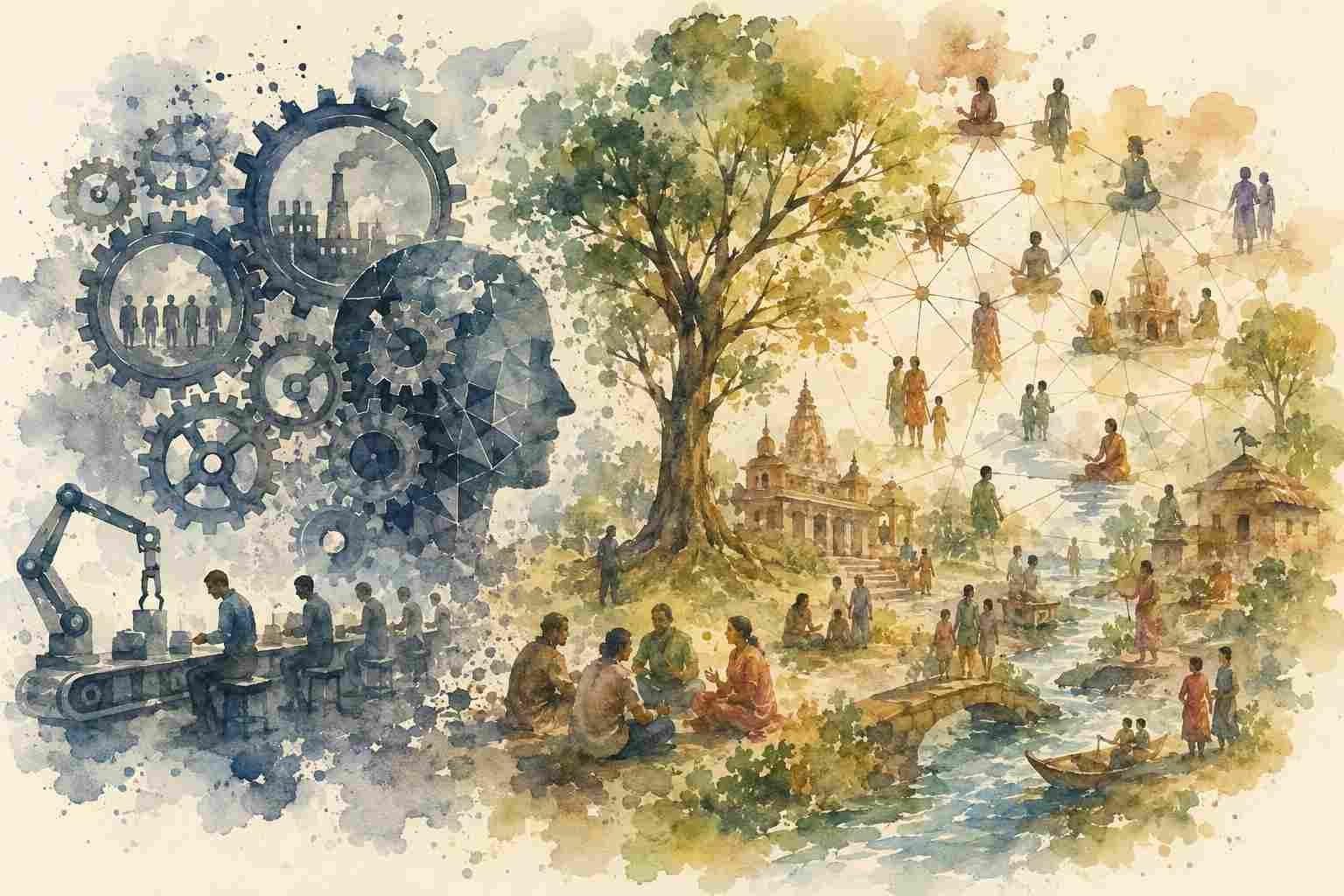
Is Society a Machine or an Ecosystem?
How do we imagine society? As a machine that can be designed, controlled and repaired from above? Or as a living ecosystem in which countless individuals, institutions and networks continuously interact, adapt and produce outcomes that nobody fully controls?
Much of modern social thought emerged during the age of machines. The Industrial Revolution transformed not only economies but also the intellectual imagination of the modern world. States became administrative machines. Economies became production machines. Bureaucracies became institutional machines. Society itself increasingly appeared as something that could be engineered.
The machine metaphor is powerful. But is it adequate? A machine has identifiable components. Its parts can be separated and reassembled. Inputs are expected to produce predictable outputs. If one part fails, the engineer identifies the defect and repairs it.
Human society rarely behaves this way. A small event can produce consequences far beyond its apparent importance. An institution may survive long after its founders have disappeared. An idea may travel across centuries without central coordination. A local movement may unexpectedly transform national politics. And a policy designed to produce one outcome may generate an entirely different one.
Society is therefore not merely a structure. It is a system of relationships.
From the Machine to the System
The Systems Model begins with a basic proposition: society is a complex and adaptive system composed of interacting individuals, communities, institutions and networks.
The behaviour of such a system cannot always be understood by studying its components separately. Consider a forest. A tree can be studied individually, but the forest cannot be understood merely by adding together descriptions of its trees. Soil, insects, rainfall, roots, animals and microorganisms continuously interact. The forest is a system because relationships between its components produce outcomes that no single component creates independently.
Society functions similarly. Families influence communities. Communities shape institutions. Institutions affect economic behaviour. Economic change transforms family structures. Political decisions reshape institutions, while social responses reshape politics. The system constantly produces feedback.
This is why social life is often non-linear. The same policy may produce different results in different societies because the surrounding relationships are different. What works in one institutional ecosystem may fail in another. The question therefore changes. Instead of asking only, “What does this institution do?”, we must ask: “How does this institution interact with the wider system?”
Why Bharat Requires a Systems Perspective
This perspective becomes particularly important when studying Bharatiya civilization. For much of history, Bharat was not organized through one centralized authority governing every dimension of social life. Political kingdoms rose and fell. Dynasties changed. Territorial boundaries shifted. Yet civilizational continuity persisted.
Why? The answer cannot lie in political centralization alone.
Knowledge traditions survived changing rulers. Pilgrimage routes connected distant regions. Trade networks linked communities across linguistic boundaries. Temples, monasteries, guilds and educational institutions performed social functions without requiring a single political centre to coordinate everything. Bharat was therefore not simply a collection of isolated regions. It functioned through multiple interconnected networks. This is the key insight: civilizational unity did not necessarily require political uniformity.
Networks That Held a Civilization Together
Consider the pilgrimage networks of Bharat.
A pilgrim could travel from the Himalayas to Rameswaram, from Dwarka to Jagannath Puri, crossing multiple languages, regions and political jurisdictions. Political boundaries could change, but the sacred geography remained connected through memory, routes, rituals and institutions.
The network did not require one ruler to create a common civilizational consciousness. Millions of interactions continuously reproduced it. The same can be seen in temple institutions. Temples were not merely places of worship. They could function as centres of learning, economic redistribution, cultural activity, artistic production and collective organization. A temple connected the local community to a wider sacred and cultural network.
Similarly, knowledge moved through Guru–Shishya lineages. A teacher transmitted knowledge to disciples. Disciples established new centres. Communities supported those centres. Institutions preserved traditions. Texts travelled across regions and generations.
No single central office controlled this entire process. Yet the system reproduced itself.
Knowledge as a Living System
This is particularly important for understanding the survival of knowledge traditions. A text alone cannot preserve a civilization. It must be transmitted, interpreted, taught and applied.
The relationship is therefore systemic:
Knowledge → Teacher → Disciple → Institution → Community → Future Generation
Each component depends upon the others. If one institution disappeared, the knowledge could survive through another lineage. If political patronage declined, communities could continue supporting the tradition. If one geographical centre weakened, another could emerge. This distributed structure created resilience.
Shaiva, Vaishnava, Buddhist and Jain traditions developed extensive networks of teachers, monasteries, pilgrimage centres, learning communities and institutions. Their continuity depended not only upon centralized authority but upon the ability of the network to reproduce itself.
The strength of a system lies not merely in its individual components, but in the relationships between them.
Emergence: When Order Has No Single Designer
The Systems Model also introduces the idea of emergence.
Emergence occurs when interactions between multiple actors produce patterns that no single actor deliberately designed. A language provides a simple example. No government designs every sentence spoken by millions of people. Yet language develops rules, patterns and structures. It continuously adapts while retaining coherence. Markets, social norms and cultural practices often develop similarly. Order does not always come from above.
This is a crucial departure from the idea that society must always be centrally designed. A society may contain deliberate institutions, but much of its actual order emerges through everyday interaction. Families develop practices. Communities establish norms. Networks create relationships. Institutions respond to these developments. Over time, larger social patterns emerge.
The system is therefore simultaneously structured and self-organizing.
Social Change Is Not Linear
The machine model encourages linear thinking: input produces output. But societies often produce unexpected consequences.
A demographic change can reshape the economy. Economic transformation can alter family structures. Changes in family structures can affect political behaviour decades later. A technological innovation can transform social relationships before institutions fully understand what has happened.
The consequences may appear slowly and then accelerate suddenly. This is why civilizations should not be understood as moving mechanically through predetermined stages of progress. Societies adapt to changing environments, and transformation often emerges through interactions that cannot be predicted from a single variable.
Stability and change can therefore exist simultaneously. Bharat itself illustrates this. Political fragmentation did not automatically produce civilizational fragmentation. Changing rulers did not necessarily eliminate cultural networks. Diversity did not prevent the existence of larger patterns of connection. A systems perspective asks us to study these relationships rather than assuming that political unity alone creates social unity.
Resilience Through Multiple Centres
A complex civilization becomes resilient when important functions are distributed across multiple institutions and networks. This is where the Systems Model connects with Indic polycentricism. Knowledge may exist in texts, teachers, families and institutions. Economic activity may operate through households, communities, markets and guilds. Cultural memory may be reproduced through rituals, festivals, pilgrimage and local traditions.
If one component weakens, the entire system does not necessarily collapse. Other components continue carrying the function forward.
This helps explain a fundamental feature of civilizational resilience. Bharat could survive repeated political disruptions because continuity was not concentrated entirely within the state. Civilizational memory existed in society itself.
The System, Not the Isolated Institution
The Systems Model therefore does not reject the study of individuals or institutions. Rather, it argues that neither should be studied in isolation. A family is connected to an economy. An economy is connected to ecology. Ecology affects settlement and migration. Migration transforms communities. Communities influence politics. Politics reshapes institutions.
The task of social analysis is to understand these connections. A system is not merely a collection of things. It is a collection of relationships. And often, the relationships are more important than the individual components.
From Control to Adaptation
The Systems Model requires a significant shift in how we understand society. We move:
- From society as a machine to society as an ecosystem.
- From linear causation to interconnected consequences.
- From centralized control to distributed networks.
- From isolated institutions to relationships between institutions.
- From social design to social emergence and adaptation.
This does not mean that societies have no institutions, leadership or political authority. It means that no single institution can completely control the system it inhabits. The state can influence society. But it does not create every social relationship. Markets can generate wealth. But they do not exist independently of social values and institutions. Communities can preserve traditions. But they are themselves transformed through wider interactions. Society is therefore always moving, adapting and reorganizing itself.
Society as a Living Civilizational System
The Systems Model offers a foundational way of studying civilization. It asks us to see Bharat not merely as a political territory or a collection of communities, but as a dynamic system of relationships extending across space, time and generations. Political kingdoms may rise and fall. Institutions may decline and re-emerge. Networks may transform. Yet the wider system can continue reproducing its memory, knowledge and relationships.
This is why the central question is not simply, “Who controlled society?” A more important question is: “What relationships allowed society to continue even when control changed?” That is the beginning of the Systems Model of Society. Society is not a machine waiting for an engineer. It is a living system that must be understood through its interactions, feedback, networks and capacity to adapt.
