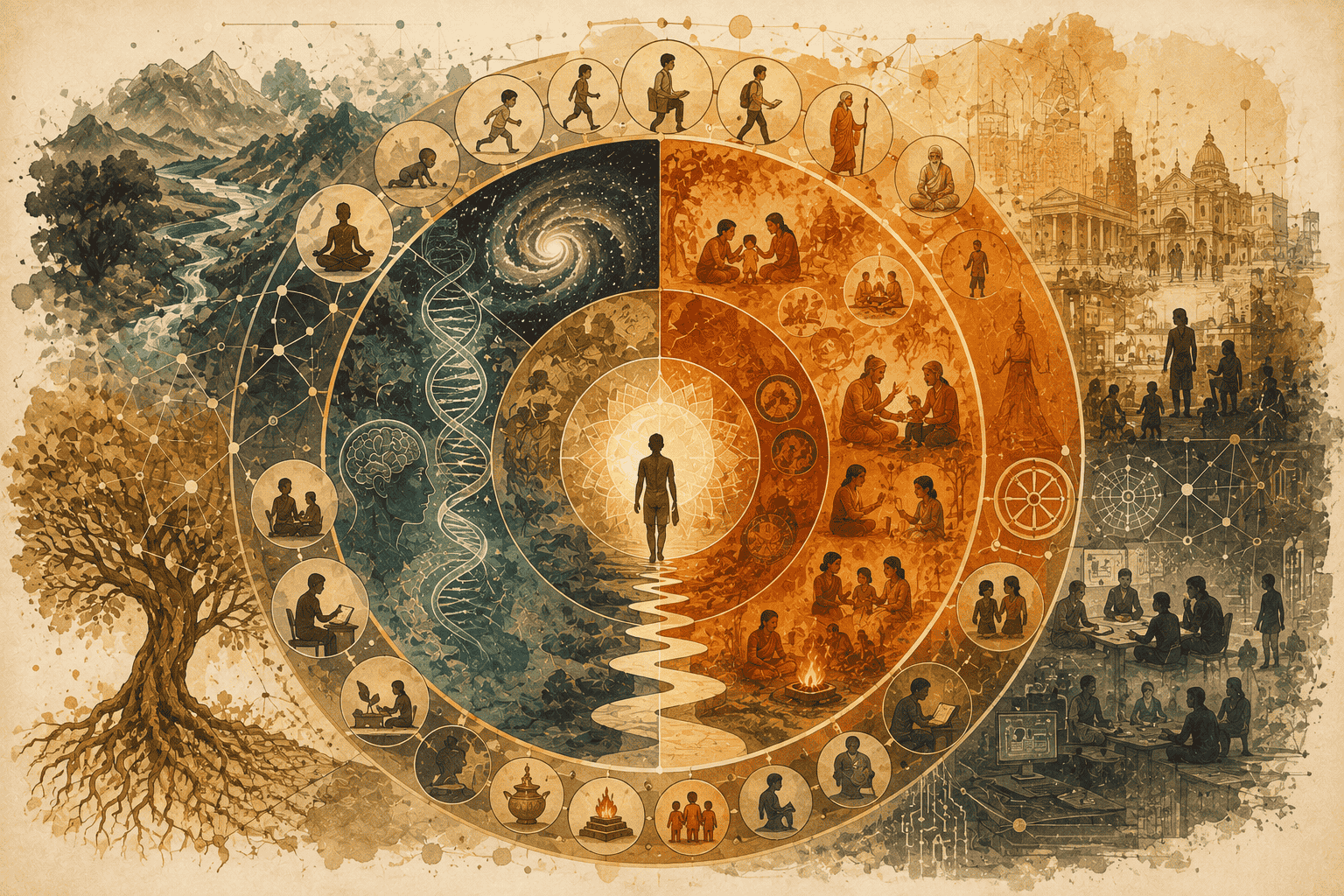
Shaping Human Behavior through an interplay of Nature (Biological and Psychological traits) and Nurture (Social Intelligence).
Are human beings born, or are they made? How are they shaped? Every civilization carries an answer to this question.
Some traditions assume that human nature is largely fixed. Others argue that human beings are products of their environment. Modern sciences continue to debate the relative influence of genetics, psychology, culture and social structures.
However, what if all of them are partially correct? The Indic tradition appears to begin with a more complex understanding of the human condition. Human beings are neither blank slates nor prisoners of biology. They are born with certain tendencies, shaped by circumstances, influenced by culture, guided by institutions and capable of consciously transforming themselves.
The question therefore is not whether human beings can change. The question is how societies participate in that change.
Modern disciplines often approach this issue from different directions. Sociobiology explores the influence of evolutionary instincts on behaviour. Psychology examines cognition, emotions and personality. Economists study incentives and decision-making. Thinkers such as Sigmund Freud investigated unconscious motivations, while researchers such as Dan Ariely demonstrated how human decisions frequently depart from rational calculations.
These insights are valuable. Yet they also raise an important question. If human behaviour is shaped by so many visible and invisible influences, how do civilizations cultivate character, responsibility and wisdom across generations?
The Indic answer lies not merely in ideas, but in institutions of human formation. For centuries, Bharatiya society developed mechanisms designed to shape individuals throughout the course of life. Education, rituals, festivals, family traditions, vows, pilgrimages and community participation were not viewed as separate cultural activities. They functioned as instruments of psychological, ethical and civilizational development.
Society was not merely organizing human beings. It was cultivating them. This understanding becomes visible in the concept of Samskara.
The sixteen Samskaras were not simply ceremonial events marking birth, marriage or death. They represented a structured process through which individuals were gradually introduced into larger circles of responsibility and meaning. Each stage sought to align personal development with family, community and civilizational obligations.
In this sense, the Samskaras may be viewed as civilizational technologies of human development.
Long before the emergence of modern behavioural sciences, societies across Bharat had already developed sophisticated methods for shaping conduct, values and identity. Whether through rites of passage, initiatory practices, communal rituals or symbolic acts, the underlying assumption remained the same: human potential requires cultivation.
This perspective led us toward a deeper philosophical question.
How does transformation occur? Many modern theories explain change through external causes and environmental pressures. Indic philosophy often approaches the matter differently. The principle of Satkaryavada suggests that the effect already exists within the cause in a latent form. Growth is not the creation of something entirely new; it is the unfolding of what already exists in potential.
Applied to human development, this produces a powerful insight. Education does not manufacture wisdom. It helps reveal it. Culture does not create human potential. It nurtures its emergence.
This idea finds surprising parallels in modern discussions of human evolution. Biologist Jonas Salk argued that humanity has entered a stage where evolution increasingly occurs through culture, knowledge, ethics and consciousness rather than biology alone. The future of human development depends not merely on genes, but on the ideas and institutions transmitted across generations.
The resemblance to the Indic understanding of Samskara is difficult to ignore. Human beings evolve through culture. Civilizations evolve through the human beings they cultivate.
This brings us to an equally important question: how does an individual learn to navigate society itself? The Indic tradition developed a series of frameworks that guided this journey. The Ashrama Vyavastha organized life into stages of learning, household responsibility, social contribution and spiritual reflection. The Samskaras marked transitions between these stages. Together, they created pathways through which personal growth remained connected to social responsibility.
One of the most fascinating insights emerging from our discussions was the movement between different modes of experience and awareness.
The individual begins with the first-person perspective – “I.” Gradually, one learns the second-person perspective – recognizing the reality of “you.” Society requires the third-person perspective — understanding institutions, systems and collective life.
Yet many Indic traditions push further still, toward what may be called a “zero perspective,” where the distinction between observer and observed begins to dissolve.
This raises a profound challenge for contemporary social sciences.
Can human beings be fully understood through external observation alone? Can consciousness, meaning and lived experience be reduced entirely to measurable variables? Or do civilizations preserve forms of knowledge that emerge from participation rather than observation?
The Indic Framework does not reject biology, psychology or sociology. Instead, it seeks to integrate them. Human beings are simultaneously biological, psychological, social, cultural and spiritual. Any framework that neglects one of these dimensions risks reducing the complexity of human existence.
Indic Constructivism therefore studies how civilizations shape human beings across generations. It examines the institutions, practices and ideas through which societies cultivate character, responsibility, consciousness and wisdom.
The individual is not merely born into society. The individual is continuously formed by it. And through that process, society itself is renewed.
