What is a human being? Before we study society, politics, economics or culture, perhaps we must confront a simpler question. Who is the human being that these disciplines seek to understand? The question appears obvious until we attempt to answer it.
Is a human being merely a biological organism seeking survival? Is he an economic actor maximizing utility? A political actor pursuing power? A psychological being responding to stimuli? Or a social creature shaped by institutions and circumstances?
Modern disciplines often study one aspect of human existence and gradually elevate it into the whole. Economics produces the economic man. Political science produces the political man. Psychology produces the psychological man. Sociology produces the social man. But is man merely the sum of these fragments? The Indic tradition approached the question differently.
Rather than beginning with institutions or systems, it began with the human being itself. It asked – कः त्वं ? कः अस्मि ? not merely what people do, but what they are. It sought to understand human existence through categories that connected the material, psychological, ethical, social and spiritual dimensions of life.
This produced a rich set of civilizational concepts that continue to shape Bharatiya society.
Concepts such as Purushartha, Ashrama, Triguna, Panchakosha, Karma, Atman and Varna were not isolated religious doctrines. They functioned as frameworks for understanding human nature, social roles, life stages, motivations and aspirations.
The idea of Purushartha is particularly significant.
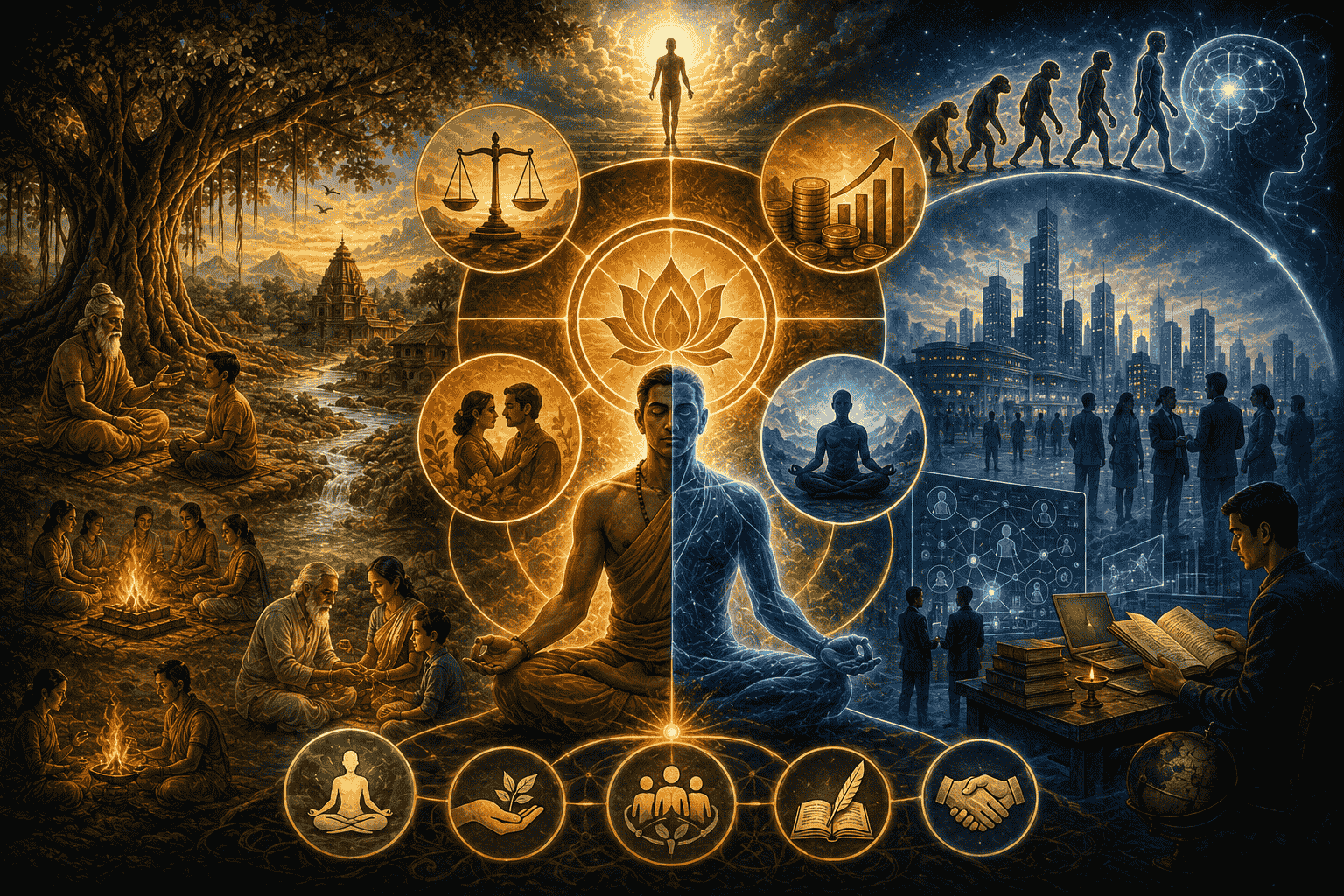
Modern societies frequently organize themselves around prosperity, consumption and individual fulfilment. Yet the Indic tradition proposed four interconnected goals of human life: Dharma, Artha, Kama and Moksha. Wealth and desire were not rejected, but neither were they treated as ultimate ends. Human life was viewed as a journey balancing material prosperity, ethical responsibility, emotional fulfilment and spiritual liberation.
The question was not merely how to live. The question was why to live. This naturally led us toward an interesting comparison with modern theories of human development.
The psychologist Abraham Maslow is widely known for his hierarchy of needs, culminating in self-actualization. Yet in his later writings, Maslow increasingly emphasized a higher stage which he called self-transcendence. Human beings, he argued, often move beyond personal fulfilment toward service, sacrifice, meaning and experiences that connect them to something larger than themselves.
The resemblance is striking.
What modern psychology arrived at after decades of inquiry appears remarkably close to insights embedded within the Indic understanding of Purusharthas and Moksha. Human development does not conclude with the self; it culminates in moving beyond the self. The discussion becomes even more interesting when viewed through the lens of human evolution.
Biologist Jonas Salk proposed that humanity has entered a stage where evolution is no longer merely biological. The future of the species increasingly depends upon culture, knowledge, ethics and consciousness. In many ways, this resonates with Indic ideas of Samskara.
Could education, rituals, festivals, family traditions and social institutions be understood as civilizational technologies designed to shape future generations?
The sixteen Samskaras, rites of passage, initiation ceremonies and other traditional practices suggest that Bharatiya society devoted immense attention to the cultivation of human character. Whether every practice remains relevant today is a separate question. What matters is the underlying assumption: human beings are not merely born; they are consciously shaped.
The concept of Panchakosha takes this inquiry even further.
A person is not reduced to the physical body alone. Human existence unfolds through multiple layers — physical, energetic, mental, intellectual and spiritual. Such a framework encourages us to ask whether social sciences can adequately understand human beings while focusing exclusively on material or behavioural dimensions.
Similarly, the theory of Triguna offers a dynamic understanding of personality and behaviour. Human tendencies emerge through varying combinations of Sattva, Rajas and Tamas rather than through fixed categories. Human nature is understood as fluid, evolving and capable of transformation.
Another concept that invites careful reconsideration is Varna. Contemporary discussions frequently reduce it to questions of caste, hierarchy or identity. While these historical realities demand serious study, they should not exhaust the meaning of the concept itself.
Perhaps we must first ask a more fundamental question. What does the word Varna actually mean? Interestingly, Sanskrit employs the same root across several domains of knowledge.
Varnamala refers to the systematic arrangement of sounds. Human speech exists as a continuous spectrum, yet language becomes intelligible by differentiating that spectrum into distinct phonetic categories.
Similarly, Varna also denotes colour. Light appears as a continuous phenomenon, yet we recognize different colours as distinguishable expressions within that continuum.
The word Varnana means description itself—the act of discerning, distinguishing and expressing reality through meaningful categories.
Could the concept of Varna in society also belong to this larger civilizational logic?
Rather than beginning as a rigid classification of persons, it may have originated as an analytical framework for understanding diversity within unity. Human beings possess different dispositions, temperaments, capacities and social functions, yet all remain participants in the same civilizational order.
In this sense, Varna may be understood not as fragmentation but as differentiation within an underlying continuum.
Whether, how and to what extent this conceptual framework evolved into historical social institutions remains an important question for future scholarship. Such inquiry requires careful historical and textual investigation rather than beginning from ideological assumptions alone.
These categories point toward a larger civilizational insight.
The Indic understanding of personhood refuses to reduce human beings to a single dimension. A person is simultaneously biological, social, ethical, intellectual and spiritual. Human flourishing therefore requires the harmonious development of all these dimensions.
The challenge before contemporary social sciences is significant.
Can societies be understood without first understanding the human beings who constitute them? Can we explain civilization while neglecting questions of consciousness, meaning, duty and transcendence? Can we truly understand another human being while remaining entirely outside their experience?
The Indic Framework invites us to revisit these questions. Not because modern categories are useless, but because they may be incomplete.
Frameworks such as Purushartha, Panchakosha, Triguna, Ashrama and Karma offer alternative lenses through which human nature, social development and civilizational continuity may be studied. They provide categories that emerged not from laboratories or political revolutions, but from centuries of reflection on what it means to be human.
The study of society, therefore, begins with the study of the self. And perhaps every civilization ultimately reflects the answer it gives to that question.
