
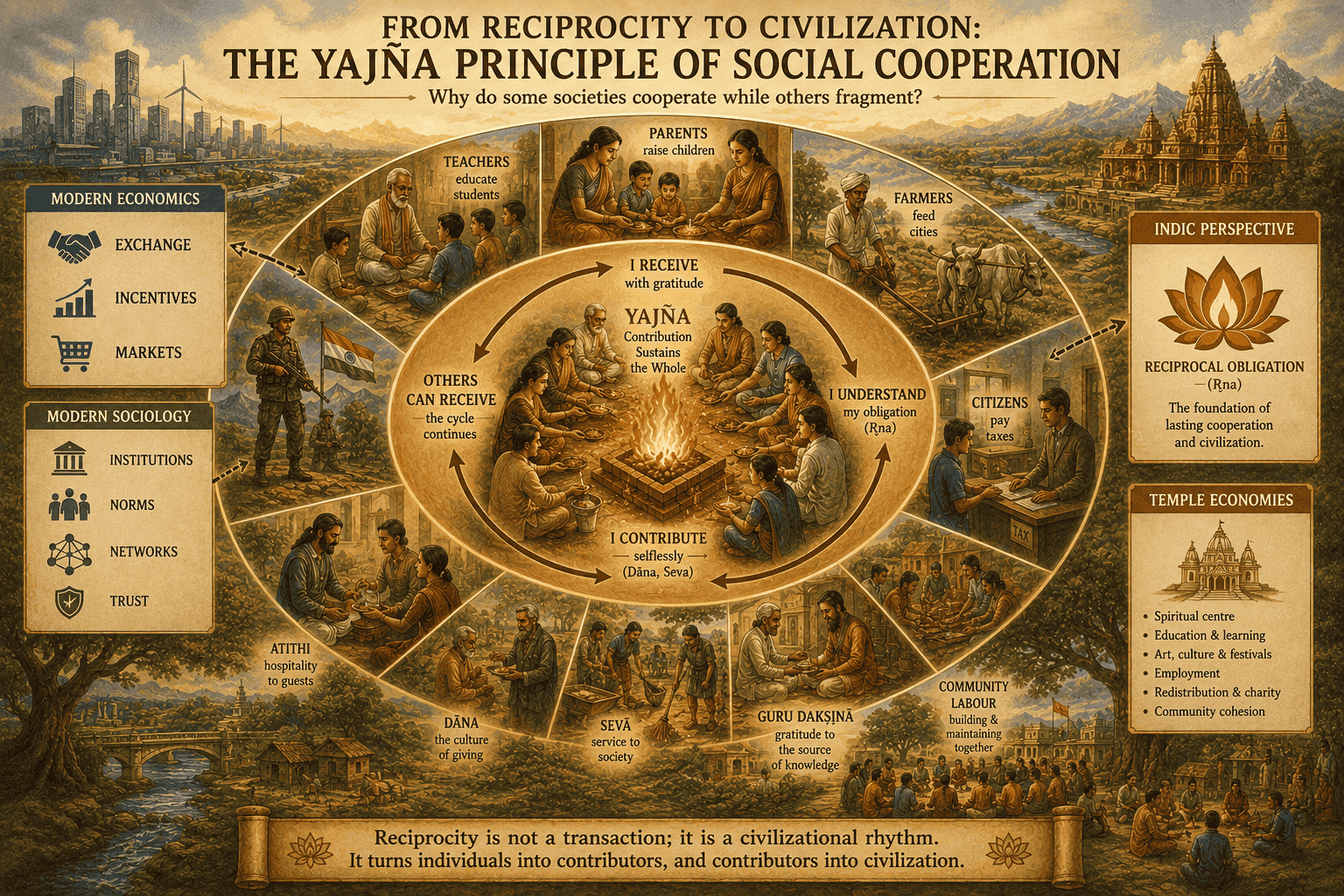
What Holds a Society Together — Competition or Contribution?
Modern social theory often begins with an assumption that appears almost self-evident today: individuals pursue their own interests, and society emerges from the interaction, competition and negotiation of those interests. Markets function through competition. Politics revolves around competing groups. Social progress is frequently explained through conflict, bargaining and the pursuit of advantage.
But is competition sufficient to explain how societies endure?
Competition can explain why individuals strive, innovate and attempt to improve their position. It can explain the functioning of markets and perhaps even some forms of political struggle. Yet a society cannot survive through competition alone. A society composed entirely of self-interested individuals pursuing advantage would eventually cease to resemble a society at all. It would become a herd in which self-interest is the highest principle and every relationship exists only as long as it produces immediate benefit.
Civilization has survived for thousands of years not merely because people compete with one another, but because they cooperate, contribute and sometimes sacrifice for people they may never personally benefit from. Parents raise children without expecting repayment. Teachers transmit knowledge accumulated across generations. Communities preserve traditions for descendants they will never meet. Families support elderly members long after their economic productivity has ceased. Temples feed strangers. Villages maintain common resources. Individuals give away wealth, labour and knowledge for purposes extending beyond themselves.
What principle explains such actions?
For the Social Ecology of the Embedded Economy, this question is foundational. A society cannot be understood only through the individual pursuit of interest. We must also understand the relationships of contribution that hold individuals together. The Indic tradition offers a powerful category through which this can be examined: Yajña.
Beyond Ritual: Yajña as a Social Principle
Today, Yajña is often understood primarily as a ritual involving offerings into a sacred fire. Yet the civilizational idea extends beyond ritual practice. The Bhagavad Gītā presents Yajña within a larger relationship of mutual nourishment and reciprocal sustenance. The fundamental idea is that life is not sustained by isolated accumulation. Every individual receives from a larger network and must, in some manner, contribute back to it.
This makes Yajña a potentially powerful principle for understanding society.
Human beings do not create the conditions of their existence independently. We are born into languages we did not create, institutions we did not build, knowledge accumulated before our birth and ecological systems that sustain us without our participation. Even our ability to think is shaped through categories, words and knowledge transmitted by others.
The question, therefore, is not merely: What belongs to me?
It is also: What have I received, and what do I owe?
This introduces the idea of Rina, or obligation. Human life begins not as the existence of an isolated individual entering society through a contract, but within an already existing network of relationships. Parents nurture us before we can stand. Teachers transmit knowledge. Society provides institutions and culture. Nature provides the material conditions of life. Previous generations have already contributed to the world into which we are born.
Human existence, therefore, begins with receiving.
The civilizational question becomes whether it also ends with contribution.
From Rina to Dana
The recognition of obligation historically generated a culture of contribution. Dana was not simply an act of charity performed by an individual who happened to possess surplus wealth. It was also a recognition that wealth acquires wider meaning when it circulates.
This is an important distinction.
Modern economics is highly effective at examining the production and allocation of resources. The Yajña perspective introduces another question: What happens when resources stop circulating through relationships of obligation?
Wealth may be privately accumulated, but a civilization survives through forms of social circulation. Knowledge must be transmitted. Food must reach those who need it. Productive capacity must support dependent populations. The successful must contribute to institutions that create future success.
In this sense, contribution is not the opposite of prosperity. It may be one of the conditions that make prosperity socially sustainable.
This perspective shaped many of Bharat’s enduring institutions.
Institutions of Contribution
Gurukulas were sustained through relationships that could not be reduced entirely to commercial exchange. Knowledge was transmitted as part of a continuing relationship between teacher, student and society.
Temples were similarly more than spiritual centres. In many historical contexts, they functioned as institutions connected with economic activity, patronage, redistribution, food distribution, education, craft production and support for communities. Annadana ensured that food reached pilgrims, travellers and those in need.
These institutions reveal something important about the Embedded Economy: not every economically significant institution exists primarily for economic purposes.
A temple may be built for sacred purposes and yet support artisans, agricultural systems, kitchens, pilgrims and local communities. A family exists for relationships and continuity, yet it also provides economic security. A community may preserve a tradition for cultural reasons, yet that tradition may sustain occupations, institutions and networks of trust.
The economy is therefore embedded within a larger social ecology.
The Jajmani System and Reciprocal Contribution
The Jajmani System provides another important illustration, though it must be approached carefully.
Modern sociology has often interpreted the system primarily through caste and occupational hierarchy. These dimensions undoubtedly existed, and they cannot simply be ignored or romanticised. But such an interpretation remains incomplete if it reduces the entire institution only to hierarchy.
The system may also be understood as a network of reciprocal obligation. Different occupational groups were connected through long-term relationships of service, exchange and responsibility. Farmers, artisans, priests, potters, barbers, blacksmiths, carpenters and numerous other occupational communities participated in a network that extended beyond anonymous market transactions.
The relationship was often not simply, “I purchase your service today because your price is lower.”
It was, instead, a continuing relationship in which economic exchange was embedded within social expectation, familiarity and obligation. Goods and services circulated through enduring networks. The relationship could continue across generations.
This does not mean that the system was always equal, just or free from exploitation. It was not. But the analytical principle remains important: economic systems can be organized through relationships of reciprocal contribution rather than through competition and contracts alone.
At its best, the Jajmani System reflected an interconnected social order in which different functions contributed to the continuity of the larger whole.
Society as a Network of Yajña
The deeper argument can now be stated clearly.
A society survives because individuals contribute to systems from which they themselves also receive. The farmer produces food but depends upon artisans, traders, families and institutions. The teacher produces knowledge but depends upon social support. The entrepreneur creates wealth but depends upon infrastructure, workers, institutions and accumulated knowledge. The elderly may cease to participate in production but continue to carry memory and experience.
Every individual receives from the larger whole.
Every individual therefore has the possibility of contributing to it.
The Yajña Model examines society as a network of these reciprocal relationships. It asks not merely how resources are produced, but how they circulate. It asks not merely how individuals succeed, but how their success becomes socially productive. It asks not merely what society gives an individual, but what individuals return to the society that has sustained them.
This produces a different understanding of social harmony.
Beyond Competition and Welfare
Competition and contribution need not be enemies. Competition may generate innovation, efficiency and excellence. But when competition becomes the only organizing principle, relationships become increasingly transactional. Every act must justify itself through individual benefit.
Similarly, a purely welfare-based society may produce a different problem if citizens increasingly understand society only through what they can receive. The Yajña Model introduces a third relationship. A person is neither merely a competitor nor merely a beneficiary. A person is a participant.
This changes the social vocabulary:
| Individual-Centred Question | Yajña-Centred Question |
|---|---|
| What can I gain? | What do I receive and contribute? |
| How much do I own? | How does value circulate? |
| What are my rights? | What are my rights and responsibilities? |
| How do I defeat others? | How do different functions contribute together? |
| What can society provide me? | What can I return to society? |
| How do I maximize? | How do I participate in sustaining the larger whole? |
This does not abolish individual aspiration. It places aspiration within relationship.
The emphasis shifts from accumulation alone to circulation, from isolated ownership to responsibility, and from individual success alone to participation in a larger social order.
The Yajña Model of Society
The Yajña Model therefore provides a foundational principle for the Embedded Economy framework.
The economy is not held together only by prices and contracts. Society is not held together only by laws and institutions. Civilization cannot survive merely because individuals happen to pursue compatible interests.
Every society requires a culture of contribution. Parents must invest in children. Teachers must transmit knowledge. The economically capable must support institutions larger than themselves. Communities must preserve shared resources. Citizens must contribute to public life. Every generation must, in some way, receive from the past and contribute to the future.
The Indic concept of Yajña provides a language for understanding this continuity. It suggests that social life is sustained when receiving and giving remain connected. For a civilization rooted in Dharma, this balance becomes essential. Rights without responsibility create entitlement. Competition without contribution creates fragmentation. Wealth without circulation creates inequality and social distance. Institutions without voluntary participation eventually become increasingly dependent upon coercion.
No law can force an entire civilization to care indefinitely. No market can generate every form of trust it requires. No welfare system can replace the willingness of society to participate in its own continuity. This is why Yajña can be understood not merely as a ritual but as a theory of society. It describes the principle through which individuals, communities, institutions, nature and generations remain connected through reciprocal contribution.
The fundamental question for a society, therefore, is not simply whether it is competitive or prosperous. It is whether those who receive from the larger order continue to feel responsible for sustaining it. That is where the Yajña Model becomes foundational to the study of the Embedded Economy: a civilization endures not only because individuals pursue their interests, but because enough people continue to contribute to something larger than themselves.
