
Was Knowledge in Bharat Controlled by One Authority?
To understand the structure of knowledge in Bharat, we must first ask a comparative question: who had the authority to decide what could be known? The answer was historically very different in different civilizations. In medieval Europe, intellectual life developed for centuries in close association with ecclesiastical institutions. Monasteries, cathedral schools and later universities were deeply connected with the Christian Church, while theological questions could be subject to institutional examination, condemnation and, in certain circumstances, censorship. This does not mean that medieval Christianity produced no science, philosophy or scholarship; Church institutions also preserved texts and created important centres of learning. The point is that European intellectual history developed within a comparatively centralized religious structure in which the Church possessed a transregional institutional authority that could intervene in matters of doctrine and intellectual orthodoxy.
Bharat developed differently. It possessed no equivalent of a single civilizational Church and no universally recognized institution that could determine, for the entire subcontinent, which ideas were permissible and which intellectual traditions had to disappear. There was no Indian Pope, no single religious council whose verdict settled all philosophical questions, and no single university that monopolized higher learning. Yet this does not mean that knowledge was without authority or that access to knowledge was universally equal. Vedic learning, in particular, was historically transmitted through particular social and pedagogical structures, and inequalities of caste, gender and social position affected access to education. These realities must be acknowledged clearly.
The more important distinction is between authority and monopoly. The Vedas possessed immense authority within traditions that accepted them, but Vedic authority did not prevent the emergence of Buddhist, Jain and materialist intellectual traditions. The result was not a civilization without hierarchy, but a civilization in which knowledge emerged from multiple centres, travelled through different institutions and remained open to prolonged intellectual disagreement.
The Vedas as an Authority, Not a Complete Monopoly of Knowledge
The Vedas formed one of the foundational sources of Bharatiya knowledge. They were not merely religious texts in the modern narrow sense, because their preservation and interpretation produced extensive developments in language, phonetics, metre, ritual theory, philosophy and other intellectual disciplines. UNESCO describes the Vedic corpus as one of the world’s oldest surviving cultural traditions and recognizes the extraordinary oral techniques through which practitioners preserved the pronunciation and structure of the texts over centuries. The system was remarkable because knowledge was preserved not only through manuscripts but through highly disciplined oral transmission involving different modes of recitation.
However, the Vedas were never the complete intellectual universe of Bharat. The Vedic corpus itself generated layers of interpretation through the Brāhmaṇas, Āraṇyakas and Upaniṣads, while the Vedāṅgas developed specialized fields such as phonetics, grammar, etymology, metre, ritual procedure and astronomy. Later intellectual traditions developed distinct systems of philosophy, including Nyāya, Vaiśeṣika, Sāṅkhya, Yoga, Mīmāṃsā and Vedānta. Alongside these emerged extensive bodies of knowledge in medicine, mathematics, astronomy, statecraft, architecture, aesthetics and linguistics.
The crucial fact, however, is that this intellectual world was never restricted to traditions that accepted the authority of the Vedas. Buddhist and Jain traditions developed extensive philosophical and scholastic systems outside the Vedic framework, while Cārvāka and Lokāyata traditions represented more radical challenges to accepted metaphysical assumptions. An official account of Bharatiya knowledge traditions by IGNCA itself places Vedic philosophical traditions alongside Buddhist, Jain and Cārvāka systems, demonstrating that the intellectual history of Bharat cannot be described as a single linear tradition emerging from one canon.
This is important because disagreement did not automatically require intellectual exclusion. A Buddhist could reject Vedic authority, a Jain could develop a different understanding of reality, and a materialist could question metaphysical claims. These positions could be criticized, defeated in debate or marginalized in particular periods, but they nevertheless generated their own texts, teachers, institutions and intellectual lineages. The existence of multiple systems of thought was therefore not a later secular development imposed upon an originally uniform civilization. Intellectual plurality was built into the civilizational structure itself.
Śruti, Smṛti and the Expansion of Knowledge
The distinction between Śruti and Smṛti is central to understanding this architecture. Śruti possessed a particular status within Vedic traditions, while Smṛti represented a vast body of remembered, transmitted and historically elaborated knowledge. Dharmaśāstras, for example, were not identical to the Vedas, and different Smṛti texts could themselves disagree. The Indian intellectual world therefore did not consist simply of an original sacred text followed by permanent closure.
Beyond Śruti and Smṛti stood the Itihāsas, Purāṇas, Āgamas, Tantras, Śāstras, regional literary traditions, medical texts and technical knowledge systems. The intellectual map included the Rāmāyaṇa and Mahābhārata, Dharmaśāstra, regional Purāṇic traditions and philosophical systems that did not always share identical assumptions. IGNCA’s own presentation of Bharatiya knowledge traditions reflects this plurality by treating Vedic texts, philosophical schools, Jain thought, Buddhist thought, Cārvāka traditions, Itihāsa, Purāṇa and Smṛti as parts of a larger intellectual landscape rather than forcing them into one homogeneous canon.
This produced an important characteristic of Bharatiya knowledge: the expansion of the tradition did not necessarily require the creation of a single final authority that closed further interpretation. New commentaries could emerge, older texts could be interpreted differently, new teachers could establish lineages and regional languages could become vehicles of sophisticated knowledge. Intellectual continuity therefore depended as much upon interpretation as preservation.
Gurukula Was Only One Centre of Knowledge
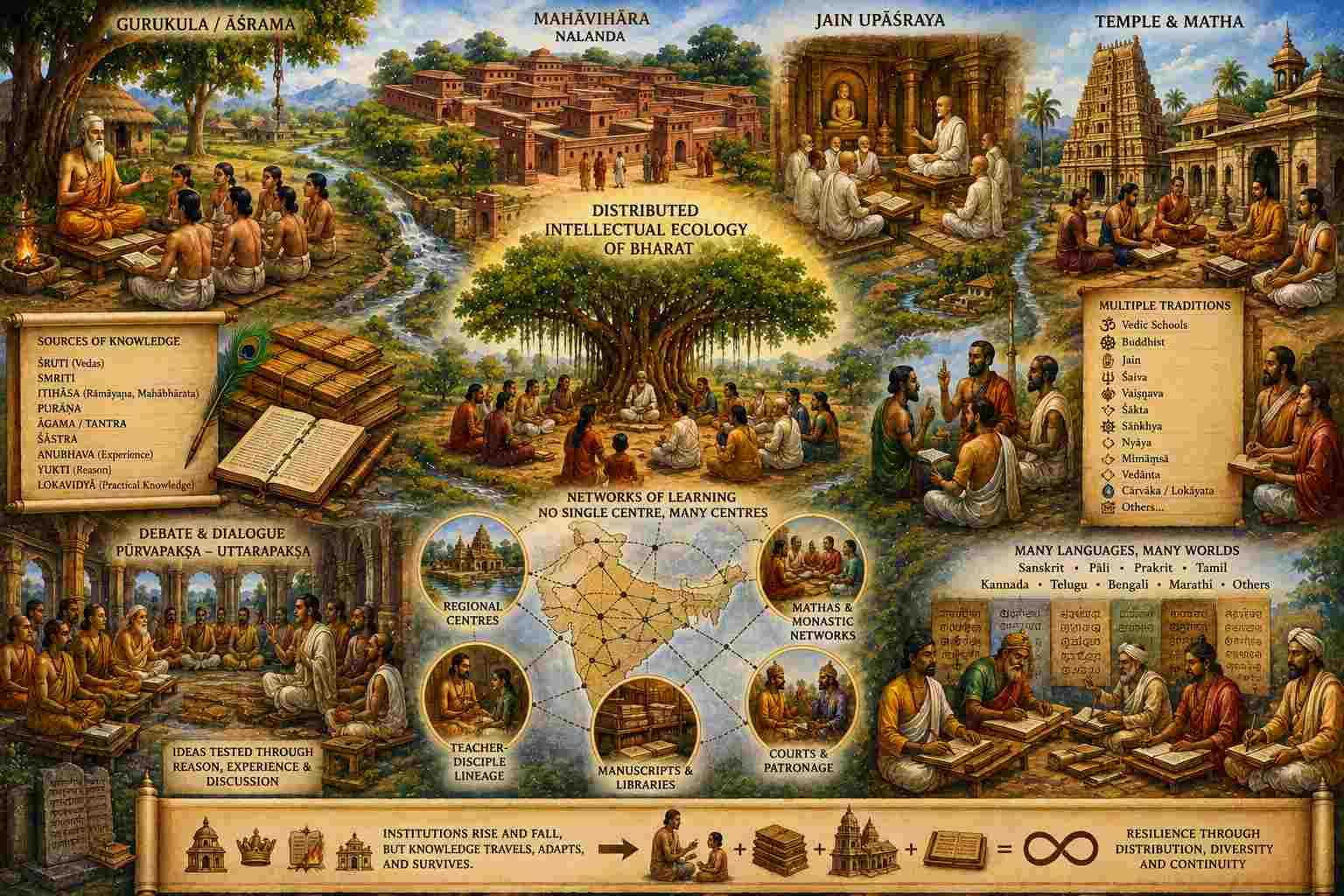
One of the most common simplifications of Indian education is to imagine that the entire system consisted of the gurukula. The guru-śiṣya relationship was undoubtedly one of the most important foundations of knowledge transmission, but it was never the only institutional form.
The gurukula and āśrama represented one model in which education was organized around a teacher and a community of students. Knowledge could be transmitted through prolonged association, observation, memorization, dialogue and practice. This pedagogical structure was particularly suitable for traditions in which knowledge was inseparable from discipline, conduct and lived experience.
But Bharat also developed maṭhas, vihāras, temple-based learning centres, Jain institutions, manuscript repositories, royal courts and specialized centres of learning. Knowledge could be preserved by a teacher, but it could also be institutionalized. It could remain within a lineage, but it could also travel through networks of scholars.
The guru was therefore one node in a much larger intellectual network.
From the Teacher to the Mahāvihāra
The growth of large centres such as Nalanda demonstrates that Indic education was capable of institutional expansion without abandoning older pedagogical principles. Nalanda was not simply a collection of isolated teachers, nor should it be understood as a modern university projected backwards into ancient India. It was a Mahāvihāra with its own monastic, scholastic and residential organization.
UNESCO describes Nalanda as one of the earliest and longest-serving monastic-cum-scholastic establishments, functioning as a major centre of learning from approximately the fifth to the thirteenth century CE. Its institutional structure included formal repositories of manuscripts, systems of learning and administration, and an intellectual culture in which debate and the guru-śiṣya tradition were central. Its influence extended across Asia through scholars and intellectual networks, while its institutional model helped shape later Mahāvihāras.
Nalanda therefore demonstrates an important point about the Indic system. The civilization did not have to choose between individual teachers and large institutions. Both could exist simultaneously. A knowledge system could be transmitted through a single teacher and, at another scale, through a vast institutional network.
This plurality also applied to Buddhist, Jain and Hindu traditions. Different sampradāyas established their own institutions, and different regions developed their own intellectual centres. The disappearance of one centre did not necessarily destroy the knowledge itself because the tradition could survive elsewhere through another institution or lineage.
Knowledge Was Distributed Across Many Institutions
This distributed architecture gave Bharatiya knowledge unusual resilience. A text could exist in manuscript form, but it could also be preserved orally. A philosophical tradition could exist within a maṭha, but its ideas could also survive through commentaries and teachers. A technical skill could remain embedded within a professional or artistic lineage without requiring a centralized university.
The history of Vedic preservation provides the clearest example. The extraordinary oral recitation systems were not dependent upon one central archive. They were distributed across lineages and regions. UNESCO notes that the Vedas survived through complex techniques of oral preservation, although only a small fraction of the historically recorded recitation branches survive today. The survival of such a system depended upon the continuous existence of multiple teacher-disciple communities rather than a single repository.
The same principle applied to other forms of knowledge. The performing arts developed through hereditary and teacher-based traditions. Philosophical systems travelled through disciples and commentaries. Medical and technical knowledge circulated through texts, practice and specialized communities. Oral traditions preserved memories that were not necessarily contained within elite textual institutions. UNESCO’s broader work on oral traditions emphasizes that knowledge survives through continued person-to-person transmission and community practice, not merely through the storage of written records.
This means that the destruction of an institution did not automatically result in the destruction of the knowledge tradition associated with it. The decline of a kingdom, the disappearance of a patron or even the loss of a library could produce immense damage, but a tradition could survive through teachers, disciples, manuscripts and other institutions located elsewhere.
The system was therefore vulnerable, but it was not dependent upon a single point of failure.
The Non-Vedic Traditions and the Autonomy of Thought
The strongest evidence against a centralized intellectual model lies in the persistence of traditions that challenged the Vedic worldview itself. If the entire civilization had been intellectually controlled by one institution, it is difficult to explain how Buddhism and Jainism developed massive monastic networks, canonical traditions and systems of philosophy that remained influential for centuries.
The Buddhist world developed major centres of learning and intellectual traditions with their own epistemological and metaphysical positions. Nalanda itself demonstrates the scale of this institutional development. Jain traditions created their own scholastic networks, monastic orders and manuscript traditions. Cārvāka thought, despite the loss of many primary texts, survived sufficiently within the intellectual record to become an object of sustained philosophical criticism and reconstruction.
The more interesting feature of Bharatiya thought was therefore not the absence of disagreement but the institutionalization of disagreement. A philosophical opponent had to be understood because the opposing argument itself became part of the intellectual process. Through Pūrvapakṣa, an opposing position could be reconstructed before its critique through Uttarapakṣa.
This did not mean that debates were always conducted with modern standards of tolerance. Intellectual traditions could be polemical, sectarian and fiercely competitive. However, the intellectual opponent was often treated as a position that had to be engaged rather than simply erased from the field of knowledge.
The result was a continuing process of commentary, response, reinterpretation and counter-response.
When One Answer Was Not Enough
This is perhaps the most important characteristic of the distributed Indian intellectual system. If a school of thought could not answer a question satisfactorily, the intellectual response was not always to wait for a central authority to produce a new doctrine. New teachers could develop new interpretations, and those interpretations could acquire disciples, commentaries and institutions.
The history of Indian philosophy reflects this process. Nyāya developed its own theories of valid knowledge. Buddhist thinkers challenged those theories and produced alternative epistemological positions. Vedāntic traditions developed different interpretations of the relationship between the individual and ultimate reality. Jain thought developed anekāntavāda, while Cārvāka traditions challenged the metaphysical assumptions shared by many other schools.
The point is not that every new school emerged in complete intellectual freedom. Teachers required communities, resources, students and social legitimacy. However, the intellectual architecture contained multiple pathways through which a new idea could become a tradition.
A new philosophical position could begin with a teacher, become a commentary, attract disciples, generate debate and eventually produce an institutional network. Knowledge could therefore move from individual inquiry to civilizational influence without requiring approval from a single centralized intellectual authority.
The Difference Was Institutional, Not Simply Religious
The difference between Europe and Bharat should therefore not be described crudely as “the West had religion and India had freedom.” Both civilizations possessed religious authority, intellectual restrictions and institutional hierarchies. Europe also produced universities, philosophical traditions and eventually powerful movements for intellectual autonomy. Bharat also contained social exclusions and powerful systems of orthodoxy.
The real difference lies in institutional architecture.
Medieval Europe developed a powerful transregional ecclesiastical organization that played a major role in defining intellectual and theological authority. Its relationship with universities was complex: ecclesiastical authority could support universities, sustain them and also intervene in disputes over doctrine. Historical scholarship on medieval academic life demonstrates that episcopal and papal power could be both enabling and restrictive, depending upon the institution and historical context.
Bharat, by contrast, developed no equivalent pan-Indian institution exercising universal authority over every darśana, sampradāya, language and educational institution. There was no single institutional centre that controlled Vedic, Buddhist, Jain, Śaiva, Vaiṣṇava and regional intellectual traditions together.
The consequence was a fundamentally plural knowledge order.
The Distributed Knowledge Model
The Indic Knowledge System can therefore be studied through what may be called a Distributed Knowledge Model. Knowledge was distributed not only geographically but institutionally, linguistically and epistemologically.
The sources of knowledge were multiple. They included Śruti, Smṛti, Śāstra, Āgama, observation, reasoning, debate, memory and practice.
The intellectual traditions were multiple. Vedic philosophical schools existed alongside Buddhist, Jain, Śaiva, Vaiṣṇava, Śākta and materialist traditions.
The institutions were multiple. Gurukulas and āśramas existed alongside maṭhas, vihāras, temple institutions, Jain centres, manuscript repositories, courts and large residential centres of learning.
The languages were multiple. Sanskrit possessed an extraordinary intellectual role, but knowledge also developed through Pāli, Prakrit, Tamil and numerous regional languages.
The transmission mechanisms were multiple. Knowledge could move orally, through manuscripts, commentary, debate, apprenticeship, performance and teacher-disciple relationships.
No single institution controlled all of these simultaneously.
This was the civilizational architecture that allowed Bharatiya knowledge to survive political fragmentation. The political map could change without necessarily reorganizing every school of learning. A dynasty could collapse without automatically terminating a philosophical lineage. A political ruler could patronize a tradition, but the tradition itself did not always belong exclusively to that ruler.
Beyond Centralized Knowledge
The larger implication extends beyond the history of education. Knowledge is often treated as something produced by a university, regulated by a state and preserved in a library. The Bharatiya experience suggests a more complex possibility. A civilization can produce knowledge through institutions, but it can also produce it through relationships between teachers, communities, texts, practices and competing traditions.
This does not mean that the Indian system should be romanticized. The unequal distribution of educational access, the restrictions imposed upon certain communities and the historical decline of many knowledge institutions remain serious parts of the story. A distributed system can also become fragmented, socially restricted and difficult to preserve.
Yet its resilience cannot be ignored.
The Vedic tradition survived through oral lineages. Buddhist thought travelled across Asia through monastic networks. Jain traditions preserved their own intellectual systems. Philosophical schools continued through commentarial lineages. Regional languages produced their own worlds of literature and knowledge. Different institutions could disappear while other centres continued the work of preservation and transmission.
Bharat therefore did not create one knowledge system. It created a civilizational ecology of knowledge in which different sources, traditions and institutions could coexist, compete and influence one another.
The fundamental question was not always whether a single institution had authorized an idea. Intellectual legitimacy could also emerge from the strength of argument, the authority of a guru, the continuity of a paramparā, the interpretation of a text, the formation of a sampradāya or the practical survival of a knowledge tradition.
To understand Bharat through the centralized model of knowledge is therefore to miss one of its deepest institutional characteristics. Knowledge did not live in one building, one canon, one language or one authority. It moved through a vast network of teachers, traditions, communities and institutions that collectively formed the intellectual architecture of civilization.
The destruction of any one institution could therefore cause serious loss, but it did not necessarily terminate the entire system. Knowledge could move, adapt, find new custodians and establish new centres. This capacity for distributed preservation and intellectual regeneration may be one of the most important reasons why the study of Bharat must move beyond the idea of knowledge as something controlled from a single centre.
Bharat’s intellectual history is better understood not as a centralized hierarchy of knowledge, but as a civilizational network in which authority existed at multiple levels and knowledge could survive through multiple pathways.
