Can a society integrate market, community and state without allowing any one of them to become absolute?
This question lies at the heart of Dattopant Thengadi Ji’s idea of the Third Way. His argument was not that capitalism should be made slightly more socialist, or socialism slightly more market-friendly. Nor was he proposing the familiar European “Third Way” as a compromise between two existing ideologies. His larger question was civilizational: why must Bharat search for its future within categories created by the conflict between capitalism and communism?
In Third Way, Thengadi examined the crisis of the dominant economic and social ideologies and argued for a more humane, non-exploitative, holistic and spiritually informed alternative rooted in the civilizational resources of Hindu thought. The book itself ranges across economics, technology, environment, law and constitutional questions.
The central mistake of ideological modernity, however, may be deeper than capitalism or socialism. It is the tendency to locate the centre of society in one institution. Capitalism tends to privilege the market. Socialism tends to privilege the state. Liberal thought begins with the individual. Traditional conservatism often gives primacy to inherited social forms.
But can any single institution carry the entire burden of society?
The Missing Institutions
Imagine three societies facing the same problem: an unemployed worker whose family has fallen into poverty.
- A strongly market-centred system may ask whether the worker can be retrained, employed or absorbed by the labour market.
- A state-centred system may provide welfare, subsidies or public employment. Both interventions may be necessary.
- But the Indic question would be broader: where is the family, the community, the occupational network and the local institution? In the Bharatiya experience, society historically did not operate only through the individual and the state. Between them existed multiple institutions: Kutumba, community, Jāti, Śreṇi, temple institutions, village organizations and diverse local associations.
This does not mean that every historical institution was ideal or should be restored unchanged. The analytical point is more important: society has institutional life of its own. A family cannot perform the same function as a state. A market cannot replace every community institution. A state cannot produce the social trust that emerges from everyday relationships. The failure of one institution to perform every function is not necessarily a weakness. It may be the basis of a plural social order.
This is where the Indic Third Way differs from a simple Left–Right compromise.
Complementarity Instead of Absolutism
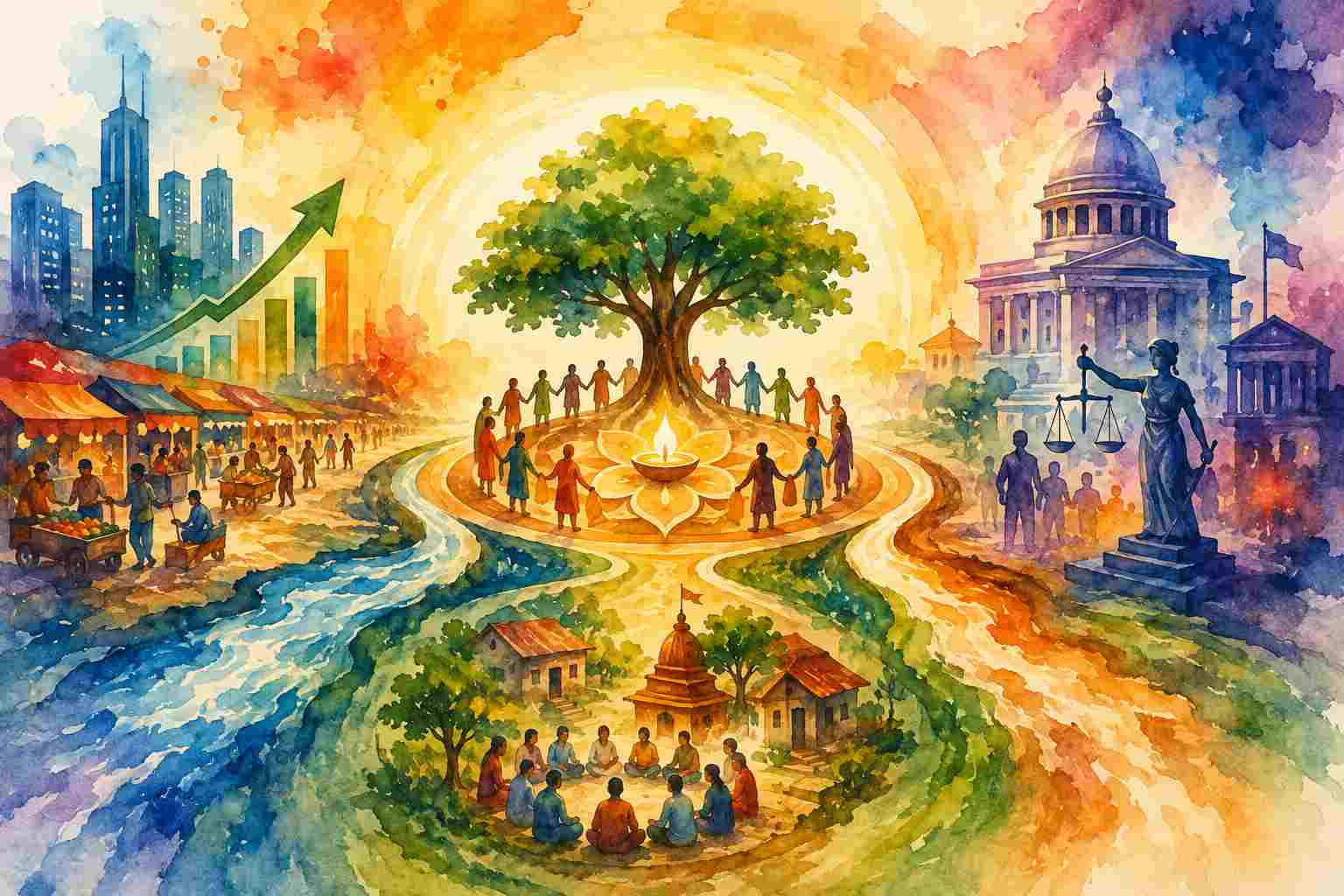
The Third Way does not divide the world into “private good, public bad” or “state good, market bad.” It asks which institution is appropriate for which function. Markets can generate innovation and coordinate exchange. But when the market becomes the sole regulator, education, health, housing and even human relationships can become commodities.
The state can provide public goods and protect citizens. But when the state absorbs society, initiative, local knowledge and institutional diversity can weaken. Communities can generate belonging and mutual support. But communities too require reform and must not become immune from ethical scrutiny. The guiding principle, therefore, cannot be the absolute supremacy of market, state or tradition. It must be Dharma—understood here as the principle that asks whether a relationship, institution or activity is fulfilling its appropriate social responsibility.
Thengadi’s economic thought reflects this integration. He argued for an approach in which economic activity must be considered alongside ethics, ecology and education, while material wealth remains connected to social purpose rather than becoming an end in itself.
Consider agriculture. A purely market-driven model may ask: What crop produces the greatest return? A purely state-driven model may ask: What production target should be imposed? A civilizational approach adds further questions: What happens to soil? Water? Local food security? Farmers’ autonomy? Village employment? Future generations?
The answer may still involve markets and the state. But neither is allowed to define the entire problem.
Society as a Plural Institutional Order
This perspective can be represented simply:
| Institution | Primary contribution |
|---|---|
| Family | Care, transmission and socialization |
| Community | Reciprocity and collective support |
| Guild / occupational network | Skill, cooperation and representation |
| Market | Exchange and innovation |
| Temple and cultural institutions | Values, memory and social integration |
| Village / local bodies | Local decision-making |
| State | Justice, coordination and public goods |
The Third Way does not deny hierarchy among institutions in every circumstance. During a pandemic, for example, the state must act decisively. During a family crisis, the family may be the first institution of care. During economic exchange, the market may be appropriate. The problem begins when one institution tries to colonize every sphere.
Bharatiya civilization historically developed a more distributed institutional order. Political kingdoms changed, yet social and cultural life continued through networks that were not created by the state alone. Temples, families, pilgrimage networks, monastic institutions, guilds and local communities carried different forms of social responsibility.
The real alternative, therefore, is plurality with coordination.
Not Anti-Market, Not State-Worship
This distinction is essential. The Indic Third Way is not a romantic rejection of modern markets. Nor is it an argument for dismantling the modern state.
The question is: What are these institutions for?
If a corporation creates enormous wealth but destroys ecological systems and communities, has society become prosperous? If the state redistributes resources but creates permanent dependency and destroys local initiative, has equality produced empowerment? If individual freedom expands while family and social responsibility collapse, can society sustain the very conditions that made individual freedom possible?
Thengadi’s answer was to reject the assumption that economics can be separated from the wider life of society. This is why his thought connects economy with nature, ethics, technology and human purpose rather than treating production and consumption as self-contained activities.
The Third Way as Madhyama Mārga
The Indic Third Way may therefore be understood through the civilizational principle of Madhyama Mārga, but not as a timid compromise.
The middle is not always correct simply because it lies between two extremes. If one ideology says everything belongs to the market and another says everything belongs to the state, giving fifty percent to each is not necessarily wisdom. The real question is whether the binary itself has understood society correctly. The Third Way does not stand halfway between two ideological walls. It asks whether society needs to remain inside that corridor at all. Its deeper proposition is that human beings live simultaneously as individuals, family members, community participants, economic actors, citizens and inheritors of a civilizational order. No single institution can fully organize these relationships.
The Indic Third Way, therefore, is not a formula waiting to be mechanically implemented. Thengadi himself resisted the search for a final blueprint; the civilizational approach had to remain responsive to changing circumstances rather than frozen into a universal design.
The task before Bharat is not to manufacture a hybrid of capitalism and socialism.
It is to recover a more fundamental question: how should different institutions relate to one another so that the individual, society, nature and the state strengthen rather than destroy each other?
That is the real intellectual challenge of the Indic Third Way.
