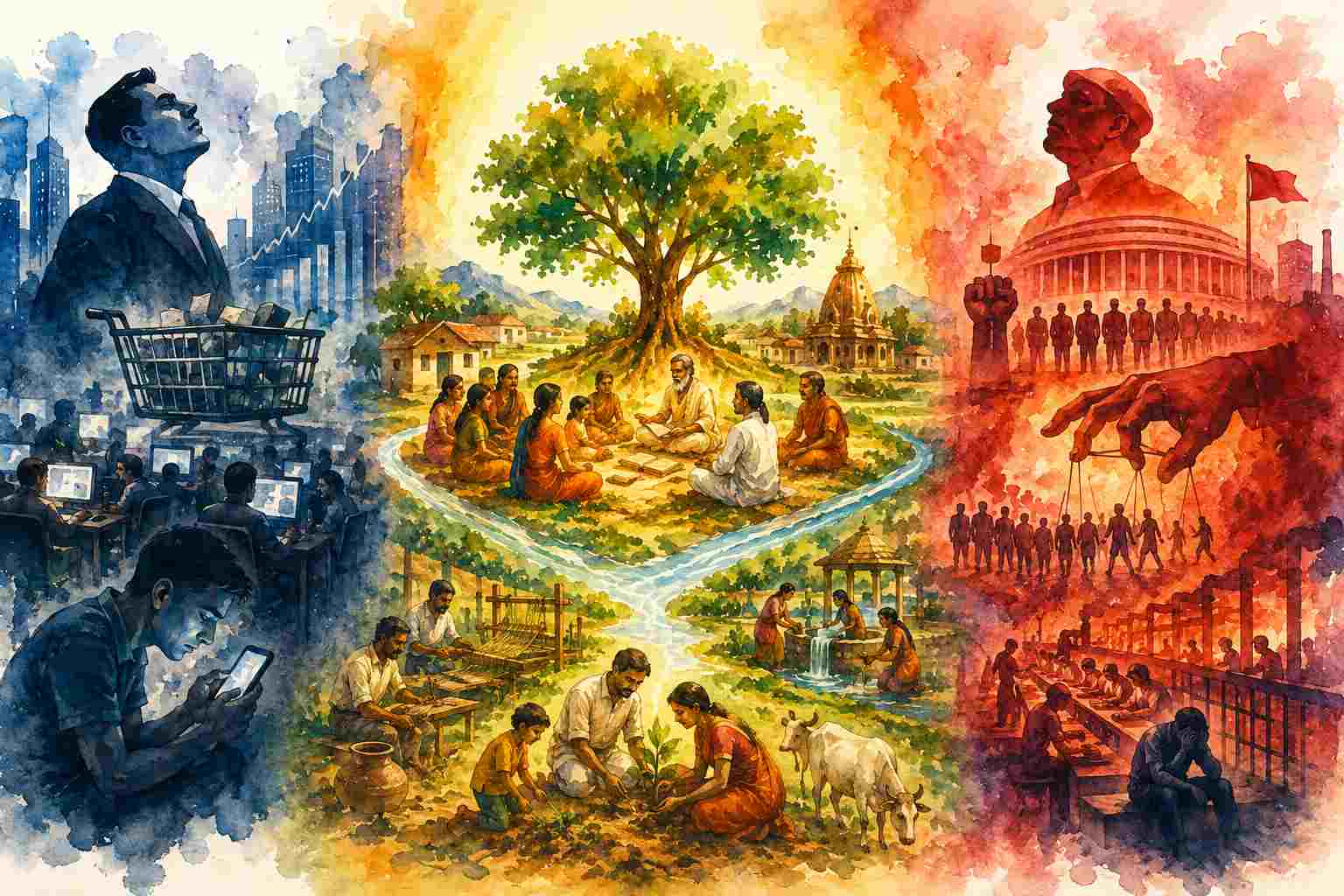
What happens when society begins not with the question of what an individual can claim, but with the question of what every individual owes?
Much of modern political thought begins with rights. The liberal tradition asks how individual liberty can be protected. Egalitarian traditions ask how social and economic equality can be secured. Theories of justice ask how rights, resources and opportunities should be distributed. These are important questions, and modern politics has produced some of its greatest achievements by placing them at the centre of public life.
Yet Bharat’s intellectual tradition begins from a different point of departure. It asks not only, What am I entitled to receive? but also, What is my Dharma in this relationship? What responsibility arises from the role I occupy?
This is not merely a moral variation on the modern language of rights. It produces a different way of imagining society itself.
Rights Begin with the Claim. Dharma Begins with the Relationship.
A right is fundamentally a claim that an individual can make. A duty is an obligation that an individual must fulfil. Modern political systems have often organized public life around the first. The Indic tradition places far greater emphasis on the second. But this should not be misunderstood as a simple rejection of rights. The question is more structural.
Consider a child. The child has a right to care and education. But the survival of that right depends on someone fulfilling a corresponding responsibility. Parents must care. Teachers must teach. Society must provide institutions. The state must protect. A society may endlessly declare the child’s right to education, but if the teacher does not teach, the institution does not function and the state does not ensure access, the right remains incomplete.
The same relationship exists everywhere. Rights require duties. My right to speak presupposes someone else’s duty not to silence me unjustly. My right to justice presupposes duties upon institutions and officials. My right to a clean environment presupposes responsibilities upon citizens, corporations and governments.
This is where Dharma becomes politically significant. It shifts attention from an isolated individual to the network of relationships that makes social life possible. The question becomes not simply, What can I claim from society? but also, What does society require from me, and what do I owe to those with whom I am connected?
Dharma Is Not Simply a Religious Command
Reducing Dharma to “religion” creates a serious conceptual problem. In the social and political context, Dharma refers to a principle of appropriate conduct, responsibility and order arising from particular relationships and circumstances. A teacher and a student do not have identical responsibilities. A parent and a child do not. A judge, a citizen, a ruler and a physician occupy different positions and therefore carry different obligations.
This makes Dharma a relational rather than merely individual principle.
Modern rights discourse often begins with abstract equality: all persons possess equal dignity and certain equal claims. Dharma begins with another fact of social life: human beings are not identical in every relationship, responsibility or circumstance. Equality remains important. A legal system cannot function if basic human dignity is denied. But equality alone cannot tell a physician how to treat a patient, a parent how to care for a child, a teacher how to educate a student or a ruler how to govern. The same person occupies many roles simultaneously. I may be a citizen, parent, teacher, neighbour and economic actor. Each relationship generates different responsibilities.
Dharma therefore does not abolish the individual. It embeds the individual within a network of responsibilities.
From Liberty and Equality to Balance
Modern political debates are often organized around competing ideals. Liberalism fears excessive power over the individual. Socialism fears inequality produced by unrestricted economic power. Conservatism fears the collapse of social continuity.
Each identifies a real danger.
The Indic framework asks a different question: What happens when one legitimate principle becomes absolute?
Liberty without responsibility can weaken the social relationships that sustain freedom itself. Equality pursued through excessive control can weaken diversity and initiative. Tradition without reform can preserve injustice. Economic growth without restraint can destroy ecological foundations. The purpose of Dharma is not to choose one extreme. It is to ask what constitutes appropriate balance in a particular context.
This is why Dharma is closely connected with the broader framework of Purushartha. Human beings pursue Dharma, Artha, Kama and Moksha. Material prosperity is legitimate, but it cannot become the only human objective. Desire is recognized, but it cannot become the sole regulator of social life. The search for transcendence is acknowledged, but society cannot ignore material responsibilities. The problem, therefore, is not wealth. The problem is the absolutization of wealth. The problem is not freedom. The problem is freedom detached from every responsibility. The problem is not equality. The problem is the belief that one principle alone can organize all human relationships.
Dharma operates as a principle against such absolutization.
Governance: What Does the Ruler Owe?
This shift becomes particularly significant in governance.
A rights-centred political system often asks: What limits should be placed on the state to protect citizens? This is essential. Yet the Dharmic question adds another dimension: What is the Dharma of the ruler?
A ruler or public official is not merely an individual exercising authority. Authority itself creates responsibility. The legitimacy of governance is therefore connected not only to constitutional power but also to the proper performance of the responsibilities attached to office. This principle is crucial because political power often encourages the language of entitlement. Citizens demand services. Governments claim authority. Political parties demand loyalty.
The language of Dharma asks everyone to account for their role. What is the duty of the ruler toward justice? What is the responsibility of the citizen toward the larger society? What is the obligation of an institution toward those who depend upon it?
The Bhagavad Gita offers the concept of Lokasangraha—the holding together, protection and guidance of the larger world—as a reason for action. In Chapter 3, Krishna invokes Janaka and other rulers who acted while considering the necessity of Lokasangraha. The point is politically important: action is not motivated only by personal gain or private interest, but also by responsibility for the continuity and welfare of the wider social order.
This gives us a different image of citizenship and leadership. Political life is not simply a competition between private claims. It is also a system of reciprocal responsibilities.
Education: From Achievement to Formation
The difference becomes equally visible in education. A rights-based approach asks whether every child has access to education. This question is indispensable. A Dharmic approach asks additional questions: What kind of human being is education producing? What responsibility does knowledge create? What is the Dharma of the teacher?
A student is not merely a consumer purchasing an educational service. A teacher is not merely an employee delivering information. Education is a relationship involving obligations on both sides. The student has a responsibility to learn. The teacher has a responsibility to teach with competence and integrity. The institution has a responsibility to create an environment for intellectual development. Society has a responsibility to ensure that education serves more than private credential accumulation.
Without this framework, education can become a marketplace where everyone possesses rights and no one accepts responsibility.
Economy: Beyond Entitlement and Profit
The same shift transforms economics.
Workers have rights. Consumers have rights. Corporations have legal responsibilities. Governments have obligations. Yet rights alone cannot answer a more fundamental question: What is economic activity for? If the only objective is individual consumption, economic success can coexist with ecological destruction, social fragmentation and exploitation.
A Dharmic framework introduces responsibility into the economic relationship itself. Wealth must be produced, but production must also consider society and ecology. Property can create rights, but ownership also creates responsibility. Consumption is legitimate, but restraint may also be necessary.
This does not mean a state-controlled economy or hostility to markets. It means that the market cannot become the only moral language of society. A forest may have a commercial value, but its significance cannot be exhausted by its market price. A river may generate economic benefit, but it also sustains communities and ecological systems. Dharma therefore asks whether economic action is appropriate within a larger web of relationships.
Citizenship Beyond the Consumer Model
Perhaps the most important political consequence of this framework concerns citizenship.
The modern citizen is increasingly imagined as a rights-bearing individual. The state must provide security, infrastructure, education and welfare. All of these expectations may be legitimate.
But what does the citizen owe in return?
The Indian constitutional order itself contains both a charter of Fundamental Rights and a set of Fundamental Duties under Article 51A. Official explanations of the Constitution have explicitly connected these duties with the idea that democratic life requires citizens to assume and discharge responsibilities, rather than treating citizenship as a purely passive relationship of entitlement.
This constitutional coexistence is important. Rights protect the citizen from arbitrary power. Duties remind the citizen that a democracy cannot survive if everyone demands from the system while refusing responsibility for its maintenance. Paying taxes honestly, protecting public property, respecting the environment, participating in civic life and developing scientific temper are not simply private moral choices. They contribute to the conditions under which collective life becomes possible.
Dharma Does Not Mean Obedience
A major misunderstanding must be avoided.
A society organized around Dharma cannot mean blind obedience to existing authority or inherited social arrangements. If Dharma merely becomes a command to accept whatever exists, it loses its critical function. Dharma also provides a standard against which institutions can be questioned. A ruler who acts unjustly cannot justify injustice merely because he occupies authority. A social practice cannot become eternally legitimate merely because it is old.
This is precisely why Dharma is more complex than a law. Law can tell us what the state commands. Dharma asks whether conduct sustains justice, relationships and social order appropriately. The two may overlap, but they are not identical.
Modern political philosophy itself continues to struggle with the foundations of political obligation: why citizens owe obedience, what justifies authority, and whether duties arise from consent, membership, fairness or broader moral principles. The Indic contribution may therefore be to ask whether political obligation is too narrowly conceived when separated from the wider network of duties created by family, society, office, ecology and civilizational continuity.
A Different Political Grammar
The fundamental difference can be represented simply:
| Modern Political Grammar | Dharmic Political Grammar |
|---|---|
| What am I entitled to? | What is my Dharma? |
| Individual claim | Relational responsibility |
| Liberty | Liberty with responsibility |
| Equality | Appropriate treatment and balance |
| Justice as distribution | Justice as right relationship and conduct |
| Private interest | Lokasangraha |
| State and citizen | Multiple relationships and obligations |
The point is not to replace rights with duties.
A society without rights can easily convert duty into an instrument of oppression. The powerful can demand sacrifice while refusing accountability. The modern language of rights emerged partly because inherited institutions often failed to protect individuals. But a society of rights alone creates the opposite danger: everyone becomes conscious of what is owed to them and increasingly indifferent to what they owe to others.
Dharma offers another starting point.
The question is not merely: What can I demand from society?
It is also: What responsibilities arise because I live within society? What do I owe to family, community, institutions, nature, future generations and the wider world?
This shift changes the meaning of politics. Politics is no longer only a negotiation between competing claims. It becomes an inquiry into the responsibilities that connect human beings. Citizenship is no longer only the possession of rights. It becomes participation in a shared order. Governance is no longer only the exercise of authority. It becomes the performance of responsibility.
That is why Dharma should not be treated merely as a moral concept inherited from the past. It may provide a fundamentally different organizing principle for thinking about governance, education, economy and citizenship. The question, therefore, is not whether rights are unnecessary. They are essential. The deeper question is whether rights can sustain society when no one asks what their Dharma is.
