
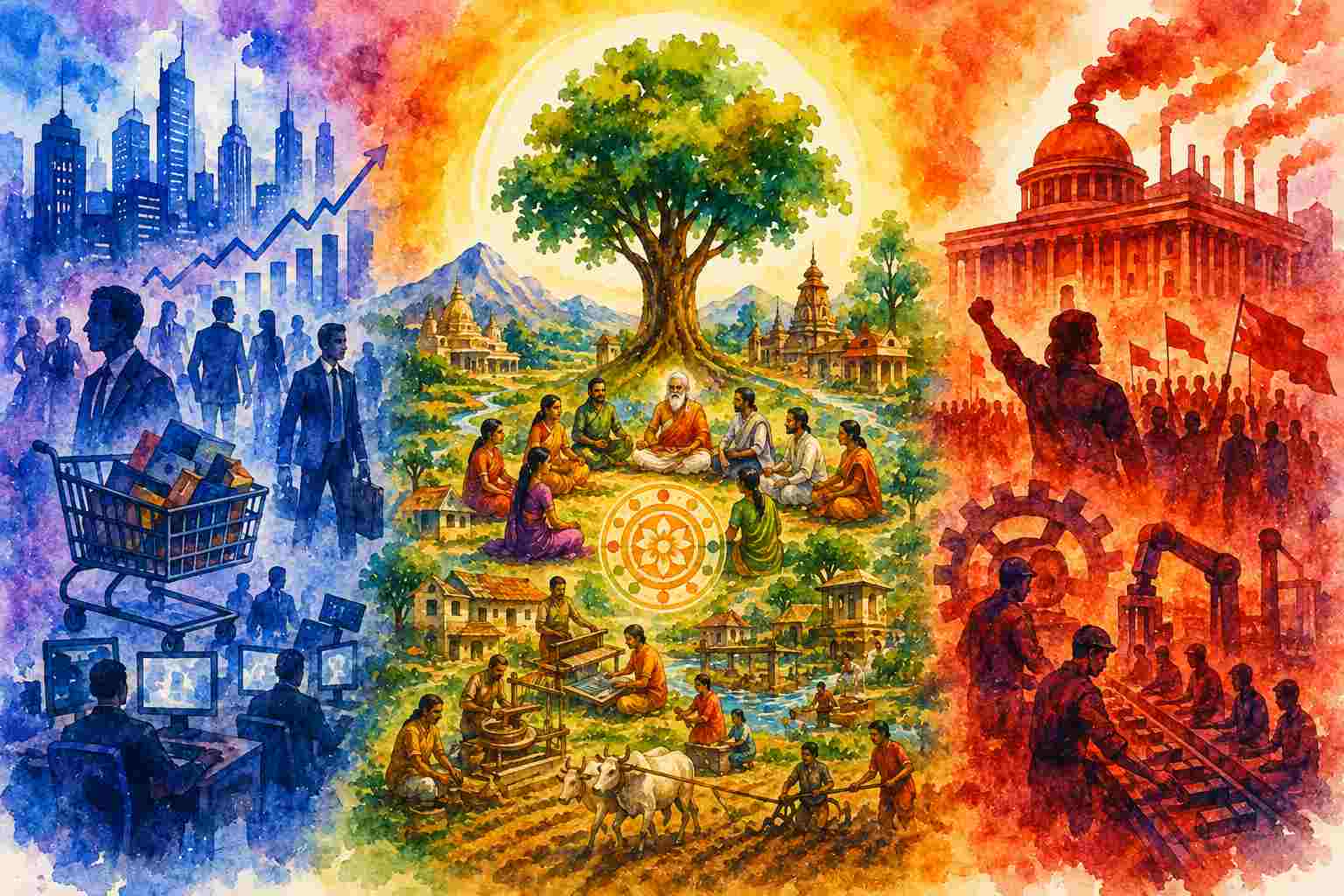
Can Indic thought be classified as conservative, socialist, capitalist, liberal or communist?
The question appears simple, but the answer is more difficult than contemporary political discourse often admits. Modern societies have become accustomed to placing every political idea somewhere on a familiar ideological spectrum. Is it Left or Right? Liberal or conservative? Capitalist or socialist? But before placing Bharatiya thought within these categories, perhaps we should ask a more fundamental question: were these categories created to understand the civilizational experience of Bharat in the first place?
The modern Left–Right distinction emerged from a particular European historical experience. The French Revolution created the political symbolism of Left and Right. The Enlightenment transformed ideas of reason, individualism and authority. The Industrial Revolution produced capitalism, new classes and unprecedented economic inequalities. The rise of modern nation-states transformed political sovereignty. Socialism, liberalism, conservatism and communism emerged as competing responses to these historical transformations.
These were responses to real problems. But were they universal problems, and were their categories universally applicable?
Dharma Is Not Conservatism
Indic civilization cannot simply be called conservative because it values tradition. Conservatism, in the modern political sense, developed in response to the disruptions of European modernity and revolution. Dharma, however, is not merely the preservation of inherited institutions.
Dharma asks whether conduct is appropriate, just and sustaining of social order. This can involve preserving tradition, but it can also require transformation when existing conduct violates the larger principle of justice and responsibility.
A tradition is not automatically Dharmic merely because it is old.
This distinction matters. Conservatism primarily asks what should be preserved. Dharma asks what should be sustained—and sometimes preservation itself may become adharma.
Artha Is Not Capitalism
Indic thought also recognizes wealth, production, trade and prosperity. Artha is one of the Purusharthas. But this does not make Bharatiya civilization capitalist.
Capitalism organizes economic life around modern concepts such as private capital accumulation, wage labour and market relations. Artha belongs to a much larger framework. Wealth is legitimate, but it does not stand alone. It exists alongside Dharma, Kama and Moksha. The pursuit of prosperity is therefore recognized without allowing prosperity to become the highest measure of civilization.
The question is not whether wealth should exist. It is whether wealth can be pursued without responsibility towards society, ecology and future generations. That is a fundamentally different economic grammar.
Dana Is Not Socialism
Similarly, Dana and social responsibility cannot be equated with socialism.
Socialism generally addresses inequality through collective ownership, redistribution or state intervention. Dana operates through a different principle. It emerges from responsibility, reciprocity and the recognition that wealth creates obligations. The same society may require both public institutions and voluntary social responsibility. The question is not whether the state should perform every welfare function.
Historically, Bharat developed multiple institutions of care—family, community, temple, guild and local networks. This does not mean that historical arrangements were always perfect. But it demonstrates that society cannot be reduced to the simple binary of individual versus state.
Rajadharma Is Not Statism
Indic political thought recognizes the necessity of the state, but it does not place the state at the centre of every social relationship.
Rajadharma defines the responsibilities of political authority. The ruler is not simply sovereign because he possesses power; power itself creates obligations. The state is one institution within a larger social order.
Family, community, temple, educational institutions, occupational networks and local bodies all possess social functions that cannot automatically be absorbed by the state.
This creates a plural institutional order. The state coordinates and protects, but society itself does not disappear into political authority.
Why the Categories Fail
The difficulty arises because modern ideologies usually begin by privileging one dimension of social life.
Liberalism gives central importance to individual liberty. Socialism focuses upon equality and economic structures. Conservatism emphasizes continuity and tradition. Nationalism prioritizes the political community. Environmentalism foregrounds ecological limits.
Each identifies something important. The problem begins when one principle becomes the universal key for understanding every social problem.
Indic civilization developed through a different logic. It recognized multiple goals, multiple institutions and multiple levels of social life. The individual was not simply dissolved into society, but neither was society imagined as a collection of autonomous individuals.
Dharma provided responsibility. Artha recognized material life. Kama acknowledged human desire. Moksha recognized transcendence.
The individual was situated within family, community, occupation, locality, Rashtra and a larger cosmic order.
This is why Indic thought cannot be reduced to a position on the modern ideological spectrum.
| Modern Category | Indic Equivalent? |
|---|---|
| Conservatism | Dharma ≠ preservation of tradition alone |
| Capitalism | Artha ≠ accumulation of wealth |
| Socialism | Dana ≠ state redistribution |
| Statism | Rajadharma ≠ supremacy of the state |
| Liberal individualism | Moksha ≠ isolated individual freedom |
An Independent Political Tradition
The point is not that Indic thought has nothing in common with modern ideologies. One may find concern for liberty, social welfare, decentralization, tradition and economic prosperity within different Indic traditions.
But resemblance does not mean equivalence.
A civilization that values wealth is not necessarily capitalist. A civilization that values social responsibility is not necessarily socialist. A civilization that respects tradition is not necessarily conservative.
The real intellectual challenge is therefore not to decide whether Bharat belongs to the Left or Right.
It is to recognize that Bharat developed its own political and social categories before these modern ideological labels existed.
Indic civilization should therefore be studied as an independent political tradition—one capable of dialogue with liberalism, socialism, conservatism and other modern traditions, but not reducible to any of them. The question is no longer, Where does Bharat stand on the Left–Right spectrum? The more important question is: why must Bharat stand on a spectrum created to explain someone else’s civilizational history?
