How does an individual move through society?
Modern theories of human development generally describe life through stages—childhood, adolescence, adulthood and old age. But the Indic tradition asks a deeper question: what changes when a person moves from one stage of life to another? Is the individual merely growing older, or is he entering new relationships, acquiring new responsibilities and gradually becoming embedded in wider circles of social life?
The Indic answer can be understood through the interconnected ideas of Āśrama, Puruṣārtha, Saṃskāra, Kutumba, Samāja and Dharma. The individual does not merely pass through time. The individual passes through relationships.
From Development to Navigation
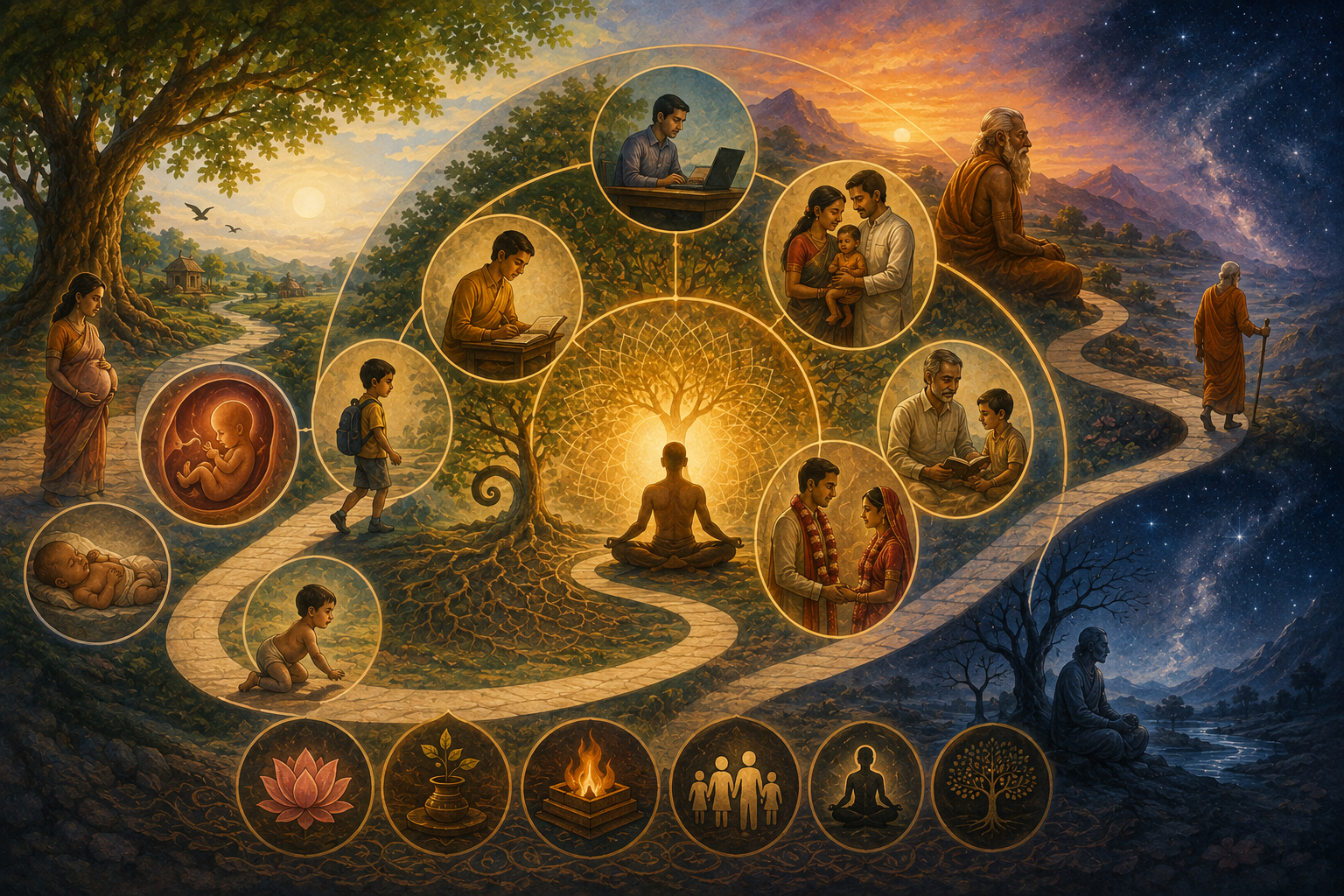
The four Āśramas—Brahmacarya, Gṛhastha, Vānaprastha and Saṃnyāsa – can be read as a life-course architecture. They describe changing orientations toward learning, family, social contribution, reflection and liberation.
In Brahmacarya, the individual is primarily a learner. Education is not merely the accumulation of information; it is the cultivation of discipline, knowledge and character. This connects with the broader Indic idea of Saṃskāra: human beings are not simply born mature—they are cultivated.
Gṛhastha represents a fundamental transition. The individual becomes a contributor: establishing a family, earning wealth, caring for dependants and participating in society. Artha and Kāma are legitimate pursuits, but they remain situated within Dharma. Material life is therefore not rejected; it is socially embedded.
In Vānaprastha, the emphasis gradually shifts from acquisition toward reflection and transmission. Experience becomes a social resource. The question of later life is not merely, “How should the elderly be cared for?” but also, “What wisdom can the experienced transmit to the next generation?”
Finally, Saṃnyāsa represents a movement beyond attachment to social identities themselves. The ultimate horizon becomes Mokṣa. Here the Indic model moves beyond conventional sociology: human development does not necessarily culminate in becoming a more productive citizen, but in asking who one is beyond one’s social roles.
The Four Puruṣārthas
The life-course becomes even more meaningful when read alongside the Puruṣārthas:
Dharma → Artha → Kāma → Mokṣa
These are not four isolated goals but interconnected dimensions of human life. The Indic framework recognizes that different stages may require different emphases. Wealth and desire have a legitimate place, but they are not necessarily the final purpose of existence. This produces a remarkably different understanding of development.
Life has seasons, and each season has its own responsibilities.
The Saṃskāras reinforce this architecture by marking important transitions—birth, naming, education, initiation, marriage and death. Their precise forms varied historically, but their broader function was to give social and cultural meaning to biological transitions.
The Individual as a Navigator
The deeper insight emerges when we place the individual within the Indic social continuum:
Vyakti → Kutumba → Samāja → Janapada → Rāṣṭra → Jagat
The child begins within the family, becomes a learner, enters economic and social life, contributes to the community and gradually encounters wider questions of responsibility and existence.
This is why navigation may be a better metaphor than development.
Development often asks: How does the individual change with age?
Navigation asks:
What relationships am I entering? What responsibilities am I acquiring? What am I receiving? What am I contributing? What should I eventually relinquish?
Indic thinkers approached these questions in different ways. Yājñavalkya explored the nature of the self and liberation; Śaṅkara emphasized the distinction between the Self and changing worldly identities; Rāmānuja developed a different understanding of the relationship between self, world and ultimate reality; and Swami Vivekananda connected human development with education, service and the realization of inner potential.
They disagreed—and that disagreement is itself part of the richness of Indic thought. The Indic life-course model therefore does not simply ask us to grow up. It asks us to learn how to belong, how to contribute, how to transmit, how to withdraw—and ultimately, how to transcend. That is development understood not merely as ageing, but as navigation through society and beyond it.
