Can rituals function as institutions of socialization?
Modern sociology has a familiar answer to the question of how human beings become members of society.
- The family socializes the child.
- The school transmits knowledge.
- Peer groups shape behaviour.
- Media influences identity.
- Institutions establish norms and expectations.
But what if a civilization deliberately designed another layer of socialization—one that accompanied the individual through the entire life course? This is where the Ṣoḍaśa Saṃskāras, or sixteen saṃskāras, become analytically fascinating.
They are usually encountered as rituals: ceremonies associated with conception, birth, naming, education, initiation, marriage and death. Classical traditions, however, contain variations in both the number and formulation of saṃskāras; the familiar list of sixteen represents a particular historical standardization within a much wider saṃskāra tradition.
The important question for social theory is therefore not simply: “What ritual is performed?” It is: “What does the ritual do to the individual and to society?”
That question changes everything.
From Ritual to Human Formation
The word saṃskāra itself carries the idea of formation, refinement or cultivation. The individual is not treated as someone who simply moves biologically from birth to adulthood and eventually death.
Life is organized into meaningful transitions.
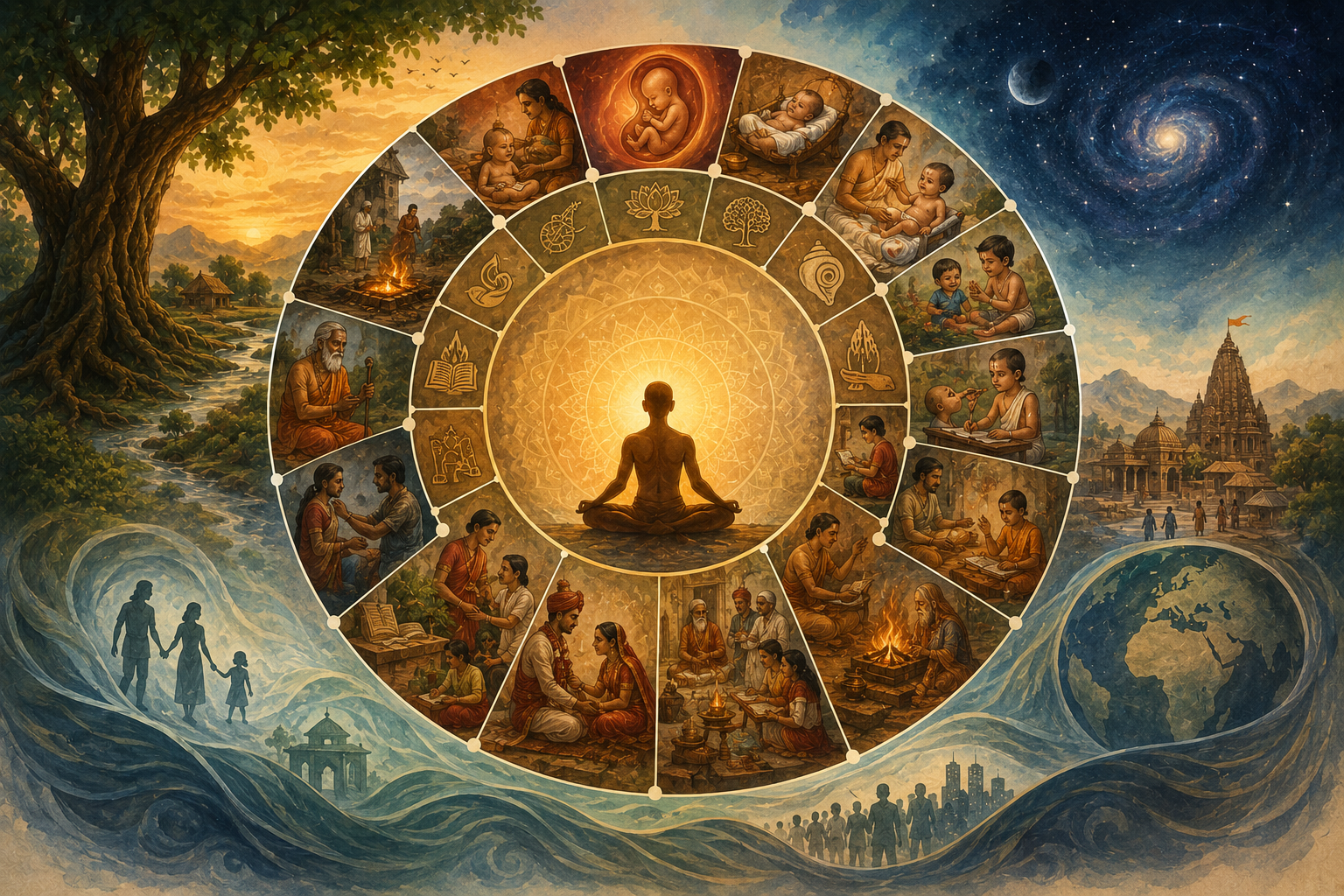
Birth is marked. The child receives a name. The child encounters the wider world. Food is introduced. Education begins. Initiation takes place. The person enters a new stage of responsibility. Marriage establishes another form of social participation. Death becomes a transition requiring ritual recognition and incorporation into ancestral memory.
Classical studies of Hindu life-cycle rituals similarly describe saṃskāras as rites marking transitions from conception and birth through childhood, initiation, marriage, old age and death. Axel Michaels notes that such rituals help individuals and communities negotiate biological and social transitions that might otherwise threaten social cohesion.
This gives us a useful conceptual shift:
A Saṃskāra is not merely an event. It is an institutionalized transition.
And institutions matter because they tell people when they have entered a new stage, what that stage means, and what is expected of them now.
The Life-Course Architecture
Modern societies also mark transitions. We celebrate birthdays. We begin school. We graduate. We marry. We retire. We conduct funerals. Even apparently secular societies create ceremonies around major transformations. Anthropological scholarship on rites of passage has long recognized that transitions between social statuses require symbolic processes of separation, transition and incorporation.
The Indic system takes this principle much further. The Saṃskāras create something resembling a life-course architecture. The individual is repeatedly introduced to new relationships and responsibilities. The newborn becomes a named member of a family. The child becomes a learner. The student becomes a socially accountable person. The adult enters household responsibilities. The person eventually confronts old age, death and the continuity of the ancestral order.
The precise practices varied considerably by region, tradition, community and historical period. But beneath these variations lies an important sociological principle: Biological development is accompanied by social recognition.
You do not merely grow older. You become something new in relation to others.
The Child Is Not Simply Born; the Person Is Cultivated
This connects directly with the central proposition of Indic Constructivism. Modern social theory often asks how individuals are socialized into society. The Saṃskāras allow us to ask a more ambitious question: How does society consciously participate in constructing the human being it hopes to reproduce?
The answer is not found only in formal education. It is found in repetition, symbolism, participation and embodied experience. A child does not merely hear that family matters. The child experiences family through ritual. A student does not merely receive information about a tradition. The student is placed within a lineage of knowledge. A married person does not simply sign a legal document. Marriage becomes publicly recognized as a new field of responsibility. Ritual therefore performs a kind of social pedagogy. It teaches without necessarily looking like teaching.
Saṃskāra as Civilizational Technology
This is why the phrase “civilizational technology” is useful. Technology need not mean machinery. A technology is, more broadly, an organized method for producing a desired transformation. Agriculture is a technology for cultivating food. Writing is a technology for preserving knowledge. Institutions are technologies for organizing collective behaviour.
In this analytical sense, the Saṃskāras can be understood as technologies for cultivating persons within a civilization. Their objective was not merely to mark biological events but to connect those events with meaning, identity, obligation and community.
Consider Upanayana. It has historically been interpreted through different traditions and contexts, but as a rite of passage it clearly represents a transition into a new relationship with learning, discipline and the teacher. A modern sociological study of Upanayana similarly examines it explicitly through the framework of rites of passage and social-cultural transition.
The point is not that every historical form of Upanayana should simply be reproduced today.
The analytical question is:
What happens when education itself becomes a socially recognized transformation of the person rather than merely the acquisition of information?
That is a very contemporary question.
The Individual and the Larger Social Order
The Saṃskāras also demonstrate something central to the Indic conception of society: the individual is never completely detached from the social whole. Each transition simultaneously concerns the individual and the community. Birth concerns the family. Education concerns the lineage of knowledge. Marriage concerns two individuals but also their families and communities. Death concerns the individual but also the continuity of ancestors and collective memory.
The ritual therefore constantly moves between:
Individual → Family → Community → Civilization
This is precisely the movement proposed by the broader Indic Constructivist framework. The individual is shaped by institutions, but those institutions are themselves reproduced through individuals who have been shaped by them. The relationship is recursive.
Ritual as Memory
There is another dimension that modern social theory sometimes underestimates: memory requires institutions. Civilizations do not survive simply because people possess information about their past. They survive because people repeatedly perform that past. A festival is remembered through participation. A family tradition survives through repetition. A rite survives because one generation performs it for the next.
The Saṃskāras therefore function not only as mechanisms of socialization but also as technologies of intergenerational memory. The child does not simply learn that he or she belongs to a tradition. The child experiences belonging. And that distinction is profound.
Beyond Romanticism
None of this requires romanticizing the past. Historical saṃskāra practices differed significantly across regions, communities and periods. Some became associated with particular social groups, and some practices may no longer be relevant or acceptable in contemporary circumstances. A serious civilizational study must therefore distinguish between the principle and its historical forms.
The question is not:
“Were all sixteen Saṃskāras perfectly practiced everywhere?”
They were not. Nor is the question:
“Should every traditional form simply be restored?”
That would turn scholarship into nostalgia.
The more interesting question is:
What can contemporary societies learn from a civilization that treated human development as a structured, life-long process of formation?
Modern institutions have not eliminated the need for such formation. If anything, the problem has become more urgent. Children encounter algorithms before philosophy. Adolescents encounter social media before civic maturity. Consumers are trained by advertising. Citizens are shaped by political communication. Professional identities are increasingly separated from older forms of community and responsibility.
So the question remains remarkably contemporary:
Who is cultivating the human being?
From Socialization to Cultivation
This is where the Saṃskāras offer something beyond conventional theories of socialization. Socialization often describes how individuals learn existing norms. Saṃskāra suggests something more ambitious: The cultivation of the person who will carry those norms, reinterpret them and transmit them forward.
The distinction is subtle but important. Society does not merely reproduce itself by telling people what to do. It reproduces itself by forming people capable of participating in its continuity.
That is why the Sixteen Saṃskāras can be read as a civilizational technology of human development. They transform biological milestones into social meaning. They transform individual transitions into collective recognition. They transform memory into practice. And they transform the passage of time into a structured journey of becoming.
Perhaps, then, the most important lesson is not that every society needs exactly sixteen rites. It is that no civilization can survive indefinitely if it leaves human formation entirely to accident. Every civilization must decide, consciously or unconsciously, what kind of person it hopes to cultivate. The Saṃskāras represent one historically developed Indic answer.
And their deeper question remains with us:
If human beings are continuously formed by the institutions through which they pass, what kind of human being should our institutions be designed to produce?
That is where ritual becomes social theory. And where Saṃskāra becomes Constructivism.
