
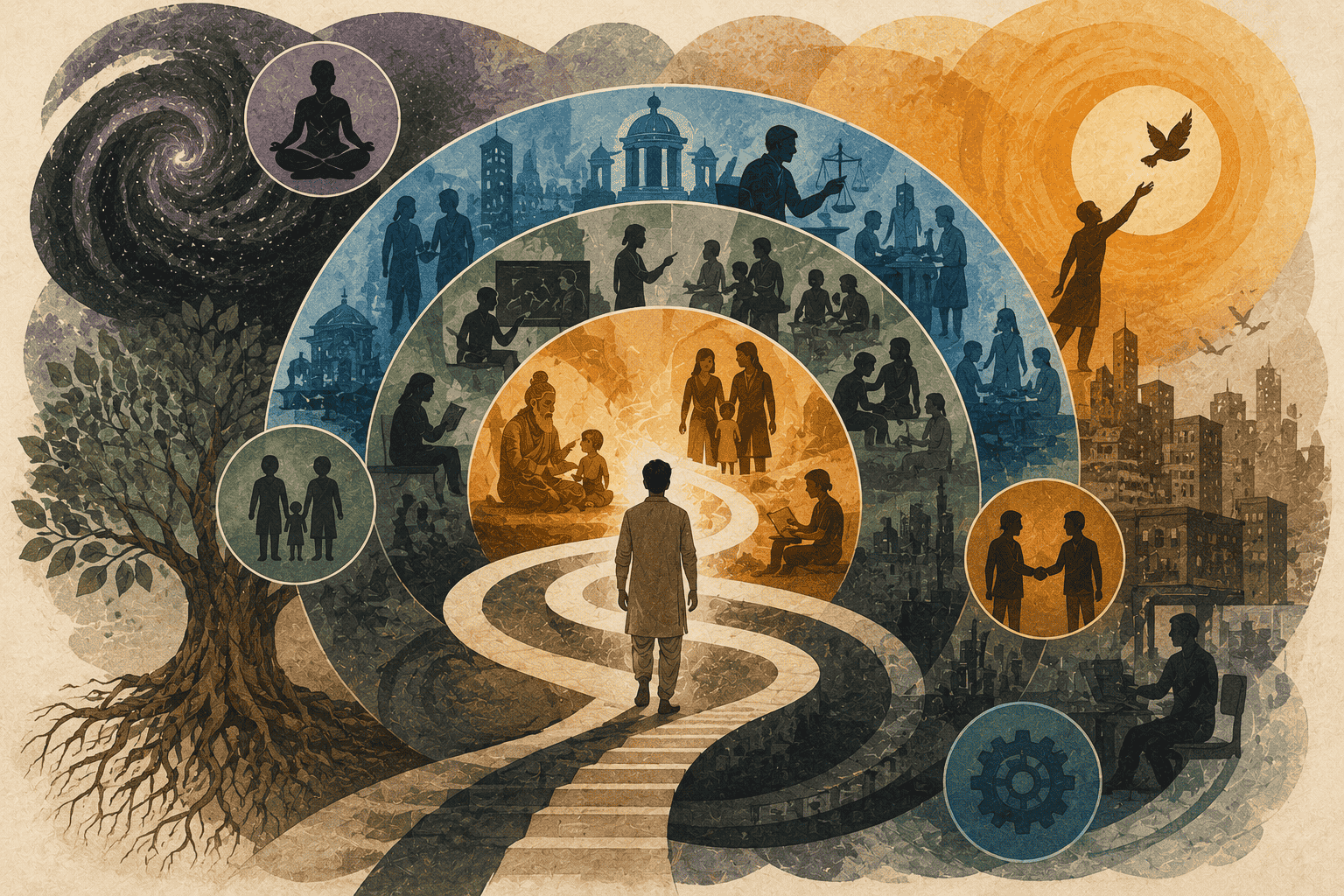
How does an individual become the person that society eventually encounters?
The familiar debate between nature and nurture begins with a division. Are we shaped primarily by biology, genetics and temperament? Or are we products of family, education, culture and socialization? Both answers capture something important. Neither is sufficient.
Biology gives us a constitution. Psychology explains cognition and emotion. Sociology explains how institutions and social environments shape behaviour. But the human being who actually walks through society is produced through the interaction of all these forces.
This is where Indic Constructivism offers a different starting point. It does not ask simply whether society shapes the individual.
It asks:
How does the individual, already possessing a particular constitution and history, navigate through—and get shaped by—the multiple institutions of society?
The distinction is important. The individual is not a blank slate waiting to be socialized. Nor is the individual a biologically predetermined organism merely responding to external stimuli. The person enters society with Prakṛti, encounters different tendencies represented through Triguṇa, carries the consequences and continuities of previous action through Karma, acquires formative impressions through Saṃskāra, and gradually develops an orientation toward action through Dharma.
But none of these operate in isolation.
The individual enters the Kutumba. The family becomes the first site of formation. Then come education, community, occupation, economy, religion, political institutions, law and culture. Each institution does something to the individual—but the individual also interprets, negotiates, accepts, modifies and sometimes resists what these institutions offer.
This is why Indic Constructivism is not simply a theory of socialization. It is a theory of navigation.
Consider a child entering school. The school does not create the child from nothing. It encounters an already developing personality, shaped by family, temperament and experience. Education then adds new knowledge, disciplines habits, creates aspirations and introduces new social relationships. Later, the individual enters an occupation, political community and wider cultural world. At every stage, the person is being formed.
But at every stage, the person is also choosing and responding.
This produces a dynamic relationship:
Prakṛti → Individual → Institution → Experience → Saṃskāra → Action → Transformation
The process is recursive. Society shapes the individual. The individual acts within society. Those actions reshape institutions and relationships. And the transformed social environment shapes the next individual. This is where the Indic framework becomes particularly powerful. Karma introduces continuity; Saṃskāra introduces accumulated formation; Prakṛti introduces constitution; Triguṇa introduces dynamic tendencies; and Dharma introduces orientation.
Together they allow us to ask a question that the nature–nurture binary struggles to capture: How does a human being become capable of navigating a social world?
The answer cannot be found entirely inside biology. Nor entirely inside society. It emerges in the relationship between person and institution.
This has significant implications for social science. If we study only institutions, we risk treating individuals as passive products of structures. If we study only individuals, we risk forgetting that preferences, habits and identities are themselves socially formed.
Indic Constructivism therefore places the individual-in-relation at the centre.
- The family does not merely contain the individual.
- Education does not merely inform the individual.
- The economy does not merely employ the individual.
- Politics does not merely govern the individual.
- Culture does not merely surround the individual.
Each becomes a site of human formation.
And the individual moves through these sites carrying previous experiences while acquiring new ones. The objective, therefore, is not to discover whether nature or nurture wins. It is to understand how human beings are continuously constructed through the encounter between constitution, action, institutions, relationships and ethical orientation.
That is the core proposition of Indic Constructivism. The human being is neither simply born nor simply made. The human being is continually formed—and continually participates in his or her own formation.
