
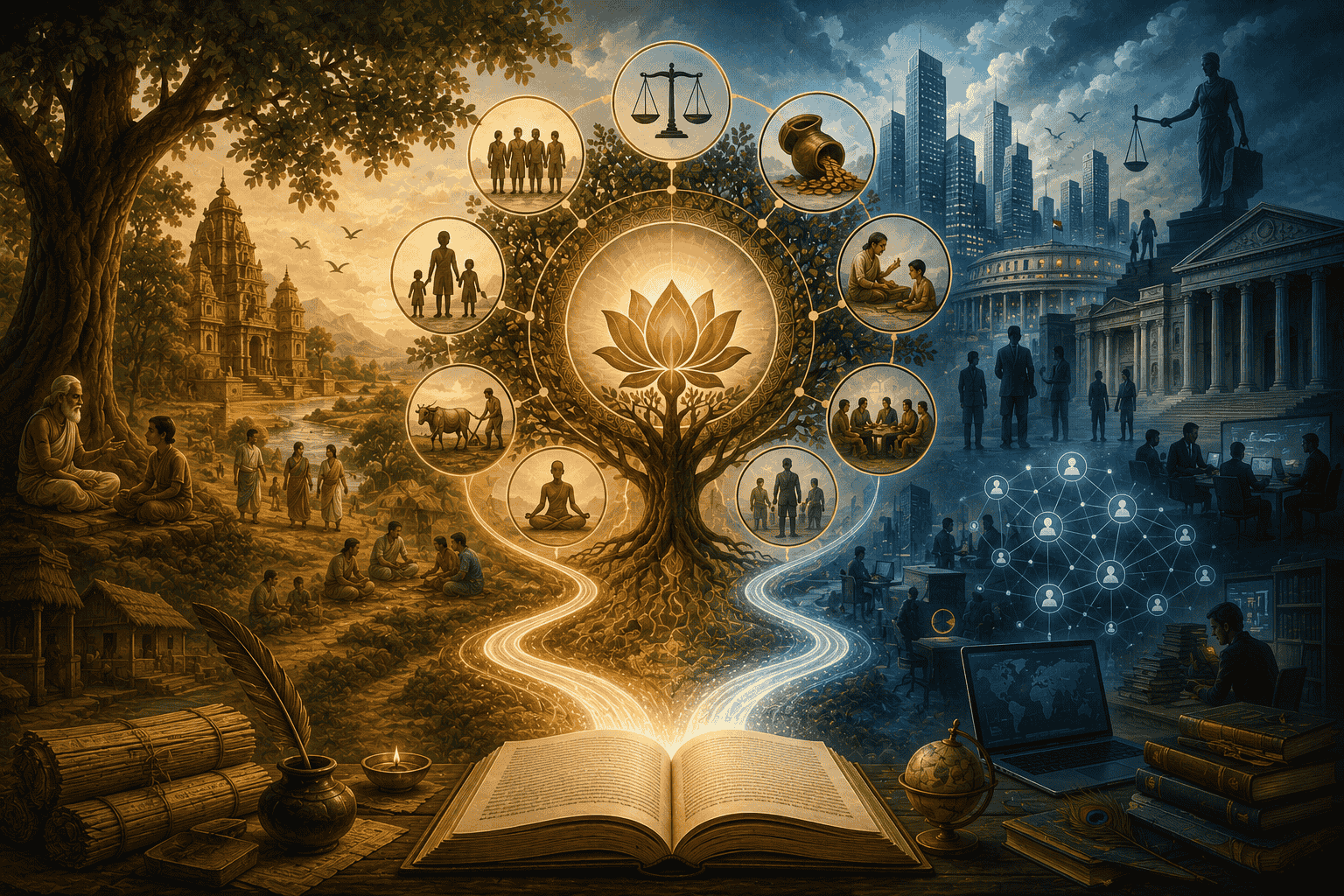
Can the social sciences be rewritten using Indic terminology?
Suppose we take a familiar social-science textbook and replace a few words.
- “Society” becomes Samāja.
- “State” becomes Rājya.
- “Economy” becomes Artha.
- “Justice” becomes Nyāya.
- “Welfare” becomes Lokasaṅgraha.
- “Knowledge” becomes Jñāna.
- “Education” becomes Vidyā.
At first glance, this may look like nothing more than translation. It is not. The moment we make such substitutions, we encounter a much deeper problem: words do not merely describe concepts; they carry assumptions about the world those concepts are meant to explain. This is why an Indic social science cannot be created simply by translating English textbooks into Sanskrit-derived terminology. The real task is to ask whether the concepts themselves need to be reconstructed.
Translation Is Never Neutral
Consider Dharma. If we translate Dharma as “religion,” we immediately place it within a conceptual framework in which religion is generally understood as one sphere of human life alongside politics, economy, law and society. But Dharma does not necessarily occupy such a compartment. It can concern conduct, obligation, order, justice, relationships, law and the appropriate functioning of social roles. Classical Dharmaśāstra literature, for instance, encompasses areas that modern disciplines would distribute across law, ethics and social norms.
Something similar happens with Artha. If Artha is translated simply as “economics,” we risk reducing a much wider concern with material well-being, wealth, political economy, statecraft and worldly objectives to a modern academic discipline.
Likewise, Nyāya is not exhausted by the English word “justice”; Vidyā is not merely “education”; and Jñāna is not simply “knowledge” in the narrow epistemological sense.
The issue, therefore, is not whether English translations are useful. They are. The issue is whether the translation is allowed to erase the conceptual difference between the original and the translated category.
From Translation to Conceptual Comparison
An Indic lexicon should therefore not function as a list of Sanskrit substitutes for English words.
It should be a comparative conceptual dictionary.
| Modern category | Indic category | The question that changes |
|---|---|---|
| Society | Samāja | How are people socially related and organized? |
| State | Rājya | What is the institutional organization of political authority? |
| Politics | Rājadharma / Rājanīti | What should political authority do, and how should it be exercised? |
| Economy | Artha | How should material prosperity be pursued and ordered? |
| Ethics | Dharma | What constitutes appropriate and responsible conduct? |
| Justice | Nyāya | What makes an outcome or process just? |
| Welfare | Lokasaṅgraha | What sustains the welfare and cohesion of the larger social order? |
| Law | Dharma / Nīti / Vyavahāra | How are norms, conduct and disputes ordered? |
| Religion | Dharma / Sampradāya | How are belief, practice, obligation and tradition conceptualized? |
| Development | Abhyudaya | What constitutes human and collective flourishing? |
| Knowledge | Jñāna | What does it mean to know? |
| Education | Vidyā | How is knowledge cultivated, transmitted and embodied? |
The table is deliberately provocative. It does not suggest that these pairs are perfect equivalents. They are not. In fact, their differences are the whole point. If Lokasaṅgraha cannot be completely captured by “welfare,” then we should not force it into that category. We should ask what becomes visible when Lokasaṅgraha is allowed to retain its own conceptual character. That is how a lexicon becomes a tool of theory rather than a glossary.
Why This Matters for Social Science
Let’s consider the term development.
Modern development discourse commonly measures progress through indicators such as income, productivity, health, education and infrastructure. These are important. But what if development is understood not merely as accumulation or expansion, but also through the idea of abhyudaya—human flourishing and material advancement situated within a larger conception of life? The question changes.
Similarly, if welfare is understood only as the delivery of state benefits, the citizen becomes primarily a recipient. A concept such as lokasaṅgraha encourages us to ask a different question:
What sustains the larger social order, and what responsibilities do individuals and institutions have toward it?
The same shift occurs with justice.
“Justice” often directs attention toward rights, equality, procedure or distribution. Nyāya can open a wider field of inquiry involving reasoning, fairness, appropriate judgment and the conditions under which an outcome can be considered just.
And with education, the difference between education and vidyā can become particularly significant. Education may be understood institutionally—as schooling, degrees, curricula and credentials.
Vidyā can prompt a larger question:
What kind of knowing transforms the learner?
The purpose is not to claim that one word is superior to another. It is to prevent the English category from becoming the unquestioned boundary of the question itself.
A Dictionary Can Become a Method
This is where the proposed Indic lexicon becomes more than an intellectual exercise.
- Imagine a political-science textbook beginning not with “state” as an unquestioned universal category, but by placing Rājya alongside state and asking how different civilizational traditions conceptualize political authority.
- Imagine a sociology textbook placing Samāja alongside society and examining relationships, institutions and social obligations through indigenous categories.
- Imagine economics beginning with Artha and asking how material prosperity relates to Dharma and Kāma rather than treating economic behaviour as an isolated domain.
- Imagine environmental studies examining human–nature relationships through concepts of ṛta, prakṛti and reciprocal obligation.
The textbook would not become “less scientific.” The questions would become more plural.
This is crucial. An Indic lexicon should not demand that every Western concept be discarded. Concepts such as class, state, market, gender, capital or bureaucracy may remain analytically useful. The objective is to place them alongside indigenous conceptual resources rather than allowing one vocabulary to monopolize explanation.
In other words:
Do not replace one orthodoxy with another. Expand the conceptual field.
From Vocabulary to Theory
There is, however, a final challenge. Using Sanskrit words does not automatically produce Indic scholarship. A paper does not become decolonized because society has been replaced by samāja. The real test is whether the indigenous concept does analytical work.
Can Dharma generate research questions? Can Lokasaṅgraha help explain institutional behaviour? Can Ṛṇa help us study intergenerational obligation? Can Yajña illuminate systems of contribution? Can Kutumba change how we understand the relationship between family and society? Can Puruṣārtha generate a more complex theory of human motivation?
If these concepts can generate hypotheses, classifications, comparisons and explanations, then they cease to be merely cultural vocabulary. They become social-scientific categories. That is the larger ambition of an Indic lexicon. Not to Sanskritize the social sciences. Not to reject everything that came from Europe. And certainly not to pretend that ancient categories can simply be transplanted unchanged into the twenty-first century.
The task is more demanding:
To allow Indic concepts to enter into genuine dialogue with modern social science and see what new questions emerge when neither vocabulary is assumed to be universally sufficient.
Perhaps decolonization therefore begins not by asking, “Which Western concepts should we remove?”
Perhaps the better question is:
“How many ways of seeing society are we willing to make intellectually possible?”
Because the most important freedom in scholarship is not merely the freedom to choose different answers. It is the freedom to ask different questions.
And an Indic lexicon gives us precisely that possibility: a way to recover the conceptual resources through which Indian civilization has historically interpreted society, human purpose, knowledge, justice, obligation and order—and to bring those resources back into the living practice of social inquiry.
The objective is not to replace one vocabulary with another. It is to make the social sciences capable of speaking in more than one civilizational language.
