
Reconstructing the Indic Theory of Human Behaviour
How does a civilization understand the human being?
This question appears deceptively simple. Modern psychology and social theory have produced an extraordinary range of answers: the rational actor, the economic man, the conditioned subject, the psychologically driven individual, the utility-maximizing agent. From Homo economicus to behaviourism and psychoanalysis, modern disciplines have developed different models for explaining why human beings think, desire, act and change.
But what if the human being is not adequately understood through a single explanatory principle? What if desire, temperament, action, habit, bodily existence, social responsibility and the search for meaning all belong to the same analytical picture?
This is where the Indic conceptual vocabulary becomes particularly interesting.
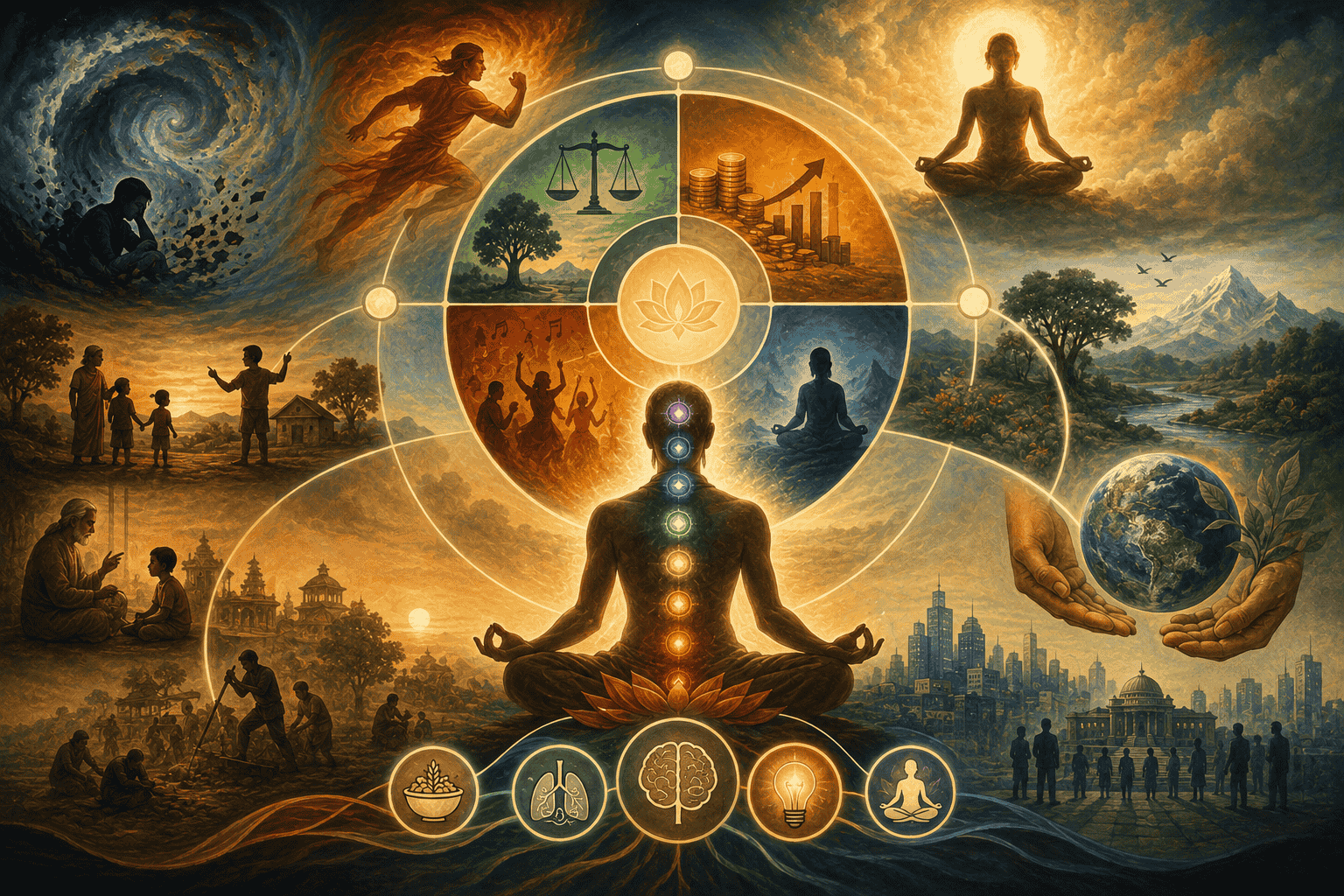
Puruṣārtha, Triguṇa, Pañcakośa, Karma and Saṃskāra can be read not merely as spiritual or religious ideas, but as different analytical models of the human being.
The important word here is models. They are not necessarily competing psychological theories in the modern empirical sense. Nor should we claim that ancient Indian thinkers secretly anticipated contemporary psychology. The more intellectually productive proposition is that these concepts provide alternative ways of organizing questions about human behaviour.
And that is precisely where an Indic social science can begin.
Puruṣārtha: What Is a Human Being Trying to Achieve?
Every theory of behaviour begins, implicitly or explicitly, with a theory of motivation.
Why does a person work? Why does someone pursue wealth? Why seek pleasure? Why sacrifice immediate happiness for duty? Why do some people eventually turn toward questions that cannot be answered through material success?
Modern economics frequently simplifies motivation around utility and preference. The Indic framework begins with a more plural conception of human ends: Dharma, Artha, Kāma and Mokṣa. Classical Hindu thought recognizes these four puruṣārthas as legitimate aims of human endeavour, although their meanings and relative importance vary across texts and traditions.
This immediately produces a richer model of motivation.
| Puruṣārtha | Behavioural question |
|---|---|
| Dharma | What ought I to do? |
| Artha | What do I need to secure and build? |
| Kāma | What do I desire and enjoy? |
| Mokṣa | What ultimately liberates or fulfills me? |
The significance is not simply that there are four goals instead of one. It is that human behaviour is understood as potentially containing multiple, sometimes competing, motivations. A person can simultaneously seek wealth, pleasure, responsibility and transcendence. The interesting social-scientific question therefore becomes one of balance, hierarchy and conflict among motivations. The human being cannot be reduced to a consumer.
Triguṇa: Why Do People Respond Differently?
If Puruṣārtha asks what people seek, Triguṇa helps us ask how dispositions influence the way they seek it.
The Bhagavad Gītā describes sattva, rajas and tamas as the three guṇas of prakṛti. It associates sattva with clarity and knowledge, rajas with activity, desire and attachment, and tamas with inertia, heedlessness and delusion. This is analytically interesting because it does not simply divide people into fixed personality types.
The guṇas are dynamic qualities.
A person may display different tendencies under different circumstances. Someone may be energetic and ambitious in one context, lethargic in another and contemplative in yet another. The framework therefore encourages us to examine states, tendencies and dispositions rather than assuming a completely fixed personality. Again, we should resist the temptation to call this an ancient version of the Big Five or modern personality psychology. It is doing something conceptually different.
It asks: What qualities are currently shaping action? That is a very useful behavioural question.
Pañcakośa: Who Is the Human Being?
The third model moves deeper.
The Pañcakośa teaching of the Taittirīya Upaniṣad presents the human being through five increasingly subtle “sheaths”: annamaya, prāṇamaya, manomaya, vijñānamaya and ānandamaya. The framework is not simply a biological classification. It presents human existence as layered, moving from bodily nourishment and vitality toward mind, understanding and deeper dimensions of experience.
This creates a striking contrast with models that reduce behaviour to either biological drives or observable responses.
The question becomes:
Can human behaviour be understood by looking at only one layer of the person?
The Pañcakośa model says, in effect, that we should be cautious.
- Hunger affects behaviour.
- Breath and vitality affect behaviour.
- Mind affects behaviour.
- Understanding affects behaviour.
- And human beings also experience dimensions of meaning and fulfillment that cannot easily be reduced to immediate biological or economic incentives.
The model therefore gives us a layered theory of the person.
Karma and Saṃskāra: Behaviour Has a History
Human behaviour also has memory. We do not act in every moment as if we were beginning from zero. Past actions shape future possibilities. Habits become dispositions. Experiences leave impressions. Repeated conduct can reinforce patterns of response.
This is where Karma and Saṃskāra become analytically important. The concept of karma has a complex intellectual history, but broadly concerns action and its consequences, with later Hindu traditions connecting actions to future results and, often, rebirth. Saṃskāra, meanwhile, can be approached as the formative imprint produced through experience, practice and cultural formation. Together they introduce a temporal dimension into behavioural analysis:
What I do shapes what I become.
Behaviour is therefore not simply a response to an external stimulus. It is also the product of accumulated tendencies and previous action. This gives the Indic model an interesting recursive quality:
Action → impression → disposition → action.
The person shapes conduct, but conduct also shapes the person.
One Human Being, Multiple Analytical Lenses
The real strength of these concepts emerges when we stop treating them as isolated doctrines.
They can be arranged as complementary questions:
| Indic model | Primary question |
|---|---|
| Puruṣārtha | What does the person seek? |
| Triguṇa | What tendencies shape the person’s action? |
| Pañcakośa | What layers constitute the person? |
| Karma | How do actions generate consequences? |
| Saṃskāra | How are dispositions formed and transmitted? |
Now compare this with the simplified figure of Homo economicus. The latter asks us to understand behaviour largely through preferences, incentives and rational calculation. The Indic framework asks a much larger set of questions:
What do I desire?
What do I value?
What tendencies influence me?
What has shaped those tendencies?
What consequences will my actions produce?
What kind of person am I becoming?
And what constitutes human fulfillment?
This is not merely a different answer. It is a different map of the human problem.
That distinction matters for the social sciences. An Indic theory of human behaviour should not attempt to prove that Puruṣārtha is “scientifically superior” to economics, or that Triguṇa can simply replace contemporary psychology. Such claims would confuse philosophical models with empirical scientific theories.
The more ambitious and defensible task is conceptual reconstruction.
- Can these categories generate hypotheses?
- Can they help classify motivations?
- Can they illuminate behavioural differences?
- Can they generate new questions about education, leadership, consumption, family, work, well-being and social cooperation?
If the answer is yes, then they deserve to be treated as analytical resources rather than merely as objects of religious study. And perhaps this is where an Indic social science becomes genuinely interesting. The objective is not to return to the past. It is to ask whether concepts inherited from an ancient intellectual tradition can be reconstructed, critically examined and operationalized for contemporary inquiry. Because perhaps the deepest mistake in studying the human being is to assume that one model must explain everything.
The Indic tradition offers another possibility:
The human being has goals (Puruṣārtha), tendencies (Triguṇa), layers (Pañcakośa), consequences (Karma) and formative impressions (Saṃskāra).
Together they produce a picture of the person that is motivational, psychological, embodied, social, ethical and temporal. And that leads to the central question:
What if understanding human behaviour requires not one universal model of the human being, but multiple complementary lenses through which the person can be seen?
That is precisely the intellectual possibility offered by Puruṣārtha, Triguṇa and Pañcakośa. Not merely spirituality. A vocabulary for analysing the human being.
