
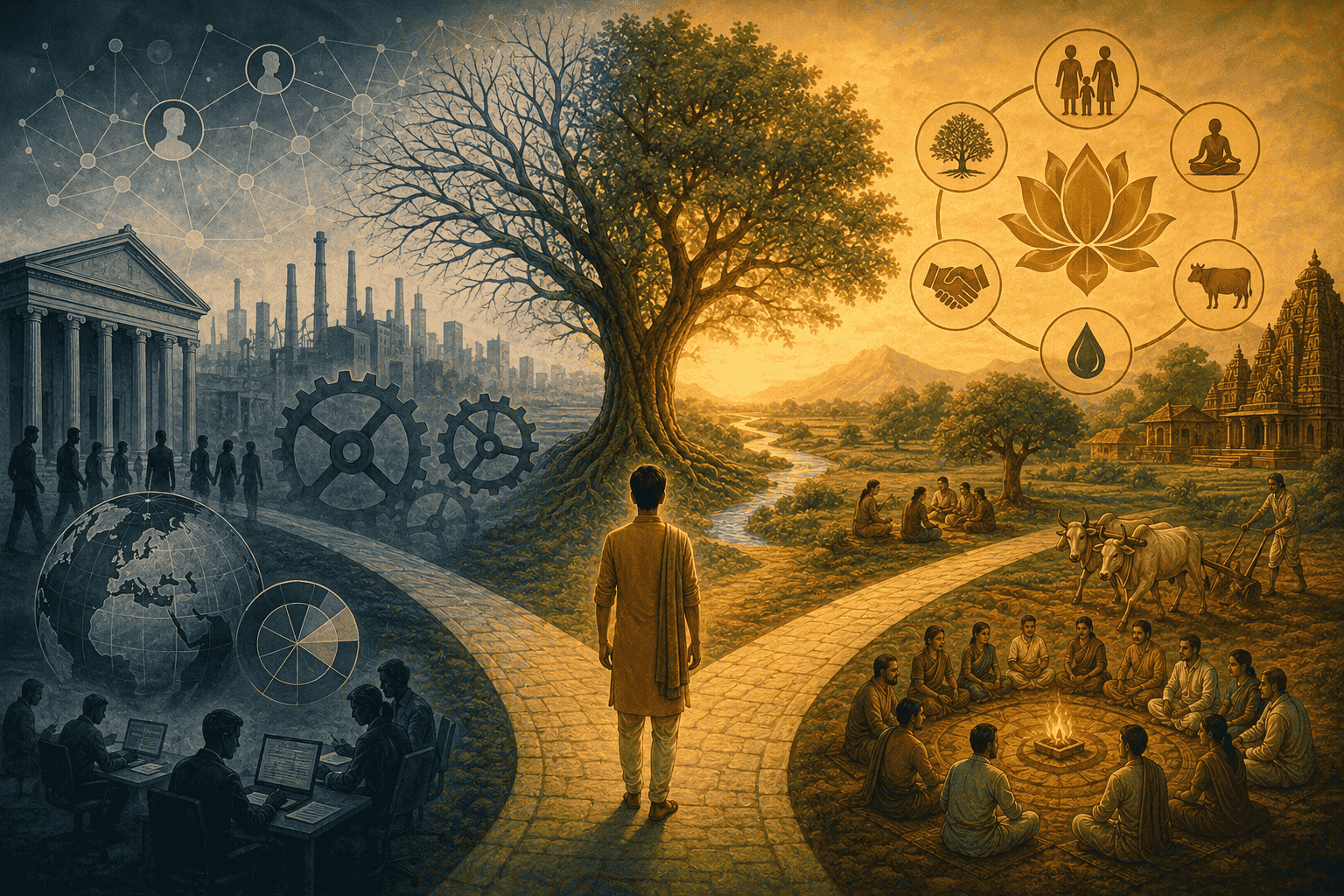
Can India understand itself through concepts like class, race, gender, state, religion and economy alone?
There is a strange paradox at the heart of the Indian social sciences. We have produced enormous amounts of knowledge about India, yet much of that knowledge continues to be organized through conceptual categories that emerged from very different historical experiences.
We study Indian society through class.
Indian identities through race.
Indian traditions through religion.
Indian political life through the state.
Indian economic relations through the market.
Indian public life through civil society.
These categories are not necessarily wrong. The problem begins when they become the only vocabulary through which reality is allowed to speak.
The deeper question, therefore, is not whether Western social-scientific concepts should be discarded. It is:
Why should concepts developed from one civilizational experience automatically possess universal explanatory authority over another?
Every civilization develops categories through which it makes sense of human life. Categories are not neutral containers. They determine what we notice, what we measure, what we classify—and sometimes what we fail to see.
This is why the problem is fundamentally epistemological, not merely terminological.
The Problem of Translation
Consider the word dharma.
It is frequently translated as “religion,” “law,” “duty” or “morality.” Each translation captures something, but none captures the entire conceptual field. Arvind Sharma, for example, describes dharma as an ordering principle that operates across nature, society and the transcendent, connecting it with the idea of ṛta. Donald Davis similarly notes that dharma has a substantial legal and normative tradition in Dharmaśāstra while also extending beyond a narrow modern category of law.
Now imagine beginning a study of Indian society with the assumption that dharma simply means “religion.” Something has already happened. A conceptual translation has become a conceptual reduction. The same problem appears elsewhere. Puruṣārtha is not simply “life goals.” Āśrama is not merely “life stage.” Ṛṇa is not simply “debt.” Yajña is not merely “sacrifice.” Saṃskāra is not merely “ritual.” Lokasaṅgraha is not merely “social welfare.”
The words may have approximate English equivalents. Their conceptual worlds do not. This distinction matters because social science does not merely describe reality. It constructs analytical questions about reality. If we begin with the category of “individual,” we are likely to ask about individual rights, preferences and autonomy.
If we begin with vyakti, situated within kutumba, samāja and rāṣṭra, we may instead ask about relationships, responsibilities and social embeddedness. The empirical world may be the same. The questions are not.
From Categories to Drishti
This is where decolonization must become more ambitious.
It is relatively easy to criticize colonial education, replace a few authors in a syllabus or add an Indian thinker to a reading list. These are useful interventions, but they do not necessarily change the architecture of knowledge.
The deeper task is to recover conceptual agency.
Dipesh Chakrabarty’s Provincializing Europe made a related argument from within postcolonial historiography: European categories have become deeply embedded within the social sciences, and translating non-European worlds into those categories can produce conceptual distortions. Importantly, Chakrabarty did not advocate simply abandoning European thought; he argued for making its universality less presumptive and allowing other historical experiences to reshape theory itself.
This is an important distinction. Decolonization is not intellectual isolation. It is the refusal to mistake one civilization’s categories for the natural grammar of humanity. India therefore does not need to choose between “Western theory” and “Indian tradition.” It needs the capacity to think from its own categories while remaining intellectually open to others.
That is the difference between borrowing concepts and entering into dialogue with concepts.
What Would an Indic Vocabulary Change?
Consider the contrast:
| Predominant modern category | Indic conceptual possibility |
|---|---|
| Individual | Vyakti |
| Society | Samāja |
| Family | Kutumba |
| Religion | Dharma / Sampradāya |
| Life goals | Puruṣārtha |
| Life stages | Āśrama |
| Social classification | Varṇa / Jāti |
| Cosmic order | Ṛta |
| Responsibility/debt | Ṛṇa |
| Sacrifice/contribution | Yajña |
| Social cohesion | Lokasaṅgraha |
| Cultural formation | Saṃskāra |
The purpose of such a table is not to claim that the two columns are perfect equivalents. In fact, the opposite is true. Their differences are precisely what make comparison intellectually productive.
Take jāti. If we begin with “caste” as the unquestioned category, we immediately inherit a particular history of classification. Jāti may then be treated simply as an Indian version of a universal sociological type. But beginning with the indigenous term forces us to ask different questions about locality, kinship, occupation, marriage, status, community and social organization.
This does not mean abandoning the concept of caste. It means refusing to let “caste” become the only possible question. M. N. Srinivas demonstrated the productive potential of developing concepts from Indian social realities himself. His concepts of Sanskritization and dominant caste emerged from engagement with Indian field realities and subsequently became influential within sociology and anthropology.
That is perhaps the model we should follow. Theory should emerge from the encounter with society—not society be forced into a predetermined theoretical vocabulary.
The Risk of Romanticism
There is, however, an important danger. Indigenization can itself become superficial if every Sanskrit word is automatically treated as a profound social-scientific concept. That would simply replace one form of intellectual dependence with another. Not every traditional category is universal. Not every inherited institution was just. Not every historical practice deserves preservation. And there was never one completely uniform “Indian society” speaking in a single voice across thousands of years.
A serious Indic social science must therefore be critical as well as civilizational. It must ask of dharma, varṇa, jāti, āśrama, yajña and other concepts:
What did they mean in different texts and periods?
How were they actually lived?
Who interpreted them?
Who benefited from particular interpretations?
How did communities modify them?
What changed across regions and historical periods?
This is where indigenous categories become intellectually powerful rather than merely cultural symbols. The objective is not to worship the vocabulary. It is to think with it.
From Borrowing to Conceptual Production
This is ultimately what is missing from much of the decolonization debate. We have become very good at identifying what was imposed upon us. We now need to demonstrate what we can generate ourselves.
- An Indian sociology should be capable of theorizing through kutumba, samāja, ṛṇa, yajña and lokasaṅgraha.
- An Indian political science should be capable of asking questions through rājadharma, dandanīti, rāṣṭra and lokasaṅgraha.
- An Indian economics should be capable of examining artha through the relationship between wealth, dharma and social responsibility.
- An Indian anthropology should be capable of taking seriously indigenous categories of personhood, community, ritual and belonging.
- An Indian environmental studies should be able to explore relationships between human beings, prakṛti, ṛta and reciprocal obligation.
The objective is not to create a Sanskritized social science for the sake of appearance. It is to create a social science in which Indian categories are capable of generating hypotheses, concepts, comparisons and explanations.
That is the real test. Because a civilization does not become intellectually independent merely when it stops quoting foreign thinkers. It becomes intellectually independent when it can name its own reality. And perhaps this is where decolonization truly begins. Not with the rejection of the West. Not even with criticism of colonialism.
But with a much more demanding act:
The ability to look at one’s own society and ask: What if the concepts required to understand it are already present within its own intellectual traditions—and what new knowledge becomes possible when we allow those concepts to speak?
That is the movement beyond borrowed categories. And that is the beginning of an Indic social science.
