
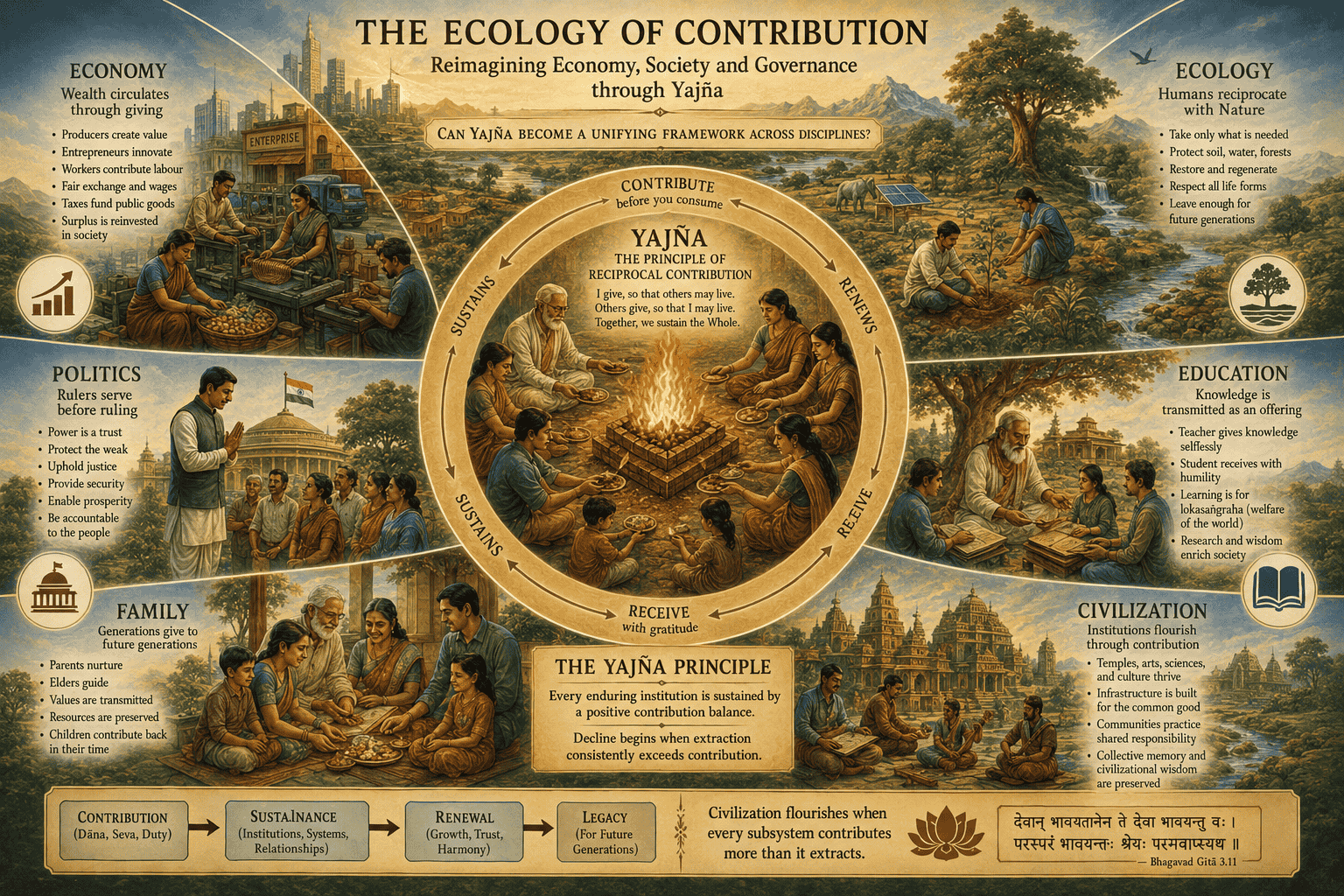
Can Yajña become a unifying framework across disciplines?
We have become very good at asking what a system produces. We measure GDP, institutional performance, educational outcomes, administrative efficiency and ecological productivity. We also ask how much individuals or institutions consume from a system.
But there is another question that we rarely ask with equal seriousness:
What does each part contribute to the system that sustains it?
This question opens the possibility of reading Yajña not merely as a ritual category or even simply as a principle of social cooperation, but as a systems principle. The Bhagavad Gītā provides an important starting point. Its discussion of Yajña describes a chain of mutual sustenance in which sacrifice, action, rain, food and living beings are connected. The famous formulation is not simply about ritual performance; it presents a world in which life is sustained through relationships of action and reciprocal nourishment.
This offers an intriguing conceptual proposition: Every system survives because its constituent parts contribute to something larger than themselves. The idea can therefore travel across disciplines.
From Social Principle to Systems Principle
Consider the economy. An economy is not sustained merely because individuals consume. Production, investment, entrepreneurship, labour, taxation, infrastructure and knowledge all contribute to the economic system. Wealth has to circulate. When resources become permanently concentrated without productive reinvestment, the system’s capacity to reproduce itself can weaken.
The Yajña question would therefore be: Does economic activity merely extract value, or does it replenish the conditions of future production?
The same question can be asked of ecology.
Modern environmental thought increasingly understands human beings and ecosystems as components of interconnected social-ecological systems. Elinor Ostrom’s work on commons demonstrated that communities can develop institutions for managing shared resources sustainably, challenging the assumption that common resources must inevitably be either privatized or centrally controlled.
Here the ecological interpretation of Yajña becomes particularly interesting. Nature gives. Agriculture receives. Human beings transform. But what do they return? If a society extracts water, soil fertility, forests and biodiversity faster than ecological systems can regenerate them, the contribution balance turns negative. The system may continue functioning for a while—sometimes impressively so—but it is consuming its own foundations.
A Yajña perspective therefore asks us to move from resource extraction toward reciprocal stewardship. This is not an argument that ancient India possessed modern environmental science. It is an attempt to use an Indic category to formulate a contemporary analytical question.
Governance: Authority as Contribution
The same principle applies to politics. Modern political theory often asks how power should be acquired, limited and exercised. These remain essential questions. But Yajña introduces another: What does authority contribute?
A ruler, administrator or institution receives authority, resources and legitimacy from society. What does it return? Protection. Justice. Public goods. Infrastructure. Security. Institutional continuity. This brings Yajña close to the broader idea of rājadharma: political authority is not merely possession of power; it carries obligations toward the social order. Governance therefore becomes more than administration.
Power must justify itself through contribution. The principle can be extended to modern institutions as well. A university receives public trust, student fees, faculty expertise and social resources. What does it contribute back? A corporation receives labour, capital, infrastructure and natural resources. What does it return to society? A public institution receives authority and taxation. What does it produce for the citizen?
The question is deceptively simple. But it changes the way institutional performance is understood.
Education: Knowledge as an Offering
Education provides perhaps the clearest example. Knowledge is rarely created by one generation alone. A scholar inherits language, concepts, methods, institutions and accumulated discoveries. A teacher receives from previous teachers and passes knowledge forward to students.
The student is therefore not merely a consumer of education. The student is a temporary recipient within a much longer chain.
This is remarkably close to the logic of guru-dakṣiṇā: what is received creates an obligation to acknowledge and contribute to the source of that knowledge. A Yajña model of education would therefore ask not simply: “What will this degree give me?” but: “What will I contribute with what I have received?”
That is a very different philosophy of education.
Family: Contribution Across Generations
The family makes the temporal dimension even clearer. Parents contribute to children long before children can reciprocate. Children later care for parents. Grandparents transmit memory. Each generation inherits from the previous one and becomes responsible for the next.
The exchange is not symmetrical. It is intergenerational.
This is perhaps one of the deepest features of Yajña: contribution does not require immediate repayment. The person who plants a tree may never sit beneath it. The teacher may never meet the student whose work transforms society. A generation may preserve institutions whose greatest beneficiaries will be born decades later. Civilization depends upon precisely such actions.
The Yajña Principle
These examples allow us to formulate a broader proposition:
Yajña Principle: Every enduring institution is sustained by a positive contribution balance; decline begins when extraction consistently exceeds contribution.
This should not be understood as a literal accounting equation. It is an analytical heuristic.
We might represent it as:
Contribution > Extraction → Renewal
Contribution ≈ Extraction → Stability
Contribution < Extraction → Depletion
The proposition becomes useful because it can be applied across different systems.
| System | What it receives | What it must contribute |
|---|---|---|
| Economy | Labour, capital, resources | Wealth, employment, innovation |
| Ecology | Human stewardship | Regeneration and restraint |
| Governance | Authority, taxation, legitimacy | Justice and public goods |
| Education | Knowledge, institutions, teachers | New knowledge and capable citizens |
| Family | Care and inherited resources | Care, continuity and transmission |
| Civilization | Cultural inheritance | Renewal and transmission to the future |
The concept also helps us connect seemingly separate disciplines. Economics can ask about productive circulation. Political science can examine the contribution of institutions. Environmental studies can examine ecological regeneration. Sociology can investigate reciprocal norms. Organizational theory can study whether institutions replenish the human and social resources on which they depend.
In this sense, Yajña becomes a cross-disciplinary analytical lens. And there is an important contemporary parallel here. Ostrom’s work demonstrated that cooperation and institutional design matter enormously for the sustainability of shared resources, while subsequent social-ecological research has emphasized the interaction between institutions, resource systems and collective action.
But the Yajña framework asks an additional normative question: Are we designing systems that encourage contribution, or systems that reward extraction?
That distinction may be decisive. A corporation that extracts human attention without renewing human capability eventually exhausts its workforce. A state that extracts taxation without delivering public value weakens legitimacy. An economy that consumes ecological capital without regeneration undermines its future. An educational system that produces credentials without creating knowledge becomes hollow.
The problem is not consumption itself.
The problem is consumption without contribution.
This is why Yajña may be more than a metaphor for social cooperation. It can become a way of thinking about systemic sustainability. Civilization flourishes when its parts do not merely take from the whole, but continually feed the conditions that allow the whole to exist. And perhaps the most important question we can ask of any institution is therefore not simply: “How much does it produce?” but: “What does it give back to the system that sustains it?”
That is where Yajña moves from ritual to social theory, from social theory to systems thinking, and from systems thinking to a possible Indic theory of civilizational sustainability.
