
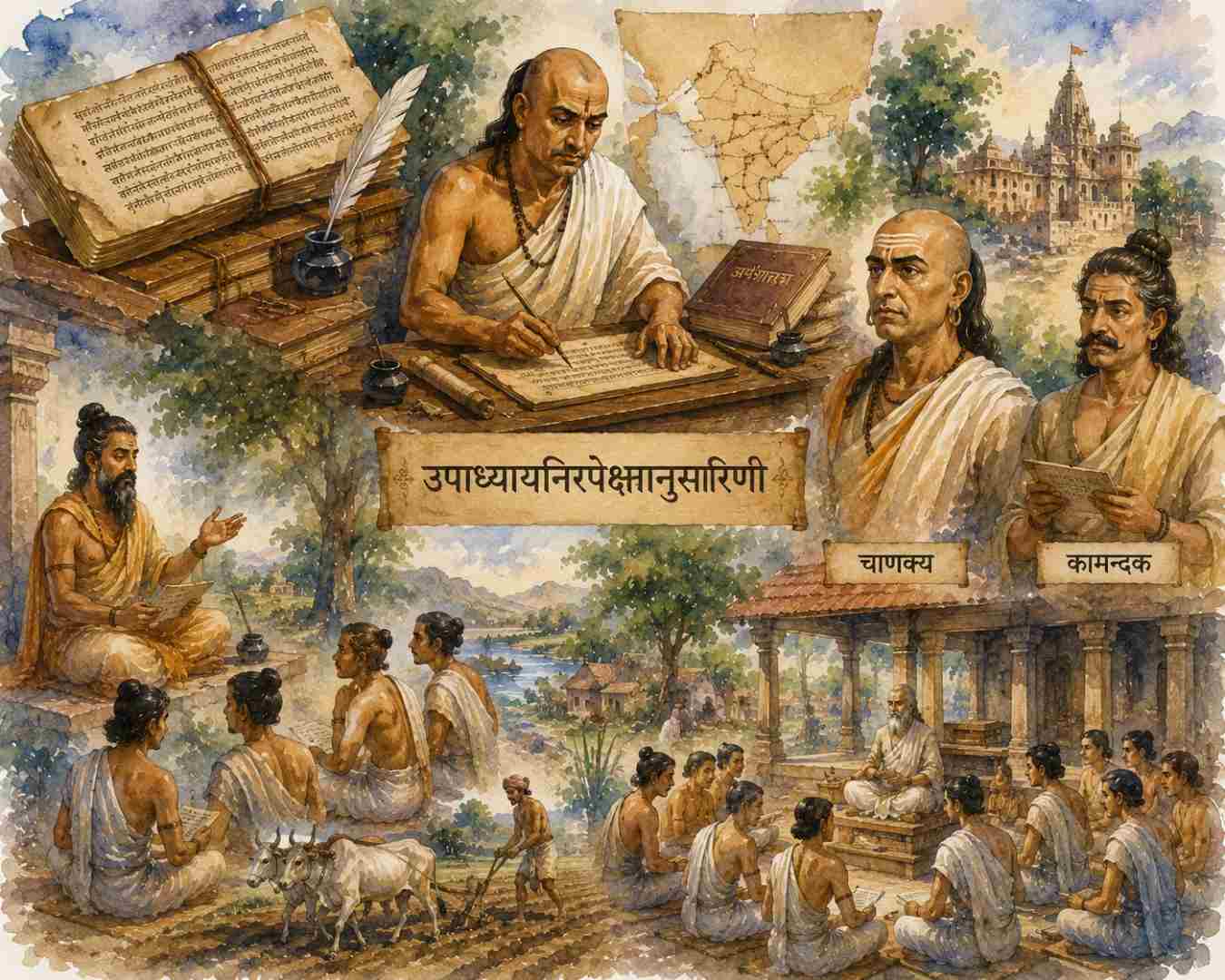
A Later Reading of Kāmandaka’s Political Thought
Introduction
The history of Sanskrit political thought is usually narrated through major works and famous authors: Kauṭilya and the Arthaśāstra, Kāmandaka and the Nītisāra, or Śukra and the Śukranīti. Such a history, however, remains incomplete if it excludes the commentaries through which these works were read, explained, and transmitted.
Upādhyāyanirapekṣānusāriṇī is one such commentary. It is a commentary on Kāmandaka’s Nītisāra, but it should not be treated merely as an unnamed supplement to Kāmandaka. Its importance lies in the particular work it performs: it guides the reader through a compressed political text, clarifies technical expressions, preserves or records parallels attributed to the Arthaśāstra tradition, and places Kāmandaka’s political reasoning within a later scholastic framework.
The commentator’s identity and date are not securely established. A nineteenth-century edition records a Calcutta publication in Saṃvat 1941. If the date refers to Vikrama Saṃvat, it corresponds approximately to 1884 CE; this conversion should be confirmed from the edition’s title page. By the early twentieth century, the commentary had entered European Sanskrit scholarship. Julius Jolly and Richard Schmidt refer to a commentary on the Nītisāra under the abbreviation U and associate it with quotations or parallels relevant to the Arthaśāstra. The exact page and wording of their reference should be cited from their 1924 edition.
The present article focuses on Upādhyāyanirapekṣānusāriṇī itself: its character as a commentary, its explanatory method, its treatment of political circumstances, its handling of the maṇḍala and saptāṅga doctrines, and its value for studying the later life of Sanskrit political knowledge.
The Book and Its Title
The title Upādhyāyanirapekṣānusāriṇī requires bibliographical attention. It should be reproduced exactly as it appears in the edition consulted, including the final feminine form and the diacritics. Shorter forms, such as Upādhyāyanirapekṣā, may occur in catalogues, manuscript descriptions, or later editions. These forms should not be assumed to refer to precisely the same textual object until the title pages, colophons, and catalogues have been compared.
The title is also significant because it does not immediately identify the work by its subject. Unlike a title such as Nītisāraṭīkā, it points toward a relationship with an upādhyāya or teacher and with the idea of nirapekṣā. The grammatical and semantic force of the compound should be established from the Sanskrit text and colophon. Until that work is done, the title should be treated primarily as the received name of the commentary rather than translated confidently.
A catalogue of Sanskrit manuscripts records a Nītisāra manuscript with a commentary referred to as Upādhyāyanirapekṣā, noting that it was translated by Lakṣmīpati, described as a minister of Cikadevarāja. This catalogue entry is important evidence that the commentary circulated in manuscript environments under a related title, but it does not by itself establish the relationship between every manuscript bearing that name and the printed Upādhyāyanirapekṣānusāriṇī.
The title’s obscurity should not be mistaken for lack of importance. Many Sanskrit commentaries are known less by their independent historical biographies than by the explanatory work they perform on a root text. In the case of Upādhyāyanirapekṣānusāriṇī, the commentary’s historical value emerges through its method of reading Kāmandaka.
The Commentary as a Scholarly Work
Kāmandaka writes in the compressed style of śāstra. A single verse can presuppose a long argument concerning the ruler, the strength of the enemy, the treasury, the army, the reliability of allies, the political season, or the suitability of a particular strategy. The reader is expected to know technical vocabulary, recognize inherited doctrines, and reconstruct the practical situation to which a rule applies.
A commentary therefore performs more than a grammatical service. It can explain difficult terms, supply implied subjects and objects, connect one verse with another, distinguish similar political measures, and identify the circumstances in which a rule should be applied. Upādhyāyanirapekṣānusāriṇī should be studied through precisely these operations.
Its central scholarly function is mediation. It stands between the brevity of Kāmandaka’s verse and the analytical work required of a reader. The commentator’s explanations can reveal which words were considered obscure, which concepts required elaboration, and which portions of the Nītisāra remained important to later readers.
The commentary should consequently be read at two levels. At one level, it explains what Kāmandaka says. At another, it records how a later Sanskrit scholar believed Kāmandaka ought to be understood. Those two levels should not be collapsed. A commentator’s explanation is evidence for the reception of the Nītisāra, even when it is not a neutral report of Kāmandaka’s original intention.
Its Method of Explanation
The specific character of Upādhyāyanirapekṣānusāriṇī should be reconstructed from its actual prose. The article should therefore quote representative passages rather than describe the commentary only in general terms.
The following features should be examined throughout the book:
- whether the commentary proceeds word by word or by larger conceptual units;
- whether it supplies grammatical constructions omitted in the verse;
- whether it explains a term through synonyms, definitions, examples, or contrast;
- whether it identifies earlier authorities by name;
- whether it quotes other political texts directly;
- whether it reconciles apparently different rules;
- whether it explains political conduct through the categories of strength, time, place, and opportunity; and
- whether it treats Kāmandaka as an independent author or primarily as a transmitter of older political science.
These questions will make it possible to describe the commentary’s intellectual personality. Without such analysis, the work risks being reduced to a source merely because it contains useful quotations.
The commentary’s value is not dependent only on the number of quotations it contains. Its organization of political knowledge, its choice of explanations, and its interpretation of difficult passages are equally important. A commentary may be historically significant even where it does not preserve an exact quotation from an earlier text.
Deśa and Kāla
One of the most important themes for examining the commentary is the relationship between political action and circumstance. The categories of deśa and kāla—place and time—provide a useful framework for asking how political rules are made practical.
A ruler must know not only what may be done, but whether it should be done now, in this place, against this particular opponent, and with the resources currently available. A policy suitable for a powerful king may be dangerous for a weaker ruler. A military expedition that is feasible in one season may be impractical in another. An alliance that appears useful may become a liability if the ally’s interests change.
Upādhyāyanirapekṣānusāriṇī should be examined for the exact ways in which it explains these contextual conditions. Does it define deśa geographically, militarily, or politically? Does it treat kāla as season, timing, opportunity, or historical circumstance? Does it connect these categories with the strength of the ruler, the enemy, or the treasury?
These questions can turn a general statement about “practical politics” into a precise account of the commentator’s method. The article should add at least one Sanskrit passage in which the commentary explicitly explains the relevance of place and time.
The significance of deśa and kāla is that they prevent nīti from becoming a collection of mechanically applicable rules. Political knowledge depends upon judgment. The commentator’s task is to show how a reader moves from a general maxim to a decision in a particular situation.
The Maṇḍala as Political Context
The maṇḍala, or circle of states, is another important area in which the commentary should be studied in its own right. Kāmandaka places the ruler within a network of neighbouring powers. The immediate neighbour may be an enemy, while a more distant ruler may become a potential ally. Political action therefore depends upon relationships among states, not merely upon the isolated conduct of one kingdom.
The value of Upādhyāyanirapekṣānusāriṇī lies in the possibility that it clarifies how these relationships are to be recognized and used. The commentator may explain the status of an enemy, ally, neutral power, or intermediary ruler; distinguish permanent from temporary relationships; or show how the position of one state changes when the balance of power changes.
The discussion should focus on the commentator’s language. Does the commentary define the maṇḍala through geographical proximity, political hostility, strategic interest, or all three? Does it explain how a ruler should identify a friend and an enemy? Does it regard the circle of states as a fixed structure or as a changing configuration?
These questions are more useful than simply repeating that Kāmandaka discusses diplomacy. They allow us to identify the specific political reasoning that Upādhyāyanirapekṣānusāriṇī adds to the Nītisāra.
The commentary should also be examined for its treatment of the six measures of foreign policy: sandhi, vigraha, āsana, yāna, saṃśraya, and dvaidhibhāva. Each should be cited from the text, and the translations should remain consistent. A passage-by-passage study may show whether the commentator understands these measures as distinct policies, stages in a strategy, or choices determined by relative strength.
The Seven Limbs of the Polity
The saptāṅga doctrine provides a further opportunity to study the commentary’s specific contribution. The seven elements are conventionally identified as the ruler, ministers, territory and people, fort, treasury, army, and ally. The exact terms and order should be verified from the edition used.
The importance of the commentary is not exhausted by reproducing this list. Its real contribution lies in explaining the relationship among the elements. A ruler may be courageous but ineffective if the treasury is empty. An army may be large but unreliable if it is unpaid. A treasury may be substantial but unsustainable if the territory is unproductive. A kingdom may possess capable ministers but remain vulnerable if it lacks dependable allies.
Such examples show why the polity can be analysed as an interdependent configuration. This should not be equated with a modern constitutional or impersonal state. The political order remains strongly king-centred. Nevertheless, the king is presented within a larger system whose other elements condition the success of rulership.
The article should identify whether Upādhyāyanirapekṣānusāriṇī merely glosses the names of the seven limbs or explains their functions and mutual dependence. Does it discuss the qualifications of ministers? Does it describe the economic basis of the treasury? Does it connect fortifications with territory and military strategy? Does it explain the ally as a diplomatic resource rather than simply as a friendly ruler?
A direct quotation from the commentary on the saptāṅga passage would establish its specificity and prevent the section from becoming a general summary of Kāmandaka.
Diplomacy, Spies, and Political Action
A detailed study should also examine the commentary’s treatment of diplomatic instruments and political agents. The Nītisāra discusses envoys, spies, messengers, alliances, hostile action, military movement, and the management of enemies. These subjects allow the commentator’s practical vocabulary to be studied closely.
The questions to ask include:
- How does the commentary distinguish an envoy from a spy?
- What qualities does it associate with a successful political messenger?
- Does it treat intelligence as information gathering, deception, or both?
- How does it explain the timing of a military expedition?
- Does it distinguish open warfare from indirect or deceptive action?
- How does it connect the ruler’s personal discipline with the reliability of political information?
These are not merely themes of the root text. They are possible points at which the later commentator clarifies the operational meaning of political categories.
The article should avoid presenting Indian political thought as either purely moral or purely realist. Upādhyāyanirapekṣānusāriṇī should instead be examined for the manner in which normative obligations and strategic calculations are placed together. Protection of the people, preservation of order, intelligence, coercion, alliance, deception, and military prudence may all belong to the same political vocabulary.
The Arthaśāstra Connection
The relationship between Upādhyāyanirapekṣānusāriṇī and the Arthaśāstra should be discussed, but only as one part of the article rather than as its organizing subject.
Jolly and Schmidt’s 1924 edition refers to a commentary abbreviated as U, identifies it as a commentary on the Nītisāra, and associates it with quotations or parallels relevant to Kauṭilyan political material. The exact reference should be transcribed from the edition and cited by volume and page.
This evidence may be important, but “quotation” should be used only after the relevant passages have been checked. A passage may be a direct quotation, a close parallel, a shared inheritance from an earlier political source, or a formulation transmitted through an intermediate text. The commentary should therefore be treated as a comparative witness, not automatically as a transparent record of the original Arthaśāstra.
If the passages identified by Jolly and Schmidt are verified, they may show that Kauṭilyan political formulations remained available within later Sanskrit scholastic traditions. They may also reveal how such formulations were adapted to the conceptual organization of Kāmandaka’s Nītisāra. This is the appropriate extent of the connection: the central subject remains Upādhyāyanirapekṣānusāriṇī and its own work of interpretation.
Manuscript and Print History
The publication history of the commentary is an important part of its biography. A nineteenth-century edition records a Calcutta publication in Saṃvat 1941. The edition’s title page and preface should be consulted to establish the exact title, editor, printer, publication date, and era intended by the Saṃvat date.
If the date is Vikrama Saṃvat, Saṃvat 1941 corresponds approximately to 1884 CE. This should be expressed conditionally until the era is confirmed. The phrase “later-day commentary,” if retained, should be placed in quotation marks only when it reproduces the exact wording of the source.
The nineteenth century should not be described simply as a period of Western “rediscovery.” Sanskrit works were collected, edited, printed, and circulated through Indian, princely, missionary, colonial, and scholarly institutions. The printing of this commentary belongs to a transition from manuscript circulation to modern print, but print itself was not a neutral process. Editors selected readings, corrected errors, compared manuscripts, and determined how the work would be presented to new readers.
The later Ānandāśrama publication of the Kāmandakīyanītisāra with Jayamaṅgalā and Upādhyāyanirapekṣā is also relevant. It brings multiple commentarial layers into a modern scholarly setting. The exact editor, year, volume, and title form should be taken from the copy consulted. The Ānandāśrama collection identifies the work with series number 136, but the publication details should be completed from the bibliographical record.
The history should therefore be represented not as a single linear chain but as a layered process:
Kauṭilyan political materials and other śāstric traditions → Kāmandaka’s reorganization of political knowledge → later commentary and quotation practices → manuscript circulation → nineteenth-century printing → modern comparative scholarship.
This model allows for parallel transmission, lost intermediaries, independent quotations, and textual reworking.
Why This Specific Book Matters
Upādhyāyanirapekṣānusāriṇī matters because it reveals the practical and scholarly work involved in reading a compressed political text. Its significance is not reducible to the fact that it is attached to Kāmandaka, nor to the possibility that it contains material related to Kauṭilya.
The commentary deserves study for at least five specific reasons.
- First, it is evidence for the continuing readership of the Nītisāra. Someone considered Kāmandaka’s verses sufficiently important, difficult, or authoritative to require extensive explanation.
- Second, it reveals what a later scholar considered necessary for understanding political science. The commentator’s definitions, distinctions, examples, and citations identify the points at which the root text required intellectual mediation.
- Third, it may preserve a vocabulary of political judgment organized around strength, time, place, alliance, intelligence, and opportunity. This vocabulary can show how nīti was made operational for readers.
- Fourth, its treatment of quotations or parallels may provide evidence for the circulation of older political material. That evidence must be verified passage by passage, but the possibility makes the commentary important for textual history.
- Fifth, the work demonstrates that the history of Sanskrit political thought includes not only doctrines but also reading practices. How a scholar explains a verse can reveal as much about the later life of a political tradition as the verse itself.
Conclusion
Upādhyāyanirapekṣānusāriṇī should be understood as a substantial witness to the later interpretation of Kāmandaka’s political science. Its importance lies in its own explanatory activity: the way it mediates compressed verses, clarifies political terms, relates rules to circumstances, explains the organization of the polity, and possibly preserves quotations or parallels associated with the Arthaśāstra tradition.
The connection with Kāmandaka is fundamental because the work is his commentary. The connection with Kauṭilya is historically valuable because Jolly and Schmidt associate the commentary with Kauṭilyan material. Neither connection, however, should replace the study of the commentary itself.
The work’s author, date, title history, and textual relationship with other commentaries require further investigation. Its Calcutta publication in Saṃvat 1941 should be verified from the original edition; its abbreviation as U should be documented directly from Jolly and Schmidt; and the passages described as quotations from the Arthaśāstra should be compared with reliable Sanskrit editions.
The deeper methodological lesson is that a political tradition survives through layered acts of reading. Kāmandaka formulated political knowledge in compact verse. A later commentator expanded, interpreted, and organized that knowledge for another intellectual world. Manuscript and print traditions then carried the commentary into modern scholarship.
Upādhyāyanirapekṣānusāriṇī is therefore not merely a quiet appendix to the Nītisāra. It is a book about how political knowledge becomes intelligible, how technical ideas acquire new explanatory settings, and how a Sanskrit intellectual tradition continues through commentary.
References and Online Sources
Primary editions and digital copies
-
T. Gaṇapati Śāstrī, ed., The Nītisāra of Kāmandaka. Trivandrum Sanskrit Series, 1912. The Internet Archive record identifies the Sanskrit edition as a 1912 publication by the Travancore Government Press, with 344 pages. Original scanned book.
-
Rajendralala Mitra, ed., The Nītisāra. Calcutta: Asiatic Society of Bengal, 1861. This is an early printed edition and English-language resource for the Nītisāra. Original scanned book.
-
Ānandāśrama Sanskrit Series, no. 136, Kāmandakīyanītisāra with Jayamaṅgalā and Upādhyāyanirapekṣā. The exact editor, year, and volume details should be taken from the copy consulted. The Ānandāśrama catalogue identifies no. 136 with Kāmandakīya Nītisāra. Series information.
Kauṭilyan comparison
-
Jolly, Julius, and Richard Schmidt. Arthaśāstra: A New Edition. 2 vols. Lahore: Punjab Sanskrit Book Depot, 1924. Consult the notes and commentary volume for the exact reference to U, the identification of Upādhyāyanirapekṣānusāriṇī, and the passages described as quotations or parallels. Digital record.
-
Jolly, Julius. “On Some Early References to the Kauṭilīya.” 1927. This study is useful for the wider question of quotations, parallels, and early references to the Arthaśāstra. Digital copy.
Manuscript and catalogue evidence
-
Descriptive Catalogue of Sanskrit Manuscripts in the Madras Presidency, vol. 8. The catalogue records a Nītisāra manuscript with a commentary referred to as Upādhyāyanirapekṣā and notes a translation by Lakṣmīpati. This should be used as manuscript evidence, not as proof that all related titles designate an identical recension.
Modern contextual study
-
Knutson, Jesse, ed. Kāmandaki’s Essence of Politics: Nītisāra. Murty Classical Library of India. Cambridge, MA: Harvard University Press, 2021. Useful for a modern edition and interpretation of Kāmandaka, but not a substitute for citing the commentary itself.
