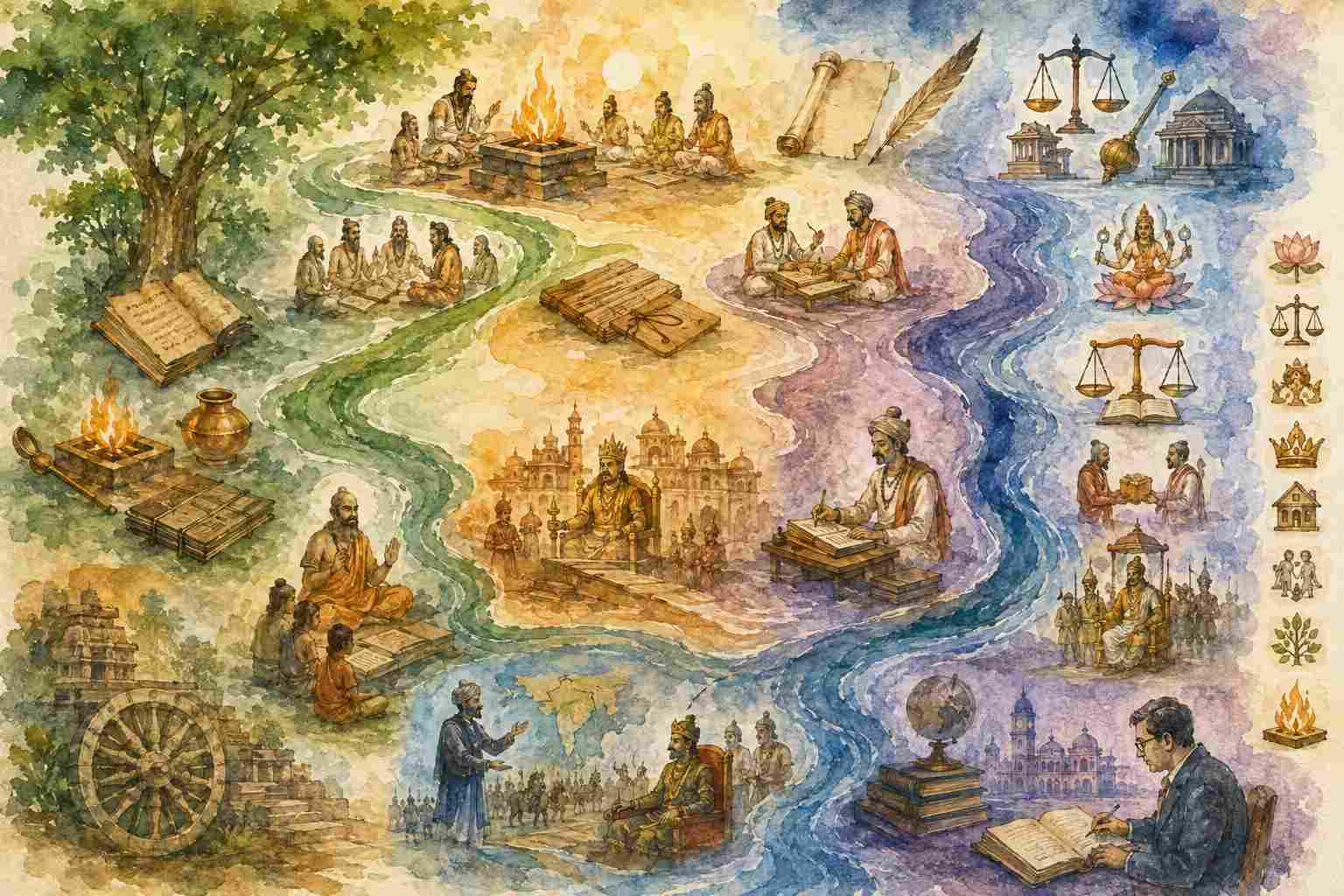
Most of the people think that Dharmashatric tradition is only confined to smritis and most of the smritis are from Manu. But, the Dharmaśāstric tradition cannot be reduced to the Manusmṛti, nor can it be understood simply as an ancient Indian equivalent of a modern legal code. It is better understood as a continuously developing body of normative literature concerned with dharma, social conduct, ritual obligation, kingship, judicial procedure, inheritance, property, punishment, penance, family relations, religious duties and the ordering of society. The beauty of Bharatiya tradition is that its literary form also changes over time. The early tradition appears in sūtra literature; it subsequently develops into metrical Smṛtis; from the early medieval period it increasingly produces commentaries; and from around the twelfth century the nibandha or digest becomes a major literary form. Modern scholarship therefore commonly distinguishes between the earlier Smṛti period and the later commentarial and digest traditions.
What is particularly striking is that the later authors did not simply abandon the earlier texts. They collected, compared, reconciled, interpreted and sometimes restricted or expanded them. A later Dharmaśāstra work is therefore often a record not merely of its own author’s opinion, but of a conversation with centuries of preceding authorities.
1. The Vedic foundations
The earliest layer of the tradition represented in the literary sources is the Vedic corpus. These texts are not Dharmaśāstra works in the later technical sense, but they provide much of the ritual, social and normative vocabulary from which the later Dharma tradition develops.
Ṛgveda
Date: c. 1500–1200 BCE
Author: Vedic ṛṣis; composite tradition
Content: Hymns concerning ṛta, sacrifice, gods, social relationships, kingship, ritual order and the relationship between cosmic and human order.
The Ṛgveda is particularly important as a background source because later Dharma literature operates with the idea that human conduct exists within a larger order. Dharmaśāstra will eventually formulate this order in much more explicit normative terms.
Vājasaneya Saṃhitā
Date: c. 1200–900 BCE
Tradition: Śukla Yajurveda
Content: Sacrificial formulas, ritual procedures, social and royal rituals and the ritual ordering of society.
Taittirīya Saṃhitā
Date: c. 1200–900 BCE
Tradition: Kṛṣṇa Yajurveda
Content: Sacrificial ritual, ritual obligations and the conceptual framework underlying later Śrauta and Dharma literature.
Aitareya Brāhmaṇa
Date: c. 1000–800 BCE
Tradition: Ṛgvedic
Content: Ritual interpretation, sacrifice, kingship and the relationship between ritual authority and political authority.
Taittirīya Brāhmaṇa
Date: c. 1000–800 BCE
Tradition: Taittirīya school
Content: Ritual, sacrifice, priestly functions and social-religious obligations.
Tāṇḍya / Pañcaviṃśa Brāhmaṇa
Date: broadly c. 1000–800 BCE
Tradition: Sāmaveda
Content: Sacrificial ritual and ritual interpretation.
Śatapatha Brāhmaṇa
Date: c. 900–700 BCE
Tradition: Śukla Yajurveda
Content: Extensive discussion of sacrifice, ritual symbolism, kingship, social order and normative practices.
Taittirīya Āraṇyaka
Date: c. 900–700 BCE
Tradition: Taittirīya
Content: Ritual, meditation, ascetic and theological themes that form part of the transition from ritual literature toward the Upaniṣadic world.
Bṛhadāraṇyaka Upaniṣad
Date: c. 800–600 BCE
Tradition: Śatapatha Brāhmaṇa/Yajurvedic tradition
Content: Ātman, brahman, knowledge, renunciation, ethical conduct and the relationship between knowledge and the highest human goal.
The photographed list explicitly includes the Aitareya Brāhmaṇa, Bṛhadāraṇyaka Upaniṣad and several Taittirīya and Vājasaneya texts.
2. The Dharmasūtra tradition
The decisive literary development is the emergence of the Dharmasūtra. These texts move from the wider ritual world of the Kalpasūtras toward explicit treatment of conduct, social duties, rites, inheritance, punishment, kingship and legal procedure.
There is disagreement about exact dates. For example, Patrick Olivelle’s chronology places Āpastamba around 300–200 BCE, Gautama around 200–150 BCE, Baudhāyana around 150–100 BCE and Vasiṣṭha around 100 BCE–100 CE, while older chronologies, including Kane’s, sometimes place them earlier. It is therefore better to give approximate ranges rather than false precision.
Āpastamba Dharmasūtra
Date: approximately 3rd–2nd century BCE
Author/tradition: Āpastamba
Content: Conduct, āśrama duties, student discipline, marriage, household duties, food, impurity, penance, inheritance, social obligations and aspects of judicial and royal authority.
Āpastamba Gṛhyasūtra
Date: broadly early Dharmasūtra period
Author: Āpastamba
Content: Domestic rituals, marriage, birth, death, household ceremonies and rites of passage.
Āpastambīya Mantrapāṭha
Date: early sūtra period
Tradition: Āpastamba
Content: Mantras associated with domestic and ritual practices.
These three Āpastamba works appear together in Kane’s abbreviation list.
Gautama Dharmasūtra
Date: approximately 2nd–1st century BCE, though older datings exist
Author/tradition: Gautama
Content: Dharma, studenthood, marriage, household duties, inheritance, impurity, penance, asceticism, king, punishment and judicial matters.
Baudhāyana Dharmasūtra
Date: approximately 2nd–1st century BCE, with layers of different periods
Author/tradition: Baudhāyana
Content: Ācāra, ritual purity, social duties, penances, marriage, inheritance and other areas of dharma.
Baudhāyana Gṛhyasūtra
Date: early sūtra period
Author: Baudhāyana
Content: Domestic rites and ceremonies.
Hiraṇyakeśi Dharmasūtra
Date: early centuries BCE/CE; precise dating uncertain
Tradition: Hiraṇyakeśi
Content: Dharma, ritual obligations, social conduct and penance.
Pāraskara Gṛhyasūtra
Date: early centuries BCE/CE
Author/tradition: Pāraskara, associated with the Śukla Yajurveda
Content: Domestic rites, marriage, household ceremonies and saṃskāras.
Mānava Gṛhyasūtra
Date: early period; exact date uncertain
Tradition: Mānava
Content: Domestic ritual and household obligations.
Vasiṣṭha Dharmasūtra
Date: approximately 1st century BCE–1st century CE
Author/tradition: Vasiṣṭha
Content: Dharma, social duties, purity, penance, asceticism and rules of conduct.
The photographed pages explicitly distinguish Āpastamba, Baudhāyana, Gautama, Hiraṇyakeśi, Mānava, Pāraskara and Vasiṣṭha materials.
3. The transition to the Smṛti tradition
The next major literary development is the transformation of the aphoristic sūtra style into metrical Dharmaśāstra or Smṛti literature. The period is generally associated with the emergence of texts that organise dharma into large systematic compositions.
Manusmṛti / Mānavadharmaśāstra
Date: approximately 2nd century BCE–2nd century CE; modern scholarship often places the extant text around the early centuries CE
Author/tradition: Manu
Content: Creation, sources of dharma, varṇa and āśrama, saṃskāras, marriage, household duties, kingship, daṇḍa, judicial procedure, inheritance, social duties, penance and liberation.
The Manusmṛti is the foundational text of the classical Dharmaśāstra genre and one of the most influential texts in the entire tradition.
Yājñavalkya Smṛti
Date: approximately 3rd–5th century CE
Author: Yājñavalkya
Content: The work is structured around Ācāra, Vyavahāra and Prāyaścitta. It discusses conduct, kingship, judicial procedure, evidence, inheritance, property, punishment, penance and religious duties.
Its systematic organisation made it particularly influential for the later commentarial tradition.
Nārada Smṛti
Date: approximately 5th–6th century CE
Author/tradition: Nārada
Content: Particularly concerned with Vyavahāra, including courts, litigation, evidence, debt, property, inheritance, contracts and judicial procedure.
The Nārada Smṛti is therefore especially important for understanding the development of the legal dimension of Dharmaśāstra. Modern scholarship generally places it later than Manu and Yājñavalkya.
Viṣṇu Dharmasūtra / Viṣṇu Smṛti
Date: approximately 6th–7th century CE
Tradition: Viṣṇu
Content: Dharma, ritual, social duties, penance, inheritance, royal duties and religious observances.
Parāśara Smṛti
Date: approximately 6th–8th century CE
Author/tradition: Parāśara
Content: Dharma, particularly the rules of conduct and religious duties associated with the Kali age, along with ritual and expiatory matters.
The photographed list explicitly identifies Manu, Yājñavalkya, Nārada, Viṣṇu Dharmasūtra, Parāśara and related texts.
4. Commentaries: the tradition begins interpreting itself
From approximately the eighth century onward, a major literary transformation occurs. Authors increasingly write commentaries on earlier Smṛtis, especially Manu and Yājñavalkya. The purpose is not simply explanation. Commentators frequently reconcile apparently conflicting authorities, explain obscure rules and establish principles for applying earlier texts.
Medhātithi’s Commentary on Manu
Date: approximately 9th century CE
Author: Medhātithi
Content: Extensive interpretation of the Manusmṛti, including dharma, social duties, kingship, punishment, legal procedure and sources of normative authority.
Medhātithi is particularly significant because the commentary demonstrates that Manu was already being treated as a text requiring systematic interpretation rather than merely repetition.
Viśvarūpa’s Commentary on Yājñavalkya
Date: c. 800–850 CE
Author: Viśvarūpa
Also known as: Bālakrīḍā
Content: Detailed interpretation of the Yājñavalkya Smṛti, establishing an important bridge between the early Smṛti period and later Dharmaśāstra jurisprudence.
The University of Texas Dharmaśāstra bibliography identifies Bālakrīḍā as Viśvarūpa’s commentary on the Yājñavalkya Dharmaśāstra.
Mitākṣarā
Date: c. 1075–1125 CE
Author: Vijñāneśvara
Base text: Yājñavalkya Smṛti
Content: A comprehensive commentary with enormous importance for inheritance, property, family law, judicial matters and broader Dharmaśāstra interpretation.
The Mitākṣarā became one of the most influential works in the subsequent history of Hindu law.
5. The emergence of the nibandha tradition
Around the twelfth century the literary form changes again. Instead of commenting on one Smṛti from beginning to end, authors begin producing nibandhas, or systematic digests. A nibandhakāra collects relevant passages from numerous earlier authorities, compares them, organises them thematically and offers a conclusion.
This is one of the most important transformations in the Dharmaśāstric tradition. It means that the tradition becomes increasingly cumulative and encyclopaedic.
Dāyabhāga
Date: c. 1075–1125 CE
Author: Jīmūtavāhana
Content: Primarily inheritance, partition and property rights.
The Dāyabhāga became particularly influential in eastern India and represents an important alternative to the Mitākṣarā inheritance tradition.
Kṛtyakalpataru
Date: c. 1110–1150 CE
Author: Lakṣmīdhara
Content: A vast Dharmaśāstra digest dealing with numerous subjects, including gifts, ritual, legal procedure, kingship and liberation.
Its surviving sections show how broad the Dharmaśāstra field had already become by the twelfth century.
Aparārka
Date: c. 1125–1175 CE
Author: Aparārka
Base text: Yājñavalkya Smṛti
Content: Extensive commentary dealing with ritual, social conduct, legal matters, kingship and other areas of dharma.
Smṛtyarthasāra
Date: c. 1150–1200 CE
Author: Śrīdhara
Content: Thematic treatment of daily rites, duties and expiations.
Smṛticandrikā
Date: c. 1175–1225 CE
Author: Devaṇṇa Bhaṭṭa
Content: Major Dharmaśāstra digest covering ritual, social duties, inheritance, legal matters and other areas of dharma.
The University of Texas describes it as a major digest extending across five volumes.
6. The great medieval encyclopaedic tradition
Caturvargacintāmaṇi
Date: c. 1260–1270 CE
Author: Hemādri
Content: A vast compilation dealing with the four human goals—dharma, artha, kāma and mokṣa—with extensive treatment of gifts, vows, pilgrimage, rituals, religious observances and related matters.
The work represents the movement toward a comprehensive encyclopaedic organisation of Dharmaśāstra knowledge. The photographed abbreviation list explicitly gives Caturvargacintāmaṇi of Hemādri.
Parāśaramādhavīya
Date: c. 1300–1400 CE
Author: Mādhava
Base text: Parāśara Smṛti
Content: Systematic interpretation of Parāśara’s Dharmaśāstra, including religious duties, ritual, penance and social conduct.
Vyavahāraratnākara
Date: c. 14th century CE
Author: Caṇḍeśvara
Content: Legal procedure, judicial institutions, litigation, evidence and other aspects of vyavahāra.
Madanapārijāta
Date: c. 1300–1400 CE
Author/tradition: associated with Madanapāla
Content: Broad Dharmaśāstra compilation covering ritual, conduct and legal matters.
The chronology of these medieval texts is necessarily approximate, but their sequence demonstrates the increasing importance of the nibandha form. Modern bibliographies also classify Caturvargacintāmaṇi, Dāyabhāga, Kṛtyakalpataru, Sarasvatīvilāsa and Smṛticandrikā among the major Dharmaśāstra digests.
7. Fifteenth- and sixteenth-century regional and thematic developments
Vivādacintāmaṇi
Date: approximately 15th century CE
Author: Vācaspati Miśra
Content: Dispute, judicial procedure, evidence and legal questions.
Sarasvatīvilāsa
Date: c. 16th century CE
Author: associated with Pratāparudradeva
Content: Particularly concerned with vyavahāra, legal procedure and judicial matters.
The University of Texas classifies Sarasvatīvilāsa specifically as a digest on legal procedure.
Raghunandana’s Tattva literature
Date: c. 1510–1580 CE
Author: Raghunandana Bhaṭṭācārya
Content: A large corpus of thematic Dharmaśāstra works dealing with ritual, social duties, purification, religious observance and particular branches of dharma.
Among the works associated with him are texts dealing with śuddhi, ordeals, ritual and social duties. His works became particularly influential in Bengal.
Ṭoḍarānanda
Date: c. 1572–1589 CE
Author/compiler: associated with Rājā Ṭoḍaramal
Context: Mughal-period compilation
Content: A broad compilation incorporating Dharmaśāstra and other forms of normative and administrative knowledge.
This is important because by this period the Dharmaśāstric textual tradition is operating within a much more complex political and regional environment.
8. Seventeenth-century Dharmaśāstra
The seventeenth century produces some of the most important late classical Dharmaśāstra compilations.
Nirṇayasindhu
Date: c. 1612–1640 CE
Author: Kamalākarabhaṭṭa
Content: Dharmaśāstra rules concerning ritual, observance, purification, religious duties and associated practices.
Vīramitrodaya
Date: c. 1610–1640 CE
Author: Mitramiśra
Content: Large-scale Dharmaśāstra digest covering ritual, conduct, law, inheritance, kingship, judicial procedure and numerous other areas.
Vyavahāramayūkha
Date: c. 1615–1650 CE
Author: Nīlakaṇṭha
Content: Judicial procedure, disputes, evidence, legal institutions and vyavahāra.
Prāyaścittamayūkha
Date: c. 1615–1650 CE
Author: Nīlakaṇṭha
Content: Penance, expiation and purification.
Saṃskārakaustubha
Date: c. mid-to-late 17th century
Author: Anantadeva
Content: Saṃskāras and ritual duties associated with the stages and transitions of life.
The photographed page explicitly identifies Nirṇayasindhu, Prāyaścittamayūkha, Vīramitrodaya, Vyavahāramayūkha and Saṃskārakaustubha.
9. The later Dharmaśāstra tradition
Dharmasindhu
Date: c. 1790–1791 CE
Author: Kāśīnātha Upādhyāya
Content: Ritual, religious observances, purification, festivals and practical Dharmaśāstra rules.
Although it does not appear in the photographed abbreviation pages, it is important for completing the literary trajectory because it represents the continued production of Dharmaśāstra digests into the late eighteenth century. Modern scholarship places it at approximately 1790–1791.
10. Modern scholarship enters the tradition
The nineteenth and twentieth centuries did not end the Dharmaśāstra tradition; instead, they produced a new scholarly literature about it.
A History of Ancient Sanskrit Literature
1859
Author: Friedrich Max Müller
Content: Historical study of Sanskrit and Vedic literature.
A Digest of Hindu Law
1867
Authors: Raymond West and Johann Georg Bühler
Content: Compilation and analysis of Hindu legal materials for the colonial legal context.
Dharmaśāstra-saṃgraha
1876
Compiler/editor: Jīvānanda Vidyāsāgara
Content: Collection of Dharmaśāstra materials in two parts.
The photographed page specifically states that the Dharmaśāstra-saṃgraha was published by Jīvānanda at Calcutta in 1876.
Recht und Sitte
1896
Author: Julius Jolly
Content: Study of Hindu law, custom and Dharmaśāstra literature.
History of Dharmaśāstra
1930–1962
Author: P. V. Kane
Content: Monumental historical study of ancient and medieval Dharmaśāstra, covering texts, authors, institutions, ritual, law, social practice and intellectual development.
Kane’s work ultimately extended to seven volumes / parts and roughly 6,500 pages, with the first volume appearing in 1930 and the final volume in 1962. The published volumes themselves contain chronological tables, lists of works consulted and extensive appendices of works and authors.
The literary development in one chronology
The entire tradition can therefore be read as a sequence of changing literary forms:
| Period | Approximate date | Principal literary form | Representative texts |
|---|---|---|---|
| Vedic | c. 1500–600 BCE | Saṃhitā, Brāhmaṇa, Āraṇyaka, Upaniṣad | Ṛgveda, Aitareya Brāhmaṇa, Śatapatha Brāhmaṇa, Bṛhadāraṇyaka |
| Sūtra | c. 600–100 BCE onward | Dharmasūtra | Āpastamba, Gautama, Baudhāyana, Vasiṣṭha |
| Early Smṛti | c. 200 BCE–600 CE | Dharmaśāstra / Smṛti | Manu, Yājñavalkya, Nārada |
| Later Smṛti | c. 500–800 CE | Dharmaśāstra | Viṣṇu, Parāśara |
| Commentary | c. 600–1100 CE | Bhāṣya / ṭīkā | Medhātithi, Viśvarūpa, Mitākṣarā |
| Nibandha | c. 1100–1400 CE | Digest / thematic compilation | Dāyabhāga, Kṛtyakalpataru, Aparārka, Smṛtyarthasāra, Smṛticandrikā |
| Encyclopaedic | c. 1200–1500 CE | Large systematic digests | Caturvargacintāmaṇi, Parāśaramādhavīya, Vyavahāraratnākara |
| Regional/thematic | c. 1400–1600 CE | Regional and specialised nibandhas | Vivādacintāmaṇi, Sarasvatīvilāsa, Raghunandana’s Tattvas |
| Early modern | c. 1600–1800 CE | Large legal/ritual digests | Nirṇayasindhu, Vīramitrodaya, Mayūkhas, Saṃskārakaustubha |
| Late traditional | c. 1790 onward | Practical digest | Dharmasindhu |
| Modern scholarship | 19th–20th c. | Historical/critical study | West & Bühler, Jolly, Kane |
This broad sequence corresponds with the modern scholarly understanding that Dharmaśāstra moves from sūtra → śloka/Smṛti → commentary → nibandha, while allowing substantial overlap between the periods.
What the literary sources show
The most important conclusion from this bibliography is that the Dharmaśāstric tradition is not a single corpus frozen at the time of Manu. It is a cumulative intellectual tradition.
The Dharmasūtras establish relatively concise rules of conduct and ritual. The Smṛtis expand these rules into systematic normative texts. The commentators then interpret those texts, resolve contradictions and establish principles of application. The nibandhakāras take the next step: they bring together hundreds of earlier authorities and reorganise them according to particular subjects. A work such as Caturvargacintāmaṇi therefore represents not merely another “law book”, but a stage in the accumulation and systematisation of the entire Dharmaśāstric knowledge tradition.
This also explains why Dharmaśāstra cannot be equated simply with law. The corpus includes ritual, saṃskāra, purity, penance, pilgrimage, gifts, inheritance, marriage, kingship, punishment, judicial procedure and social duties. Modern scholarship increasingly stresses that Dharmaśāstra texts function as normative and doctrinal works that select, organise and teach rules of dharma, rather than as modern statutory law codes.
And this is where the relationship with Rājanīti becomes especially interesting. The same textual universe contains works dealing with kingship, daṇḍa, courts, punishment and political authority, while the Arthaśāstra and Kāmandakīya Nītisāra belong to the closely related but distinct traditions of artha and nīti. Thus, if we are reconstructing Indic political thought, Dharmaśāstra should neither be collapsed into Rājanīti nor artificially separated from it. Rāja-dharma and Vyavahāra form one of the principal bridges between the normative world of Dharmaśāstra and the practical world of statecraft.
One final methodological point is important. The list photographed from Kane should be treated as a source-map, not as a complete bibliography of every Dharmaśāstra text ever composed. Kane’s abbreviation list includes only the works needed for his particular study; his History of Dharmaśāstra itself contains much larger appendices of works and authors. So this article reconstructs the literary tradition represented by the photographed source-list, while adding a few closely connected texts necessary to make the chronology intelligible. That distinction will matter if we later build a genuinely comprehensive Dharmaśāstra textual atlas.
