Part V: The Nibandhas and Digests — The Great Compilation of the Dharmaśāstric Tradition
If the commentarial age taught us that a Dharmaśāstra text could never be understood without interpretation, the final great stage of the tradition took this process even further. The nibandha, or Dharmaśāstric digest, was no longer primarily concerned with explaining one foundational text from beginning to end. Its intellectual task was broader and, in many ways, more ambitious: to gather the entire accumulated archive of dharma and reorganise it around the problems of life.
This is the stage at which the Dharmaśāstric tradition becomes a vast civilizational memory.
A scholar writing a nibandha could draw upon the Veda, Dharmasūtras, Smṛtis, commentaries, Purāṇas and earlier legal authorities. A subject such as inheritance, marriage, pilgrimage, gifts, penance, vrata, royal duties or ritual impurity might require the examination of dozens of earlier sources. The task was therefore no longer simply to ask what Manu said, or what Yājñavalkya meant.
The larger question became: What does the accumulated tradition say about this particular problem?
Modern scholarship therefore distinguishes the commentary, which is organised around a particular root text, from the digest, which is organised primarily around a topic. The distinction is not always absolute, and some expansive commentaries approach the character of digests, but the change in intellectual orientation is significant. The digest became a genre of selection, comparison, reconciliation and organisation.
This was not a decline into mere compilation. The act of compilation itself was an intellectual act. To select an authority was to make a judgment. To place two verses together was to establish a relationship. To prefer one interpretation over another was to create a practical hierarchy of authority. The nibandhakāra therefore did not merely preserve the past. He actively reorganised it for his own time.
The Rise of the Digest Tradition
The roots of the digest tradition appear in the early medieval period, but it became increasingly important from roughly the eleventh century onward. The growing complexity of the Dharmaśāstric archive created the conditions for its emergence.
By this time, an educated scholar might inherit: The Dharmasūtras of Gautama, Āpastamba, Baudhāyana and Vasiṣṭha; the classical Smṛtis of Manu and Yājñavalkya; juridical texts such as Nārada; fragmentary authorities such as Bṛhaspati and Kātyāyana; Purāṇic materials; regional traditions; and a growing body of commentary.
No individual root text could contain every later discussion. The digest therefore became a way of managing abundance.
P. V. Kane devoted enormous attention to these later works because the nibandhas are indispensable for understanding how Dharmaśāstra actually developed through the medieval period. In his account, the history of Dharmaśāstra cannot end with Manu or Yājñavalkya. It continues through an extensive tradition of later jurists and compilers whose works preserved, selected and reinterpreted a far larger archive.
This is particularly important for students of Indic social and cultural history. The later digest writers are often much closer to the societies we are attempting to understand than the ancient Smṛti authors. They therefore preserve not only older textual authority but also the concerns of changing historical contexts.
A question that may have been briefly mentioned by Manu could receive extensive treatment in a medieval digest. Thus, the tradition expanded without necessarily abandoning its foundations.
Lakṣmīdhara and the Kṛtyakalpataru
One of the earliest and most important works in this tradition is the Kṛtyakalpataru of Lakṣmīdhara, generally associated with the court of the Gāhaḍavāla ruler Govindacandra of Kānyakubja and placed in the first half of the twelfth century.
The title is revealing. Kṛtyakalpataru may be understood as a “wish-fulfilling tree of religious and normative duties.” The metaphor suggests abundance. The work does not merely explain one root text; it branches across many fields of life.
Lakṣmīdhara arranged the work into thematic sections dealing with subjects such as dāna, tīrtha, vrata, rājadharma and vyavahāra. The result is one of the earliest major examples of a systematic attempt to reorganise Dharmaśāstric knowledge according to subjects rather than according to the chapter structure of an ancient Smṛti.
This is a significant intellectual transformation. Suppose a scholar wanted to understand dāna, the practice of giving. The relevant material might be scattered across Manu, Yājñavalkya, Purāṇas and numerous other authorities. Lakṣmīdhara’s task was to bring these dispersed materials into one structured discussion.
The same was true of pilgrimage, ritual observances and royal duties. The Kṛtyakalpataru therefore reveals a new form of knowledge organisation. The tradition had become too extensive to survive only through the memory of isolated texts. It required thematic architecture.
Lakṣmīdhara was not writing in a civilizational vacuum. He served within a political world in which questions of kingship and governance were immediate concerns. His Rājadharmakāṇḍa is particularly important for the study of Indic political thought because it gathers earlier conceptions of royal duty into a medieval intellectual context. The king remained significant, but the old principle remained equally important: political authority existed within dharma rather than standing as its sole source.
The Kṛtyakalpataru thus stands at a major historical threshold. It preserves ancient authority while reorganising it for a new political and social world.
Hemādri and the Vast Expansion of the Archive
If Lakṣmīdhara demonstrated the potential of the digest, Hemādri revealed its extraordinary scale.
Hemādri, the celebrated minister and scholar associated with the Yādava kingdom of Devagiri in the thirteenth century, composed the Caturvargacintāmaṇi. The title itself refers to the “wish-fulfilling jewel” concerning the four aims or values of human life, although the surviving work is particularly important for its extensive treatment of Dharma-related subjects.
The Caturvargacintāmaṇi is famous for its enormous range and its use of a vast number of earlier sources. Its sections deal with subjects such as vrata, dāna, tīrtha, mokṣa and pariśeṣa, and the work preserves quotations from many texts that are otherwise lost or poorly preserved.
This makes Hemādri’s work historically invaluable. A lost text does not always disappear completely. It may survive inside another text. A verse attributed to an otherwise lost Smṛti may continue to exist because Hemādri quoted it. A Purāṇic formulation may be preserved because the digest writer considered it relevant to a particular question. The nibandha therefore became not only an interpretative work but also an instrument of textual conservation.
This raises a fascinating question: how much of the ancient and medieval intellectual archive would be lost if later compilers had not quoted it? Probably far more than we can now calculate. The later digest tradition therefore performed the same function that large libraries perform today. It preserved intellectual memory. But again, preservation was never neutral. Hemādri chose what to quote. The arrangement of authorities created its own structure. The digest became a new text in its own right.
Modern scholarship on the history of Dharmaśāstra repeatedly emphasises this point: the later tradition did not simply preserve ancient texts mechanically but created new bodies of normative literature through selection and synthesis.
Mādhava, Vijñāneśvara’s Successors and the Continuing Life of Dharma
By the fourteenth century, the Dharmaśāstric archive had become extraordinarily extensive. Scholars increasingly relied upon earlier commentaries and digests in addition to the ancient root texts.
Mādhava, associated with the great intellectual and political milieu of fourteenth-century South India, occupies an important position in this history. His Parāśaramādhavīya became an influential work connected with the interpretation of the Parāśara Smṛti, while other works attributed to Mādhava or the wider Mādhava tradition engaged with questions of kāla, ritual and dharma.
The significance of Parāśara in this period deserves attention.
The Parāśara Smṛti was increasingly associated with the normative conditions of the Kali Yuga. This did not necessarily mean that every earlier text was simply discarded. Instead, scholars faced a more complicated interpretative problem: how should an ancient archive be understood under changing conditions of time?
The concept of yugadharma allowed the tradition to confront historical change without necessarily abandoning the authority of inherited texts.
This was one of the great intellectual strategies of Dharmaśāstra. Continuity did not always mean identical application. A norm could remain authoritative while its relevance was debated according to deśa, kāla and circumstance. The later tradition therefore increasingly developed through the interaction of: text, place, time, custom and interpretation.
This is precisely why it is misleading to imagine Dharmaśāstra as a timeless collection of rules mechanically governing every Indian society in exactly the same way. The texts themselves had to be interpreted in time.
Devanabhaṭṭa and the Smṛticandrikā
Another important contribution to the digest tradition came from Devanabhaṭṭa, generally placed around the twelfth or thirteenth century and associated with South Indian intellectual traditions.
His Smṛticandrikā became particularly influential in southern India. It is organised around major subjects such as ācāra, vyavahāra, śrāddha, aśauca and other domains of Dharma.
The title, meaning the “Moonlight of Smṛti,” reflects the wider intellectual ambition of the genre. A nibandha was intended to illuminate the accumulated Smṛti tradition by gathering and organising its dispersed authorities. The Smṛticandrikā is particularly important because it demonstrates that the digest tradition was not simply centred in one geographical region. Dharmaśāstric interpretation developed across different parts of Bharat, creating intellectual centres in the north, south, east and west.
The tradition was therefore pan-Indic without being institutionally centralised. This distinction matters. A pan-Indic civilization does not necessarily require one central authority to produce unity. Shared texts, intellectual methods and cultural categories can generate civilizational coherence while allowing regional traditions to remain distinct.
The history of Dharmaśāstra provides an important example of this.
The Nibandha as a Civilizational Technology of Memory
At this point, we should pause and ask a larger question.
What exactly was a nibandha doing?
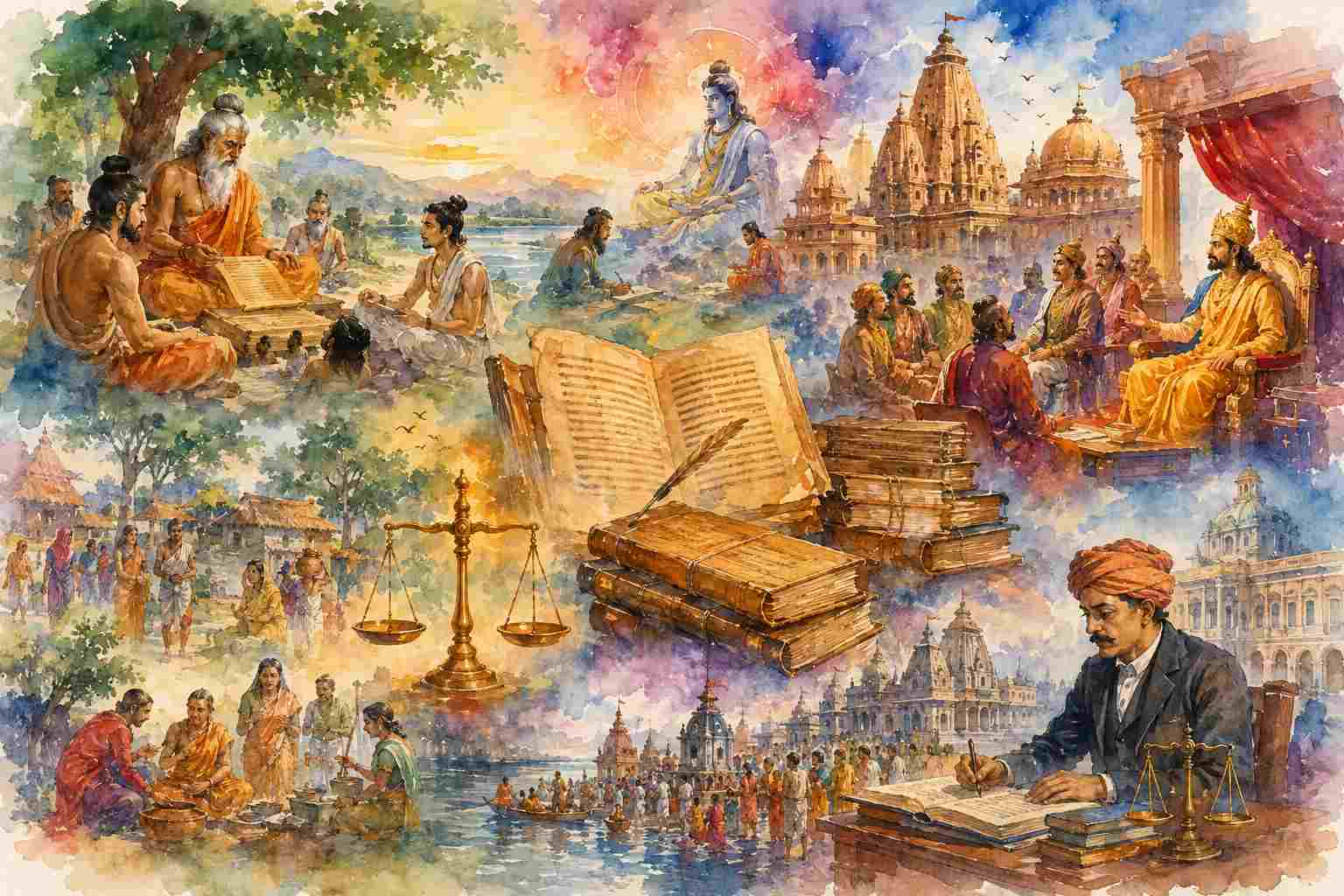
It was not simply compiling quotations. It was performing a civilizational function. Imagine the Dharmaśāstric archive as a vast forest. The Dharmasūtras were some of the earliest surviving trees. The Smṛtis expanded the forest. Commentaries created pathways through it.
The nibandha then created a map.
It could say:
- If you want to understand inheritance, these are the relevant authorities.
- If you want to understand pilgrimage, here are the texts.
- If you want to understand royal duty, these are the precedents.
- If the authorities disagree, these are the possible interpretations.
This is why the digest tradition should be treated as one of the most sophisticated systems of knowledge organisation in premodern Bharat. The intellectual challenge was not scarcity of knowledge. It was abundance.
The challenge was how to organise a civilizational archive accumulated across centuries. The answer was not to destroy the older texts and begin again. The answer was to rearrange them into new frameworks of relevance. This is an important lesson for contemporary Indic knowledge studies. A tradition survives not simply by preserving old books. It survives by continuously developing new ways of reading them.
The Later Digest Tradition and Regional Diversity
As the medieval period progressed, regional traditions of Dharmaśāstric interpretation became increasingly significant.
The Mitākṣarā tradition, the Dāyabhāga tradition and the various regional digests did not necessarily represent separate civilizations. They represented different interpretative pathways within a shared textual world. This plurality became particularly visible in the law of inheritance and property.
The Mitākṣarā system and the Dāyabhāga system differed on fundamental questions, yet both claimed legitimacy from the same wider Dharmaśāstric archive. This is one of the most remarkable features of the tradition. Shared authority did not necessarily produce uniformity. Instead, authority could generate debate.
A common civilizational archive could support different regional conclusions. The later digest tradition strengthened this tendency because scholars increasingly selected and prioritised authorities relevant to their own intellectual and regional contexts.
The unity of the tradition therefore did not rest on the idea that every person followed one identical legal rule. Its deeper unity rested upon a shared language of reasoning. Texts could disagree, but scholars knew which texts had to be consulted. Interpretations could differ, but they occurred within recognisable intellectual procedures. Regional practice could vary, but it could still be brought into conversation with the larger archive. This is a different model of civilizational unity from the modern nation-state model. The nation-state often seeks uniform law through central legislation. The Dharmaśāstric world could produce unity through shared categories, textual authority and interpretative traditions while allowing considerable variation.
From Dharmaśāstra to Colonial Hindu Law
The final transformation of the tradition came under colonial rule.
When British administrators and judges attempted to govern Indian society through a framework of “Hindu law,” they encountered an enormous problem. There was no single book called “the Hindu legal code.” Which text should they follow? Manu? Yājñavalkya? Nārada? The Mitākṣarā? The Dāyabhāga? A regional custom? A living community practice?
The colonial legal system increasingly attempted to transform this complex intellectual tradition into something resembling a modern legal system. Sanskrit texts were translated, classified and selectively elevated as authorities. Scholars and colonial judges sought to identify a single rule where the older tradition often contained multiple interpretative possibilities.
This transformation had long-term consequences.
The Mitākṣarā and Dāyabhāga, for example, became increasingly formalised as distinct “schools” of Hindu law. Sanskrit śāstric interpretation entered British courts. Textual traditions that had developed through the relationship among scholar, locality and practice were increasingly subjected to the procedures of colonial jurisprudence.
Modern scholarship has therefore warned against identifying the Dharmaśāstric tradition directly with the later colonial construction of “Hindu law.” The two are historically connected, but they are not identical.
This distinction is essential. Dharmaśāstra was an Indic intellectual tradition. Anglo-Hindu law was a colonial legal construction developed partly through selected interpretations of that tradition. The second should not be projected backwards as though it represented the original structure of the first.
What the Entire Dharmaśāstric Tradition Reveals
From the earliest Dharmasūtras to the great medieval digests, the history of Dharmaśāstra extends across more than two millennia of intellectual development.
Its history can broadly be understood as five major stages. The Dharmasūtras developed early systematic reflections on the sources and practices of dharma. The Smṛtis transformed the tradition into larger, independent and increasingly comprehensive textual works. The classical commentators created an intellectual culture in which ancient texts were continuously analysed, compared and interpreted. The nibandhas and digests reorganised the expanding archive according to subjects and practical problems. Finally, colonial codification and modern legal reform transformed selected parts of the tradition into a different legal system altogether.
But the most important lesson of this long history is perhaps that Dharmaśāstra was never a single text. It was a civilizational conversation. It contained authority, but also disagreement. It contained continuity, but also reinterpretation. It preserved ancient memory, but it also responded to changing circumstances.
- Its history cannot therefore be reduced to the statement: “Manu said this.”
- The more serious question is: How was Manu read?
- And another: Who interpreted him?
- And another: What other texts were placed beside him?
- And finally: How did those interpretations enter the actual social and political life of Bharat?
These are the questions that transform Dharmaśāstra from a static collection of ancient rules into a field of Indic social and civilizational thought.
Conclusion: Why Dharmaśāstra Still Matters
The study of Dharmaśāstra is not an attempt to revive every ancient rule. Nor is it an exercise in declaring every historical practice sacred simply because it is old. The real importance of this tradition lies elsewhere.
Dharmaśāstra reveals how Bharat attempted to think about society before the emergence of modern sociology, political science and jurisprudence. It asked questions about family, property, authority, punishment, inheritance, education, duty, conflict and social order. But it asked these questions through its own categories.
This is where the tradition becomes particularly important for Indic cultural and social studies. The objective is not to replace one dogma with another. Nor is it to assume that every ancient concept must solve a modern problem. The task is first to recover the conceptual universe through which a civilization understood itself.
Dharma. Ācāra. Vyavahāra. Daṇḍa. Rājadharma. Kula. Deśa. Kāla. Śiṣṭācāra.
These are not simply Sanskrit translations of modern academic categories. They emerged within a different historical and civilizational imagination. To study them seriously requires us to resist two opposite temptations.
The first is romanticism: the belief that every ancient category was perfect. The second is dismissal: the belief that nothing before modernity contained serious social or political thought. Both positions prevent understanding. The more difficult task is to recover the archive, understand its internal debates and ask how its categories might contribute to the study of Bharat today.
That is why Dharmaśāstra remains important. Not because it provides a ready-made answer to every modern question, but because it reminds us of something more fundamental: A civilization does not understand itself merely by accumulating information about its past. It must also recover the categories through which that past understood society itself.
The Dharmaśāstric tradition is one of the largest surviving archives of that intellectual effort.
References
Major Dharmaśāstric Digests
- Lakṣmīdhara, Kṛtyakalpataru.
- Hemādri, Caturvargacintāmaṇi.
- Devanabhaṭṭa, Smṛticandrikā.
- Mādhava, Parāśaramādhavīya and related Dharmaśāstric works.
- Jīmūtavāhana, Dāyabhāga.
- Various later regional nibandhas and Dharma digests preserved in manuscript and printed traditions.
Major Historical Reference
- Kane, P. V. History of Dharmaśāstra: Ancient and Mediaeval Religious and Civil Law in India. 5 vols. in 7 parts. Bhandarkar Oriental Research Institute, Poona. Kane remains the most extensive historical survey of the development of Dharmaśāstra, its commentators, digests and regional traditions.
Modern Scholarship
- Davis, Donald R. Jr. and Brick, David. “Social and Literary History of Dharmaśāstra: Commentaries and Legal Digests,” in Olivelle and Davis, eds., Hindu Law: A New History of Dharmaśāstra. Oxford University Press, 2018.
- Lubin, Timothy, Davis, Donald R. Jr. and Krishnan, Jayanth K., eds. Hinduism and Law: An Introduction. Cambridge University Press, 2010.
- Olivelle, Patrick and Davis, Donald R. Jr., eds. Hindu Law: A New History of Dharmaśāstra. Oxford University Press, 2018.
- Derrett, J. Duncan M. Religion, Law and the State in India. Faber & Faber, 1968.
- Davis, Donald R. Jr. The Spirit of Hindu Law. Cambridge University Press, 2010.
