About CICSS

The Centre for Indic Cultural and Social Studies (CISS), is a constituent unit of Indus Institute of Special Studies (IISS) at Indus University, Ahmedabad, and promoted by the IKS Division, Ministry of Education, Government of India, emerges from a deeper civilizational concern, the need to rethink social studies from Bharatiya lenses, and not merely about Bharat.

The Centre is envisioned, not as an exercise in reactionary rejection nor as an attempt at nostalgic romanticism, but a sincere attempt to explore the fundamental ideas and forces that have shaped Indian society. Our purpose is to cultivate scholarship grounded in Indic categories, lived experiences, classical texts, traditions, field realities, and civilizational memory.

WHAT IS CENTRE FOR INDIC CULTURAL AND SOCIAL STUDIES?

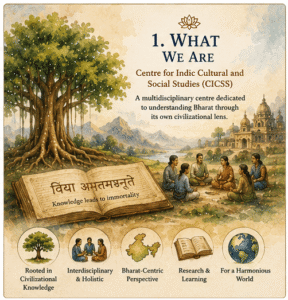
The Centre for Indic Cultural and Social Studies (CISS) is a constituent unit of the Indus Institute of Special Studies (IISS), Indus University, Ahmedabad, and is promoted with the support of the IKS Division, Ministry of Education, Government of India. The Centre emerges from a simple but fundamental civilizational concern: Can we study Bharat only through theories developed elsewhere, or can Bharat itself become a source of concepts, categories, questions, and frameworks through which society can be understood? The Centre therefore seeks to rethink Social Studies from Bharatiya lenses, and not merely about Bharat.
This is neither an exercise in rejecting everything that has emerged from modern academia nor an attempt to romanticise the past.
 The purpose is much more demanding: to return to the intellectual resources of the Bharatiya civilization, examine them critically, place them in conversation with contemporary scholarship, and ask what they can contribute to our understanding of society today. The Centre seeks to cultivate scholarship grounded in Indic categories, classical texts, lived experiences, institutions, traditions, field realities, regional knowledge, oral histories, and civilizational memory, while remaining open to comparison, criticism, evidence, and new interpretations.

The need for such an approach arises partly because contemporary Social Studies often divides human life into increasingly narrow compartments. The individual is studied separately from the family, the family from the community, the community from institutions, the economy from culture, politics from ethics, and ecology from society, as though these were independent systems that merely happen to interact with one another. Yet human beings do not actually live in these compartments. A person is simultaneously an individual, a member of a family, part of a community, participant in an economy, subject to political institutions, bearer of cultural memory, inhabitant of an ecological landscape, and seeker of meaning. To understand one dimension while isolating it completely from the others may make analysis easier, but it can also make society itself harder to understand.

Indic thought offers a different starting point. It has often approached society as a layered and interconnected continuum, extending from the individual and family towards community, institution, grama, janapada, rashtra and ultimately the wider cosmic order. The relationship between these levels is not imagined as a mechanical arrangement of separate parts, but as a dynamic relationship in which each influences and sustains the others. This does not mean that Indic society was without conflict, hierarchy, inequality, institutional failure, or historical change; rather, it suggests that these phenomena need to be understood within the larger social and civilizational relationships in which they operated.
This is particularly important because no human being can be adequately described by a single category. To describe a person only as an economic actor, a political subject, a psychological individual, a member of a caste or class, or a demographic unit is to capture something real but never the whole of human existence. Human beings live through multiple relationships of duty, affection, obligation, aspiration, identity, memory, responsibility, exchange, belief, and meaning, often inhabiting several social worlds simultaneously. The Centre therefore seeks to explore social reality without prematurely reducing it to one explanatory category.

There is another important dimension to the Indic approach: its deep awareness of context, plurality, limitation, and human complexity. Rather than assuming that society can be perfected through a single universal blueprint, Indic traditions frequently approached social order through Dharma, circumstance, time, place, duty, relationship, and the particular nature of the situation. The distinction of Desha, Kala, and Patra captures something profoundly important for social inquiry: that what may be appropriate in one context cannot necessarily be imposed mechanically upon another. Social order is not merely constructed from above; it evolves through institutions, practices, relationships, memory, adaptation, and local experience.

This does not mean that Indic civilization had no ideals or aspirations. It had them in abundance. But it did not necessarily reduce human flourishing to the achievement of a single material or political end. The framework of the Purusharthas—Dharma, Artha, Kama, and Moksha—offers a particularly important illustration. Human life was understood through multiple legitimate pursuits: ethical responsibility, material prosperity, legitimate desire and fulfilment, and liberation. These pursuits could complement, constrain, and sometimes come into tension with one another. The significance of this framework for Social Studies lies in the possibility that human beings need not be reduced to a single motive—economic utility, political power, psychological satisfaction, or biological survival—in order to explain their social behaviour.

This is also why the Centre seeks to move beyond the dominance of any single intellectual framework. Marxist, Freudian, colonial, modernist, post-modernist, liberal, institutional, structural, behavioural, and other approaches have all contributed important insights into the study of society, and they should be read, understood, debated, and used where appropriate. But no framework should become so dominant that it prevents us from asking whether other categories can reveal dimensions of reality that it cannot adequately capture. Intellectual plurality does not mean abandoning rigour; it means allowing more than one intellectual tradition to compete, converse, and demonstrate its explanatory power.

The Centre therefore asks a deceptively simple question:

What happens when we begin the study of Indian society from within the Indian civilizational experience itself?

What happens when Dharma is studied not merely as an equivalent of “religion”, when Artha is not automatically reduced to economics, when Rta is examined as a possible category for understanding order and relationship, when Lokasangraha becomes a question for the study of collective responsibility, when Janapada is studied as a form of social and territorial organisation, when Desha and Kala become categories for contextual analysis, and when institutions such as the family, temple, guild, sabha, samiti, monastery, village, pilgrimage network, and sacred landscape are examined not merely as objects of historical curiosity but as institutions that performed social, economic, political, ecological, and cultural functions?

This is where Indic Cultural and Social Studies becomes more than the study of ancient texts.

  • The village is not merely a geographical unit.
  • The temple is not merely a religious building.
  • The river is not merely an ecological resource.
  • The pilgrimage route is not merely a travel network.
  • The family is not merely a household.
  • The guild is not merely an economic association.
  • The monastery is not merely a religious institution.
  • The festival is not merely a cultural event.
  • The oral tradition is not merely folklore.

Each of these can also be approached as a repository of social knowledge, containing accumulated understandings of organisation, exchange, authority, obligation, ecology, memory, identity, education, economy, and collective life.

This requires us to change the position from which we conduct research. Bharat should not remain merely a case to which theories are applied. Bharat must also be allowed to become a source from which theories emerge.

There was a time when Bharat did not merely produce societies; it produced ways of thinking about society. It did not merely establish kingdoms; it reflected upon Rajadharma, Dandaniti, authority, duty, justice, counsel, and collective order. It did not merely inhabit forests and rivers; it developed cultural and ethical relationships with them. It did not merely create communities and institutions; it reflected upon the obligations that held them together. It did not merely pursue wealth; it developed ideas concerning Artha, exchange, occupation, prosperity, restraint, and social responsibility.

The Centre seeks to recover this intellectual possibility—not by assuming that every ancient idea provides a ready-made answer to every contemporary problem, but by asking the more intellectually productive question: what can these traditions teach us about the questions we are asking today?

This distinction is crucial. We are not looking for ancient answers to modern questions simply because they are ancient. We are looking for new questions that emerge when modern problems are encountered through Indic categories. That may lead to agreement with existing theories. It may lead to disagreement. It may reveal something that existing theories explain particularly well. It may reveal something they do not. It may even require us to modify both the Indic interpretation and the modern framework.

That is precisely what serious scholarship should permit. The Centre therefore sees research as a process of conversation rather than replacement—a conversation between texts and evidence, tradition and modernity, theory and practice, local experience and civilizational memory, Indic frameworks and global scholarship.

And this is where the Centre’s work begins. Through research projects, seminars, conferences, publications, lecture series, courses, workshops, field studies, documentation initiatives, curriculum development, primary-source collections, and interdisciplinary collaborations, the Centre seeks to create spaces where researchers and students can encounter Indic intellectual traditions not merely as subjects to be memorised but as frameworks to be explored, questioned, tested, interpreted, and developed.

The larger objective is to build an intellectual environment in which a student does not simply learn what an Indic concept means, but begins to ask what kind of social reality becomes visible when I use this concept? A researcher does not merely quote a classical text, but asks what institutional or social evidence supports its interpretation. A teacher does not merely add an Indian example to an existing theory, but asks whether the example challenges the theory itself. And a scholar does not merely recover a forgotten tradition, but considers whether that tradition can generate new conceptual possibilities for contemporary inquiry.

In this sense, the Centre is concerned not merely with adding Indian content to existing Social Studies, but with asking whether the architecture of Social Studies itself can be expanded.

The fundamental questions before us are therefore not small ones:

  • Can Bharat once again think in its own categories while engaging confidently and meaningfully with the modern world?
  • Can social studies in India be re-designed and revamped according to the indigenous vision and ethos ?
  • Can we reconnect with the Indian mind and society, grounded in the living traditions and realities of our society ?
  • Can we capture the essence and aspirations of Indian society, as it evolved over thousands of years, based on its inherent understanding of various goals of life ?
  • Can we create a framework for civilizational analysis based on Indic values  and ethos ?

These questions constitute the larger intellectual project of the Centre.

The purpose, therefore, is not to construct one final Indic theory of society. Civilizations are too complex, and knowledge is too expansive, for such a project to be intellectually desirable. Instead, we seek to create a field of inquiry in which multiple Indic perspectives can emerge, compete, converse, and evolve; where researchers can recover forgotten categories, develop new concepts, test old assumptions, bring field evidence into conversation with classical sources, and contribute to a more plural understanding of Social Sciences and Humanities.

Ultimately, the Centre for Indic Cultural and Social Studies rests on one fundamental proposition: Bharat should not remain merely an object of knowledge. Bharat must also become a source of knowledge.

And if that is possible, then the task before us is much larger than revisiting the past. It is to recover the intellectual confidence necessary to ask new questions about the present, develop better frameworks for understanding society, and imagine futures that are informed by the civilizational experience of Bharat without being imprisoned by it.

The Centre therefore does not claim that the conversation is complete.

It is only beginning. The questions are open. The sources are waiting. The frameworks are waiting to be examined. And the work of understanding Bharat—from Bharat, through Bharat, and for a wider understanding of civilization itself—remains to be done.
WHY WE FELT THE NEED FOR INDIC CULTURAL AND SOCIAL STUDIES?

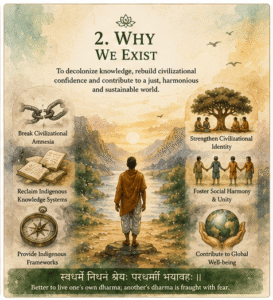
The question is not simply why should we study Indian society differently? The more fundamental question is: who taught us to see society in the way we see it today? Somewhere along the development of modern academic disciplines, almost every field came to be organised around the language of “science” – what can be observed, measured, classified, compared, tested, and externally verified. This has undoubtedly given us powerful tools for producing systematic knowledge, but what happens when the tool becomes the boundary of knowledge itself? What happens to experience, meaning, values, ethics, memory, consciousness, practice, faith, tradition, and the lived relationship between the individual and society when only that which can be measured is allowed to count as legitimate knowledge?

This is where the need for Indic Cultural and Social Studies begins.

The distinction between the objective and the subjective, between the observer and the observed, and between the knower and the known is not a universal starting point from which every civilization has approached reality. These distinctions emerged through particular historical trajectories in European intellectual thought and subsequently became embedded within modern academic disciplines. As these disciplines travelled across the world, their categories often travelled with them, and societies that had developed through very different historical experiences gradually began studying themselves through conceptual languages that were not necessarily born from their own intellectual traditions. The problem, therefore, is not that these frameworks are Western, nor that they have no value; the problem begins when one intellectual experience becomes the universal grammar through which every civilization is expected to explain itself.

India presents a particularly important case because its intellectual traditions developed an extraordinarily diverse understanding of knowledge, society, human purpose, ethics, governance, economy, ecology, and consciousness. The Indic approach did not necessarily begin by placing the “objective” and “subjective” into two sealed compartments and declaring one scientific and the other merely personal. Knowledge could emerge through observation, reasoning, dialogue, experience, disciplined practice, reflection, contemplation, memory, textual inquiry, social experience, and lived wisdom, with different questions demanding different methods of knowing. The knower was not always imagined as a completely detached spectator standing outside reality; the condition of the knower, the purpose of knowledge, the manner in which knowledge was acquired, and the transformation that knowledge produced could themselves become part of the inquiry.

This does not mean that Indic traditions should be romanticised or that every traditional claim should automatically be accepted as knowledge. Quite the opposite: An Indic approach requires us to examine Indic claims seriously enough to question, test, interpret, compare, and understand them within their own categories before deciding what they mean. If we reject a concept without first understanding the intellectual world from which it emerged, we are not being critical; we are simply judging it through an already established framework.

This is one reason the Centre deliberately uses the word “Studies” rather than “Science.” The choice is not a rejection of science, scientific reasoning, or systematic inquiry. It is an acknowledgement that the study of human beings and civilizations cannot always be exhausted by a single methodology. “Studies” allows us to bring together history, sociology, political science, economics, anthropology, psychology, philosophy, ecology, literature, linguistics, and other forms of inquiry, while also creating intellectual space for knowledge emerging from texts, practices, communities, traditions, institutions, and lived experience. It allows the question to remain open: what method is appropriate for what kind of knowledge?

After all, every civilization develops its own intellectual grammar.

Europe developed concepts through its particular historical experience. China developed distinctive traditions of statecraft, social order, and political thought. The Islamic world developed its own intellectual and legal traditions. Different civilizations created different ways of understanding authority, society, morality, economy, knowledge, and the relationship between the individual and the collective. These traditions may interact, influence one another, borrow from one another, and even disagree with one another—that exchange is itself part of human history.

So why should Bharat be different?

Why should Indian society remain merely a “case study” to which theories developed elsewhere are applied? Why should Dharma be translated immediately into “religion” before we ask what Dharma actually meant within the traditions that produced the concept? Why should Artha be reduced to economics, Rta to cosmic order, Lokasangraha to social welfare, Purushartha to a hierarchy of human needs, or Sabha and Samiti be squeezed into categories of modern political institutions without first asking how these institutions functioned within their own social and civilizational context?

The point is not that modern concepts are useless. The point is that translation is not always understanding. A civilization can be misunderstood precisely when its categories are translated too quickly into someone else’s vocabulary.

This is why Indic Cultural and Social Studies seeks to reopen the intellectual conversation rather than close it. It asks what becomes visible when we begin with Bharatiya categories and sources, when we take Dharma, Rta, Artha, Kama, Moksha, Purushartha, Sabha, Samiti, Janapada, Tirtha, Samskara, Lokasangraha and numerous other concepts seriously as possible categories of inquiry rather than treating them merely as cultural curiosities or historical relics.

And the question is not restricted to ancient texts. It extends to living institutions, communities, practices, regional traditions, knowledge systems, social organisations, ecological relationships, economic practices, political arrangements, customary institutions, and the accumulated experience of people who have continued to live within these civilizational traditions. If a concept has survived for centuries, the academic question should not be merely why it survived, but what social work it performed, what problem it attempted to solve, how it changed over time, and whether it still has something to teach us.

This is also why the Centre does not see Indic Cultural and Social Studies as an exercise in turning away from global scholarship. That would be neither intellectually useful nor historically accurate. Bharat itself has always been a civilization of encounter, exchange, debate, adaptation, argument, and synthesis. The objective is therefore not to replace one intellectual dominance with another, nor to construct an artificial wall between “Indian” and “Western” knowledge.

The objective is intellectual plurality.

We should be able to read Marx without being Marxists, Weber without becoming Weberians, Durkheim without assuming that his categories are universal, and at the same time read Kautilya, Panini, Patanjali, Manu, Yajnavalkya, Bhartrhari, Abhinavagupta, Buddhist thinkers, Jain thinkers, Bhakti traditions, regional intellectual traditions, and countless other Indic sources without assuming that they are merely “pre-modern” versions of modern theories.

Why must every Indian intellectual contribution resemble a theory that already exists elsewhere before we consider it worthy of academic attention? Perhaps it is time to reverse the question.

What if Bharat is not merely a place where existing theories are applied, but a place from which new theories, concepts, methods, and questions can emerge?

That is the intellectual space we seek to create through Indic Cultural and Social Studies.

It is an attempt to move from merely studying Bharat to allowing Bharat to become a source from which we can think about society. It is an invitation to researchers to recover sources, examine institutions, question inherited categories, test concepts against evidence, engage with lived traditions, compare civilizational experiences, and develop frameworks that are neither blindly traditional nor reflexively modern, but intellectually serious enough to stand on their own.

Ultimately, the need for Indic Cultural and Social Studies arises from a simple conviction: a civilization should have the intellectual capacity to understand itself in its own vocabulary while remaining open to the vocabulary of others. Bharat need not reject the world in order to rediscover itself, but neither should it remain permanently dependent upon categories created elsewhere to explain its own experience.

The task, therefore, is not to build another closed system of knowledge. It is to reopen the conversation. And perhaps the most important question with which this Centre begins is also the simplest:

Can Bharat once again become not only the subject of knowledge, but also a producer of knowledge?

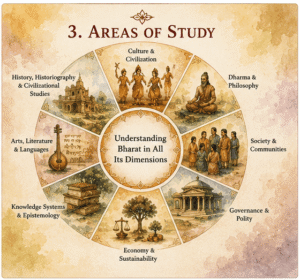
WHAT IS OUR AREA OF STUDY? 

Modern academic disciplines did not emerge in a vacuum. They evolved through particular historical experiences, intellectual debates, political transformations, economic changes, and social realities. The development of anthropology, sociology, political science, economics, law, and history was shaped by the conditions through which modern Europe and later the modern West came to understand society, institutions, power, knowledge, and human behaviour.

These disciplines have undoubtedly generated important insights and contributed significantly to their understanding of the world. Yet they also reflect the assumptions, priorities, and categories of the historical contexts from which they emerged. As these disciplines travelled across the world, they became the dominant frameworks through which societies increasingly came to study themselves, including the colonized Bharat.

The question before us is not whether these disciplines are useful. The question is whether they are sufficient. As discussed earlier, Can a civilization such as Bharat, with its long continuity, layered identities, sacred geographies, community institutions, oral traditions, and civilizational memory, be fully understood through categories developed elsewhere? Can social reality be adequately explained when society is fragmented into separate compartments such as politics, economics, culture, religion, law, and ecology, even though lived experience rarely operates in such isolation?

Indic traditions have often approached society differently. Rather than beginning with fragmentation, they frequently begin with interconnectedness. The individual, family, community, institution, ecology, economy, polity, and spiritual life are understood as part of a larger web of relationships. Distinctions certainly exist, but they are rarely viewed as entirely independent of one another.

From this perspective, disciplinary boundaries are valuable intellectual tools, but not absolute realities. They help simplify complexity, classify knowledge, and organize inquiry. Yet the phenomena they seek to explain often transcend those boundaries. Society does not function in separate departments, and civilizations do not evolve through isolated variables alone.

The Centre therefore approaches disciplines not as disconnected domains of knowledge, but as different windows into a larger civilizational whole. Anthropology, Sociology, Political Science, History, Economics, Geography, Law, Public Administration, Environmental Studies, Cultural Studies, Linguistics, and related fields are viewed as interconnected pathways for understanding society, culture, governance, ecology, institutions, and human life.

Each discipline serves as an entry point into larger questions concerning the nature of civilization, the continuity of societies, the transmission of knowledge, the organization of collective life, and the relationship between individuals, communities, institutions, and the broader civilizational order.

The following areas of study represent our attempt to explore these questions through a dialogue between established academic inquiry and the lived experiences, intellectual traditions, and civilizational processes of Bharat.

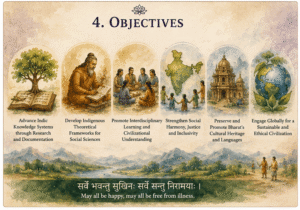
THE OBJECTIVES OF THE CENTRE

“Bharat must not remain merely a subject of study. It must also participate in shaping the questions, categories, and frameworks through which societies and civilizations are understood.”

Every civilization leaves behind monuments, institutions, and memories. Yet beneath all of them lies something even more enduring: a way of understanding society itself. For centuries, Bharat did not merely produce kingdoms, communities, economies, and cultural traditions; it also produced frameworks to understand them. Questions of duty and authority, wealth and welfare, ecology and ethics, individual aspirations and collective harmony were examined through categories that emerged from the lived experiences of this civilization.

The Centre emerges from a simple yet profound concern: can these civilizational insights once again become part of serious academic inquiry?

Our objectives therefore are not merely institutional. They are intellectual and civilizational.

To understand Bharat through its own categories

Can concepts such as Dharma, Rta, Janapada, Lokasangraha, Purushartha, Desa, and Kala help us understand Indian society in ways that conventional frameworks often overlook? The Centre seeks to explore and develop such categories as tools of academic inquiry.

To study society as an interconnected whole

Modern disciplines often divide society into separate compartments—politics, economics, culture, ecology, religion, and law. Yet lived reality is rarely so fragmented. We seek to understand how individuals, families, communities, institutions, sacred geographies, and knowledge traditions interact within a larger civilizational framework.

To explore the principles that sustain civilizations

Why do some civilizations disappear while others endure? How do societies maintain continuity despite political upheavals, economic transformations, and cultural change? The Centre seeks to investigate the forces that contribute to civilizational resilience, adaptation, and renewal.

To reconnect knowledge with lived realities

The village, the temple, the river, the pilgrimage route, the guild, the monastery, the oral tradition, and the community institution are not merely subjects of observation. They are repositories of accumulated social knowledge. The Centre seeks to bridge classical texts, field realities, historical experiences, and contemporary challenges.

To develop new frameworks for social inquiry

Rather than remaining confined within inherited intellectual categories, we seek to encourage the development of methodologies and frameworks rooted in Bharatiya experiences while remaining open to global scholarship and interdisciplinary engagement.

To document and preserve living knowledge systems

Across Bharat survive countless traditions of knowledge embedded within communities, practices, rituals, ecological systems, languages, and local institutions. The Centre seeks to document, preserve, study, and interpret these traditions for future generations.

To nurture future scholars and researchers

The future of any intellectual tradition depends not merely on ideas but on the people who carry them forward. The Centre aims to cultivate scholars capable of engaging with contemporary academia while remaining grounded in the civilizational experiences and intellectual traditions of Bharat.

To contribute to a broader understanding of civilization

Ultimately, our purpose extends beyond Bharat alone. By studying civilizations through indigenous categories and lived realities, we seek to contribute to larger conversations on society, governance, culture, ecology, human flourishing, and the future of civilizations themselves.

At its heart, the Centre is animated by a simple conviction: Bharat must not remain merely a subject of study. It must also participate in shaping the questions, categories, and frameworks through which societies and civilizations are understood.

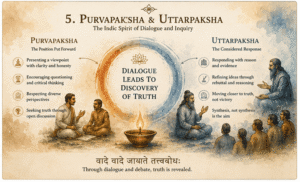
THE PURVAPAKSHA AND THE UTTARPAKSHA

“Every civilization advances knowledge through two complementary movements: Purvapaksha—the rigorous examination of existing ideas; and Uttarpaksha—the creative articulation of new possibilities.”

 Every intellectual journey must begin with a question: How have we come to understand society in the way that we do today?

The contemporary study of society is shaped by powerful intellectual traditions that emerged from specific historical experiences—industrialization, colonialism, nation-state formation, capitalism, socialism, secularization, and modernity. These traditions have generated important insights and have profoundly influenced disciplines such as anthropology, sociology, political science, economics, history, law, and cultural studies.

Yet every framework carries within it the assumptions of the civilization that produced it.

The Purvapaksha of the Centre therefore begins by critically examining the categories, methodologies, and narratives through which Bharat has been interpreted over the last two centuries. Why are questions of conflict often privileged over questions of cooperation? Why is society frequently understood through fragmented identities while civilizational continuity remains understudied? Why do concepts such as caste, class, race, tribe, state, religion, and market dominate analysis, while categories emerging from Bharatiya experience remain marginal?

The purpose is not rejection but understanding.

Purvapaksha seeks to identify the strengths, limitations, assumptions, and blind spots of inherited frameworks. It asks whether categories developed from European historical experiences can fully explain Bharatiya realities. It examines the intellectual consequences of colonial classifications, ideological interpretations, disciplinary silos, and reductionist approaches to society.

Above all, Purvapaksha is an invitation to ask difficult questions. Not because existing knowledge must be discarded, but because every living intellectual tradition must periodically re-examine its foundations.

Uttarpaksha: Towards New Possibilities of Knowledge

The challenge before us is not merely to critique existing frameworks, but to ask whether new questions, categories, and methodologies can emerge from Bharatiya experiences themselves. Can concepts such as Dharma, Rta, Purushartha, Lokasangraha, Janapada, Desa, Kala, and Samaja contribute to contemporary social inquiry? Can lived traditions, community institutions, sacred geographies, oral knowledge systems, and civilizational memory become legitimate sources of academic understanding?

Uttarpaksha therefore represents the constructive dimension of scholarship.

It seeks to generate original research, develop new frameworks of analysis, document living knowledge traditions, reinterpret classical sources, undertake field-based studies, design curricula, build archives, and create intellectual tools capable of engaging contemporary realities.

The aim is neither a return to the past nor a rejection of the present. Rather, it is the creation of a dialogue between inherited wisdom and modern inquiry, between textual knowledge and lived experience, between local realities and global conversations.

Ultimately, we ask a simple but profound question: Can Bharat once again participate not merely as a subject of study, but as a contributor to the world’s understanding of society, civilization, governance, ecology, culture, and human flourishing?

The Centre views this task not as an act of nostalgia, but as an act of intellectual responsibility.

It is the willingness to ask difficult questions: Why should Bharat always be interpreted through categories born from European historical experiences? Can Indian civilization not generate its own theories of society, polity, ecology, and culture? Can civilizational continuity itself become a category of analysis.