
The Portuguese Who Recorded a Living Bharat Before It Became a Colonial Possession
By the time Duarte Barbosa began recording what he had seen in the Indian Ocean, the world he was describing had already begun to encounter a profound disruption. Vasco da Gama had reached Calicut, Portuguese forts and trading establishments were beginning to appear along the western coast of Bharat, and the established commercial networks of Arab, Persian, Gujarati and Malabari merchants were increasingly being challenged by a new naval power. Barbosa therefore occupies a particularly important place in this series because he was simultaneously an observer of an older Indian Ocean order and an employee of the power that was beginning to transform that order. He served as a clerk at the Portuguese establishment at Cannanore, possessed knowledge of Malayalam and had lived in the region long enough to acquire forms of information that a passing traveller could not easily obtain. His Livro de Duarte Barbosa, completed around 1516–1518, consequently became one of the earliest detailed Portuguese descriptions of the societies, institutions and commercial systems of the Indian Ocean.
This is what makes Barbosa particularly valuable for Civilizational Studies. He does not simply encounter India as a strange foreign land and record whatever appears extraordinary to his European eyes. He describes occupations, merchants, ports, systems of writing, administrative practices, social groups, courts, religious customs and arrangements of justice in a manner that allows us to reconstruct relationships between different institutions. His account extends from East Africa and Arabia through Persia and western India towards Vijayanagara, while the later sections move through Malabar, eastern India, Bengal, Southeast Asia and China. Barbosa is therefore not merely another traveller in chronological succession. He gives us something different: a detailed snapshot of Bharat at the precise historical moment when an existing maritime civilization was encountering the expanding ambitions of Portuguese power.
Major Work
The Book of Duarte Barbosa
Barbosa’s principal work is generally known in English as The Book of Duarte Barbosa. It was completed around 1516–1518, and the major scholarly English edition was translated and edited by Mansel Longworth Dames for the Hakluyt Society in two volumes, published between 1918 and 1921. The first volume covers East Africa, Arabia, Persia and western India up to Vijayanagara, while the second volume moves through Malabar, eastern India, Bengal, Southeast Asia, China and the Indian archipelago.
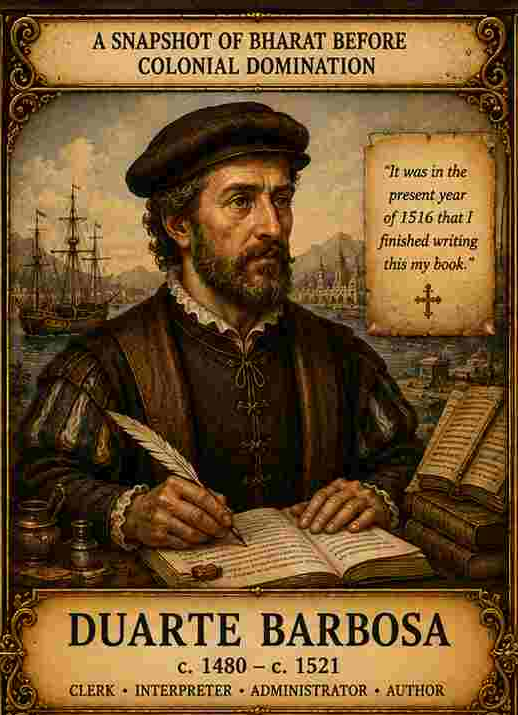
Barbosa himself marks the completion of his work with the statement:
“It was in the present year of 1516 that I finished writing this my book.”
— The Book of Duarte Barbosa, opening statement.
That statement deserves to be remembered because the world he was recording was already undergoing transformation. The Portuguese presence was new, but almost everything they encountered—the ports, merchants, ships, routes, administrative practices and commercial communities—was part of a much older and already functioning world.
1. Barbosa Was Not Simply a Traveller
Barbosa’s position within the Indian Ocean world was unusual. He was not simply a European traveller passing through unfamiliar societies and recording his impressions before continuing his journey. He worked within the Portuguese system as a scrivener, administrator and interpreter, knew the local language of Malabar and had lived in the region for years. His work brought him into contact with merchants, rulers and administrative institutions, while his position within Portuguese networks gave him access to forms of information unavailable to many ordinary travellers.
Yet this privileged access also creates an obvious methodological problem. Can the account of a man employed by an emerging imperial power be treated as a completely neutral description of the societies that power was beginning to penetrate and transform? Obviously not. But the alternative is equally inadequate. Should his testimony simply be discarded because of his position within the Portuguese system? Again, no. The more demanding approach is to treat Barbosa as a source whose observations must be analysed in relation to his historical position. We must ask what he actually saw, what he heard from others, what kinds of information his institutional position allowed him to obtain and what that same position may have prevented him from understanding.
This is where Barbosa becomes particularly valuable. His account should be read alongside inscriptions, archaeology, local texts, coins, administrative records and the testimony of other travellers. His perspective does not replace these sources, but it adds another layer of evidence. He was not a neutral observer standing outside history. He was a historically situated observer standing inside a Portuguese system that was itself becoming part of the history he recorded.
2. Calicut Was Already a Global Port
Barbosa’s description of Calicut is among the most important sections of his work because it immediately challenges a persistent misconception about the Portuguese arrival in the Indian Ocean. He encountered a city in which Arab, Persian and Gujarati merchants were already deeply involved in maritime commerce, while local commercial institutions connected the Malabar coast to a far wider world.
The Portuguese did not arrive on an economically empty coast and create commerce where none had existed. They entered a highly organized maritime system. Ships already moved across established routes, merchant communities possessed long-standing commercial relationships, port authorities regulated movement and trade, and foreign communities had often lived in these places for generations. The Portuguese therefore entered an existing system whose complexity they first had to understand before they could attempt to alter it.
This distinction is fundamental. The history of the Portuguese in India should not begin with the assumption that European arrival created connectivity. The connectivity already existed. What the Portuguese brought was a new form of military and commercial intervention within that connected world. Barbosa’s account is particularly valuable precisely because he recorded the commercial order while Portuguese power was still learning how to operate within it.
3. The Muslim Merchants of Calicut
Barbosa makes an especially direct observation about the commercial importance of the Muslim merchant communities of Calicut. He writes:
“The Muslims in Calicut are rich, and live well, and they used to control all the sea trade from that town.”
He further describes merchants from: “Arabia, Persia, and Gujarat”
as: “great merchants”
who: “sail to all parts of the world with their goods.”
This is extraordinarily important evidence for understanding the cosmopolitan character of Malabar. Calicut cannot be reduced to a simple description of a Hindu kingdom with a local economy, but neither should it be treated as an Islamic commercial city in the political sense. Barbosa describes something more complex: a Hindu-ruled polity in which Muslim, Arab, Persian and Gujarati merchant communities played major roles in maritime commerce.
The distinction between political sovereignty and commercial power becomes particularly important here. A ruler could possess territorial authority without personally conducting the commercial networks that made a port prosperous. Religious identity and economic participation were also not identical. Merchant communities of different origins and religious traditions could operate within a common political order while maintaining their own commercial and social networks. The prosperity of a port therefore depended partly upon the ability of political authority to govern diversity without necessarily eliminating it.
4. The Zamorin’s Political Pragmatism
Barbosa provides an especially revealing description of the relationship between the Zamorin of Calicut and the foreign Muslim merchant communities. He writes that these merchants:
“have their own Muslim leader who rules over them and disciplines them as necessary, without the Hindu king of Calicut meddling with them.”
This observation deserves considerably more attention than it usually receives. Barbosa appears to be describing a political arrangement in which communities could retain internal forms of organization while remaining within the broader sovereignty of the Zamorin. The ruler did not necessarily attempt to absorb every social community into a single uniform administrative structure. Internal leadership and communal organization could coexist with wider political authority.
This suggests a form of institutional pluralism. Different communities could retain internal structures while participating in a common political and economic order. The question that follows is important for civilizational analysis: must social unity always require institutional uniformity? The evidence from Calicut suggests otherwise. A political order could remain unified while allowing different communities to preserve certain internal arrangements, provided that these arrangements remained within a wider framework of sovereignty and commercial interaction.
This is also a useful reminder against reading historical societies exclusively through modern categories. The institutional arrangements of Calicut should neither be casually equated with a modern liberal state nor dismissed because they do not resemble one. They should instead be studied on their own terms as arrangements through which political authority, commercial diversity and social difference were managed together.
5. The Palm Leaf as an Administrative Technology
One of Barbosa’s most fascinating observations concerns the writing system used in the administration of Calicut. He writes that the king possessed:
“a multitude of writers”
who dealt with matters relating to:
“the King’s Exchequer and … the justice and governance of the realm.”
He then describes the physical technology through which these records were produced:
“They write upon a raised platform … on long and stiff palm leaves, with an iron style without ink.”
The officials carried these written leaves with them:
“under his arm, and the iron style in his hand.”
What Barbosa is describing here is far more than an unfamiliar writing material. He is describing a bureaucracy involving record keeping, taxation, justice, administrative writing, specialized scribes and portable documents. The palm leaf was embedded within an institutional system. Its significance therefore cannot be understood merely as an example of an exotic local technology. The material itself was adapted to the ecological environment, but it became historically important because of the administrative functions performed through it.
This is precisely the kind of institutional infrastructure that disappears when history is reduced to kings, wars and monuments. Political power does not operate only through armies and palaces. It also requires people capable of recording decisions, maintaining accounts, preserving information and communicating administrative orders. The palm leaf, in this sense, was not simply a writing surface. It formed part of a larger system through which the state remembered and acted.
6. Writing Was a Profession
Barbosa also notes that the king possessed private writers who remained close to him and were:
“men held in great esteem.”
This may appear to be a small observation, but it is historically significant because it reveals that literacy and record keeping were connected to recognized institutional authority. The ability to write was not merely an individual accomplishment. It could form part of a specialized profession embedded within administration and political power.
The person who could maintain accounts, preserve records and manage administrative information therefore occupied a particular social position. Knowledge had institutional value. The scribe became part of the political infrastructure itself. This raises a larger set of questions that Civilizational Studies must take seriously: Who records society? Who preserves memory? Who maintains accounts? Who writes laws and administrative decisions? Who controls the transmission of information?
Civilizations survive not merely through the production of knowledge but also through the institutions that preserve and transmit it. A society may possess immense intellectual traditions, but without systems of recording, copying, storing and transmitting knowledge, much of that intellectual world can disappear from historical memory. Barbosa’s brief observation about scribes therefore opens a much larger field of civilizational inquiry.
7. The Zamorin’s Court Was Highly Structured
Barbosa’s descriptions of the court reveal a sophisticated hierarchy involving the ruler, nobles, officials, scribes, military groups, palace communities and ritual specialists. Particularly important is his account of succession. When a ruler died, the transition did not simply consist of another individual occupying the throne. The death of the king initiated a larger institutional process involving mourning, ritual obligations, the confirmation of the successor, the recognition of nobles and estates, and the confirmation or replacement of officials.
Succession was therefore simultaneously political, ritual and administrative. The confirmation of a new ruler involved the reorganization and reaffirmation of a wider network of authority. Princes and nobles received recognition, governors and officers could be confirmed or replaced, and political relationships were publicly re-established.
This provides a useful corrective to the simplistic question, “Who was the next king?” The more historically meaningful question is: how was the political order reproduced when one ruler died and another succeeded him? Barbosa’s answer suggests that succession involved a complex combination of ritual, redistribution, institutional confirmation and public recognition. The continuity of monarchy depended not only upon inheritance but upon the successful reconstitution of relationships across the political system.
8. Thirteen Days of Abstinence
Barbosa describes an elaborate mourning period lasting thirteen days, during which meat and fish were prohibited, fishing itself was forbidden under severe punishment and food and alms were distributed to the poor and Brahmins. He then describes the new ruler undertaking a much longer period of ritual austerity. For one year:
“he observes the same abstinence”
and does not shave or cut his hair, body hair or nails while observing prescribed dietary and ritual restrictions.
Whatever the precise local context and whatever elements of Barbosa’s description require comparison with other sources, the broader institutional idea is significant. The ruler himself was subject to prescribed discipline. Kingship did not simply give an individual the right to command others. The body and conduct of the ruler could themselves become part of a ritual institution. His diet, appearance and daily practices were therefore politically meaningful because the king’s body participated in the public performance of royal order.
This challenges the modern assumption that political authority can be understood exclusively through administrative institutions. In many historical societies, political power was also embodied through ritual discipline. The king governed, but he too was governed by norms associated with the office he occupied. His sovereignty was therefore not necessarily equivalent to personal freedom from all constraint.
9. Charity Was Part of Royal Ritual
Barbosa repeatedly notices the distribution of food and alms during royal ceremonies. During the mourning period:
“large alms are given from the king’s property, of food to many poor people, and to Bramans.”
At the completion of the wider ritual cycle, he again describes large gatherings in which food and charity were distributed.
This should not be treated simply as an incidental feature of religious ceremony. Royal ritual possessed an economic and social dimension. Wealth was redistributed, poor people received food, Brahmins received gifts and the court publicly demonstrated generosity. The transition of power therefore became an occasion for social recognition and redistribution.
This raises an important question: can political legitimacy be produced not only through coercion and administrative power, but also through ritualized generosity? Barbosa’s account suggests that generosity was one visible component of royal public life. The distribution of wealth could demonstrate that political power possessed the capacity to nourish and support the wider social order.
The relationship between ritual and redistribution is therefore particularly important. A ceremony could perform sacred functions while simultaneously redistributing resources. Rather than assuming that religious and economic activity belonged to entirely separate spheres, we must ask how institutions connected them.
10. More Than a Hundred Thousand People
At the completion of the mourning cycle, Barbosa describes:
“more than a hundred thousand people”
assembling for the ceremony.
The figure should not be treated as an exact census. Early modern travellers frequently used large numbers, and the practical reliability of any precise numerical claim requires comparison with other evidence. Yet dismissing the passage simply because the number may not be exact would also miss its historical significance. Barbosa is communicating the scale at which the ceremony appeared to him. Royal ritual was conceived as a major public event involving an enormous gathering.
The ceremony was therefore not confined to the private space of the palace. The transition of kingship entered the wider social world. Public participation, ritual display and redistribution connected political succession to a much larger population. Once again, authority became visible through collective experience.
This is important because political power in pre-modern societies was not communicated primarily through newspapers, radio or electronic media. It had to become perceptible through gatherings, ceremonies, processions, audiences, gifts, food and public rituals. Barbosa allows us to glimpse this process of political visibility.
11. Vijayanagara Through Barbosa’s Eyes
Barbosa’s description of Vijayanagara, which he calls Narsyngua or Bisnaga, provides another important civilizational portrait. He writes:
“Vijayanagara is fenced with strong ramparts and by a river as well, on further side of a great chain of mountains.”
He further states:
“Here always dwells the King Narsyngua, who is heathen (Hindu) and is called Rayen (Raya).”
The king possessed:
“great and fair palaces”
containing:
“many enclosed courts and great houses very well built”
along with:
“water tanks in great numbers, in which [there was] reared an abundance of fish.”
What Barbosa describes is not simply royal architecture. He presents a landscape in which fortification, river, mountains, palaces, courtyards, tanks and fish existed within the same political environment. This is particularly important because it reveals the integration of ecological and built systems. Water was part of the infrastructure of the royal space, but it was also connected to food, landscape design and urban life.
Vijayanagara therefore cannot be understood simply as an accumulation of monumental buildings. The city was embedded within a wider hydraulic and ecological landscape. The river, tanks and mountains were not merely geographical background to political history. They formed part of the conditions through which the city functioned.
12. The Water Tank as Civilizational Infrastructure
The water tanks mentioned by Barbosa deserve particular attention. Modern historical narratives sometimes treat tanks and reservoirs as secondary engineering structures when compared with temples, forts or palaces. Yet such an approach reverses their actual importance. A large water storage system could sustain agriculture, urban settlement, animals, gardens, temples, palaces, markets and ordinary household life.
In a semi-arid or seasonally variable environment, the ability to capture and store water could determine whether a settlement flourished or failed. Barbosa’s description of tanks containing fish within elite spaces therefore provides evidence of a larger relationship between water management, ecology, food and political power.
This is precisely where Civilizational Analytics must move beyond the monument. A monument may reveal what a civilization could build, but water infrastructure reveals how it could survive. Tanks and reservoirs connected rainfall to storage, storage to agriculture and agriculture to urban life. The political centre could not exist independently of these systems.
The water tank was therefore not merely an engineering object. It was an institution of ecological adaptation whose effects extended across multiple domains. This is why infrastructure must be treated as part of civilizational history rather than merely as a technical background to more dramatic political events.
13. Barbosa and the Freedom of Religious Practice
One of the most frequently cited passages in Barbosa’s account concerns religious plurality in Vijayanagara. He writes:
“The King allows such freedom that every man may come and go and live according to his own creed, without suffering any annoyance.”
He continues that there was:
“Great equity and justice … to all.”
This passage must be handled carefully. It would be historically irresponsible to turn one traveller’s observation into a claim that medieval Vijayanagara represented a modern liberal secular state. Such a comparison would be anachronistic. Yet it would be equally irresponsible to ignore Barbosa’s evidence simply because its vocabulary does not fit contemporary political categories.
What Barbosa is clearly describing is a form of religious plurality under royal sovereignty. The more useful question is therefore not whether Vijayanagara was “secular” in a modern constitutional sense. The useful question is: what institutional arrangements allowed people of different religious identities to live, trade and move within the same political order?
This question directs us away from anachronism and towards historical institutions. Societies can possess mechanisms for managing religious plurality without possessing the vocabulary of modern secularism. The task is to understand those mechanisms on their own terms.
14. The Portuguese Were Not Merely Trading
Barbosa’s account becomes especially revealing when read against the wider Portuguese expansion. The Portuguese frequently presented themselves as merchants seeking access to profitable trade, but established communities around the Indian Ocean quickly recognized that something more ambitious was taking place.
A contemporary warning attributed within the documentary tradition surrounding the Portuguese presence declared:
“The true intent of the Portuguese in coming into these seas is to take possession of your city, and not to trade for spices as they pretend.”
The precise attribution and transmission of this statement should be carefully verified in the primary editions and wider documentary record. Yet the larger historical development is unmistakable. Portuguese power increasingly moved beyond commercial participation towards attempts to control maritime routes, ports and the spice trade through armed naval power.
This is what makes Barbosa’s position historically uncomfortable and intellectually valuable. He belonged to the Portuguese system while recording the commercial civilization that system was attempting to penetrate and reshape. His account therefore captures a transitional moment in which information about merchants, ports and political institutions could become useful to commercial strategy and imperial power.
15. The Merchant Network Before the Portuguese
Barbosa’s account repeatedly demonstrates that maritime commerce was already organized through established networks involving Muslim, Gujarati, Arab and Persian merchants. He describes these communities as:
“great merchants”
who:
“sail to all parts of the world with their goods.”
This is perhaps one of the most important insights available from the entire traveller series. The Indian Ocean was already global in its connections before the arrival of the Portuguese. Ports were linked to one another, merchants travelled between political worlds, commodities crossed enormous distances and communities of foreign traders lived outside their places of origin for generations.
The Portuguese did not create this global system. They entered it. What changed was increasingly the mode of power. Earlier commercial networks depended heavily upon merchant communities, ports, seasonal navigation, negotiated relationships and the coexistence of multiple commercial groups. Portuguese intervention increasingly attempted to place armed naval power behind commercial ambition.
This was therefore not merely a transformation of trade. It was a transformation of the relationship between commerce and coercion. The merchant ship increasingly encountered the warship, and commercial competition could become inseparable from military control.
16. Barbosa’s India Was Polycentric
If we read Barbosa’s work as a whole, an extraordinarily complex geography emerges. There was Calicut, Cannanore, Cochin, Cambay, Diu, Goa, Vijayanagara, Bengal and numerous smaller ports and inland centres. Yet no single city contained the entire system. Different centres possessed different functions and forms of importance. Some were political capitals, some maritime ports, some manufacturing centres, some agricultural regions, some pilgrimage centres and others military strongholds.
What connected them were networks of trade, pilgrimage, political relationships, migration and cultural exchange. Barbosa therefore gives us a picture of a polycentric civilization.
This is important because conventional state-centred history often struggles to represent such systems. It looks for a single capital, a single centre or a single political hierarchy and then treats everything else as peripheral. The civilizational world described by Barbosa does not function so simply. Multiple centres possessed different forms of significance, and integration emerged through relationships among them.
Civilizational unity, therefore, does not necessarily require uniform centralization. A civilization can be integrated through networks while retaining multiple centres of political, commercial, religious and cultural importance.
17. Why Barbosa Is Different From Varthema
The contrast between Barbosa and Varthema is particularly useful because both encountered parts of the same wider world, yet they observed it differently. Varthema often appears as the adventurous traveller moving through unfamiliar societies, noticing ships, elephants, spices and striking customs. Barbosa, by contrast, possessed institutional access.
This difference changes the kind of evidence available to us. Barbosa frequently gives us glimpses of how courts operated, how merchants organized themselves, how scribes maintained records, how succession occurred, how justice was administered and how ports functioned. Where Varthema often provides the experience of encounter, Barbosa more frequently allows us to see elements of the institutional machinery beneath that encounter.
Neither perspective is automatically superior. They reveal different things. The traveller may notice aspects of ordinary life ignored by an administrator, while the administrator may gain access to institutions unavailable to a passing traveller. This is precisely why comparative reading is so important. When different observers describe the same civilization from different positions, the differences between their accounts can themselves become evidence.
18. The Great Value—and the Great Danger—of Barbosa
Barbosa is one of the richest sources available for understanding the early sixteenth-century Indian Ocean, but he also presents one of the greatest methodological dangers. He was part of the Portuguese apparatus, possessed a particular religious worldview and wrote from within a European expansion that was already beginning to alter the political economy of the region.
Every description must therefore be read with a question: what is Barbosa seeing, and what is his position allowing him—or preventing him—from seeing? When he describes the merchants of Calicut, he is observing a commercial world that Portuguese power sought to penetrate. When he describes Vijayanagara, he is describing a political order with which Portuguese diplomacy and commerce wished to establish relationships. When he translates local customs into European language, his own intellectual categories shape the form in which those customs appear to us.
This does not make Barbosa unreliable. It makes him historically situated. In reality, every source is historically situated. The illusion of a completely neutral observer is itself a methodological problem. The task is therefore not to ask whether Barbosa is simply true or false. It is to ask what kind of source he is, how he obtained information and where his testimony can be compared with other evidence.
The strongest approach is neither blind acceptance nor automatic dismissal. It is critical comparison.
Why Duarte Barbosa Matters for Civilizational Studies
Duarte Barbosa leaves us with one of the clearest pictures in this series of Bharat as an interconnected institutional world. Through his account, we see the scribe preserving administrative memory, the merchant moving goods across oceans, the port connecting distant societies and the king performing ritual obligations that bound political authority to a larger social order. We see the court redistributing wealth, communities maintaining internal institutions, religious plurality operating under political sovereignty and water infrastructure sustaining urban life. We see Vijayanagara as a powerful inland political and economic centre, while Calicut appears as a maritime node within a world already connected across Africa, Arabia, Persia, Bharat and Southeast Asia.
Perhaps the most important thing Barbosa allows us to see is a historical transition. The world he recorded was already old. The Portuguese presence was new. The merchants were not new, the ports were not new, the ships were not new and the commercial routes were not new. The agricultural and administrative systems that sustained these societies were also not created by Portuguese arrival.
What was increasingly new was the attempt to convert maritime commerce into an instrument of imperial control. A commercial world based heavily upon negotiated relationships and distributed merchant networks was increasingly confronted by a form of power in which commerce could be backed by cannon. Ports were increasingly accompanied by forts, and commercial competition became increasingly entangled with naval monopoly.
This is why Barbosa is indispensable for Civilizational Studies. He does not simply tell us what Bharat looked like. He allows us to see Bharat at a moment when a different theory of power was entering its maritime world. The Portuguese were attempting to understand an already functioning civilizational system and, through that understanding, to secure an increasingly powerful position within it.
Barbosa therefore should not be remembered as a man who “discovered” India. The India he encountered was already trading, governing, writing, cultivating, building and sustaining relationships across an immense maritime world. His importance lies elsewhere. He left us an unusually detailed record of what the Portuguese actually found when they arrived: a complex institutional civilization whose merchants, ports, courts, scribes, water systems and political arrangements had developed long before Portuguese ships entered the Indian Ocean.
Primary Reference
Duarte Barbosa, The Book of Duarte Barbosa: An Account of the Countries Bordering on the Indian Ocean and Their Inhabitants, translated and edited by Mansel Longworth Dames, Hakluyt Society, Vols. I–II, 1918–1921.
Barbosa’s importance lies particularly in the nature of what he records. Where some travellers in this series primarily describe the visible world of cities, rulers and extraordinary customs, Barbosa repeatedly takes us into the institutions beneath them: the merchant network, the administrative scribe, the royal succession, the writing system, the port, the court and the relationship between political authority and social plurality. He therefore remains one of the most valuable witnesses for reconstructing not merely what early sixteenth-century Bharat looked like, but how its institutional worlds were connected.
